Editor’s 2025 Top 10
Dr Deepak L. Bhatt, Editor-in-Chief of JIC, presents the Top 10 articles from 2025.
2025 Top 10 Articles
Outcomes With Distal Transradial Access in Patients With Advanced Chronic Kidney Disease
Ramya C. Mosarla, MD; Hamza Ahmed, BS; Shaline D. Rao, MD; Bernard S. Kadosh, MD; Jennifer A. Cruz, DO; Randal I. Goldberg, MD; Tajinderpal Saraon, MD; Bruce E. Gelb, MD; Aprajita Mattoo, MD; Sunil V. Rao, MD; Sripal Bangalore, MD, MHA
J INVASIVE CARDIOL 2025;37(1). doi:10.25270/jic/24.00200
Watch the accompanying author interview
Kevin J. John, MD; Haval Chweich, MD; Carey Kimmelstiel, MD; Charles D. Resor, MD; Navin K. Kapur, MD
J INVASIVE CARDIOL 2025;37(2). doi:10.25270/jic/24.00168
Mounica Y. Rao, MD; Lindsay F. Eilers, MD; Tam Doan, MD; Srinath T. Gowda, MD; Athar M. Qureshi, MD; Shagun Sachdeva, MD; Stephen J. Dolgner, MD; Jeffrey Heinle, MD; E. Dean McKenzie, MD; Ziyad Binsalamah, MD; Dana Reaves-O’Neal, APNC, CPNP/AC; Silvana Molossi, MD, PhD
J INVASIVE CARDIOL 2025;37(3). doi:10.25270/jic/24.00238
Percutaneous Removal of Pulmonary Intravascular Foreign Bodies in Children
Usama Anwar, MBBS; Raja Shaikh, MBBS; Ahmad I. Alomari, MD; Horacio M. Padua, MD; Kyung R. Kim, MD; Mohammad Amarneh, MD; Gulraiz Chaudry, MBChB
J INVASIVE CARDIOL 2025;37(6). doi:10.25270/jic/24.00299
Devika Aggarwal, MBBS; Rebecca Young, MS; Milan Seth, MS; Daniel M. Wojdyla, MS; Devraj Sukul, MD; Tracy Y. Wang, MD; Simon R. Dixon, MB, ChB; Michael R. Rudnick, MD; Shweta Bansal, MBBS; Carlo Briguori, MD; Hitinder S. Gurm, MBBS
J INVASIVE CARDIOL 2025;37(6). doi:10.25270/jic/24.00313
Watch the accompanying author interview
Combined Atherectomy and Intravascular Lithotripsy in Calcified Coronary Lesions: A Meta-Analysis
Sahib Singh, MD; Aakash Garg, MD; Udaya S. Tantry, PhD; Kevin Bliden, MBA; Paul A. Gurbel, MD; Ajar Kochar, MD, MHS; Michael G. Nanna, MD, MHS; Abdulla A. Damluji, MD, PhD
J INVASIVE CARDIOL 2025;37(8). doi:10.25270/jic/24.00312
Neil Zhang, MD, MS; Kyla Sherwood, MD, MS; Brian Claggett, PhD; Sanket Dhruva, MD, MHS; Ashishdeep Sandhu, MLS(ASCP)CM; Susan Cheng, MD, MSc, MPH; Joseph Ebinger, MD, MS
J INVASIVE CARDIOL 2025;37(8). doi:10.25270/jic/24.00353
Dimitrios Strepkos, MD; Athanasios Rempakos, MD; Michaella Alexandrou, MD; Deniz Mutlu, MD; Pedro E. P. Carvalho, MD; Ozgur Selim Ser, MD; Khaldoon Alaswad, MD; Mir B. Basir, DO; Dmitrii Khelimskii, MD; Oleg Krestyaninov, MD; Jaikirshan J. Khatri, MD; Laura Young, MD; Omer Goktekin; MD; Paul Poommipanit, MD; Farouc Jaffer, MD, PhD; Sevket Gorgulu, MD; Ahmed M. ElGuindy, MD; Nidal Abi Rafeh, MD; Olga Mastrodemos, BA; Bavana V. Rangan, BDS, MPH; Sandeep Jalli, DO; Konstantinos Voudris, MD, PhD; Yader Sandoval, MD; M. Nicholas Burke, MD; Emmanouil S. Brilakis, MD, PhD
J INVASIVE CARDIOL 2025;37(9). doi:10.25270/jic/25.00004
Watch the accompanying author interview
Nicolas Majunke, MD; Hamza El Hadi, MD, PhD; Steffen Desch, MD; Tobias Kister, MD; Maria Buske, MD; Natalie Fischer, MD; Katharina Kirsch, MD; Janine Pöss, MD; Holger Thiele, MD; Marcus Sandri, MD
J INVASIVE CARDIOL 2025;37(9). doi:10.25270/jic/24.00347
David J. Schneider, MD; Sean R. McMahon, MD; Dominick J. Angiolillo, MD, PhD; Alexander C. Fanaroff, MD, MHS; Homam Ibrahim, MD; Patrick K. Hohl, DO; Brett L. Wanamaker, MD; Mark B. Effron, MD; Peter M. DiBattiste, MD; on behalf of the investigators
J INVASIVE CARDIOL 2025;37(11). doi:10.25270/jic/25.00102
Watch the accompanying author interview
Hello, I'm Dr. Deepak Bhatt, The Director of the Mount Sinai Fuster Heart Hospital at the Icahn School of Medicine in New York and the Editor-in-Chief of the Journal of Invasive Cardiology. I'm really happy to present to you the Top 10 Articles from 2025 from the Journal of Invasive Cardiology. These are in no particular order but are the top 10 articles of what was a great year. There were many fantastic articles, these were the ones that managed to percolate up to the top 10 list, and I'm just going to briefly go through each one of them. Again, not in particular order, other than the order in which they were published last year.
00:50: Number one on that list is an article from Sripal Bangalore from NYU and colleagues looking at the outcomes of distal transradial access in patients with advanced kidney disease. The outcomes were really good, is the bottom line, and that's important because there are some doctors that worry about radial access in general in patients with advanced chronic kidney disease because of fears that if the patient needs dialysis, might radial access somehow mess up a future conduit for dialysis? These data are really reassuring that even if a patient might be headed towards dialysis, that radial artery catheterization—specifically distal transradial access in this case—is safe.
01:40: The next article is one from Navin Kapoor and colleagues from Tufts examining post-closure in patients who received the Impella CP. Pre-closure is a technique many are familiar with, using the Perclose to pre-close an artery prior to use—typically—of large bore access. Here, the authors describe their post-closure experience, and it turns out it was really quite effective to ensure good hemostasis. So a useful trick. This was specifically the Impella CP, but I think, in general as we get more and more iterations, generations, versions, of mechanical support, this approach of post-closure will be quite useful.
02:23: The next article in our series is examining the use of intravascular ultrasound to assess coronary artery anomalies in young people, including children. This is from Lindsay Eilers and the Texas Children's Hospital and colleagues. What they examined were patients with coronary artery anomalies, both before and after different surgical procedures, and they found that intravascular ultrasound was safe and quite useful to assess if there's an improvement after surgery for an anomaly. So, very useful to those involved with treating coronary artery anomalies.
03:00: Next was an article on percutaneous removal of pulmonary intravascular foreign bodies in children. The Journal of Invasive Cardiology really tries to span content across all of invasive cardiology, that includes infants, children, young adults, older adults, so this is further evidence of that. This particular article by Dr Gulraiz Chaudhry and colleagues from Boston Children's Hospital really illustrated quite nicely that we can, with modern techniques, remove various foreign bodies safely from the pulmonary circuit.
03:47: The next article in the series is one by Hitinder Gurm and colleagues from the University of Michigan looking at contrast volume and complications during PCI in patients that already have kidney disease. And what they find is that if you stay at a contrast volume less than 3 times the GFR, that's a pretty good range to be in, and it's pretty safe—even in patients with advanced kidney disease—to go ahead with PCI. So that was the magic number that they found: less than 3 times the GFR in terms of contrast volume. So if the GFR is 20, you don't want to stay with a contrast volume less than 60.
04:40: The next article was one on combined atherectomy and intravascular lithotripsy. It was a meta-analysis for patients with calcified lesions. Once again, really good results seem to be safe to do, with just a few caveats, of course, as with all invasive procedures; there was a small risk of complications of perforation, likely from the atherectomy part of things, so you do need to be careful, of course, when treating calcified lesions with advanced techniques. But these days, there are a lot of calcified lesions that are showing up in cath labs, and one does need to be facile with the use, I believe, of both atherectomy and lithotripsy. There are certain rare cases where you would want to combine both of them, but realize then that the complication rate does go up, again, largely from the atherectomy part.
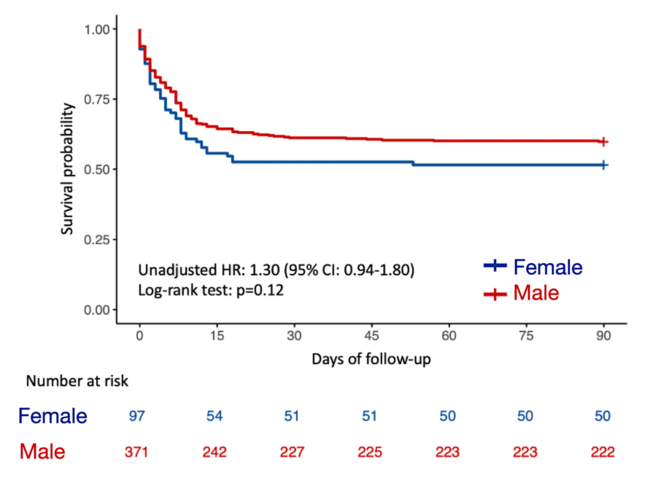
05:19: The next article was about sex differences and the role of anemia in contrast-associated kidney injury after PCI. This was work from Cedars-Sinai, and from Dr Ebinger and colleagues. What it found was that there was a higher rate of contrast-associated kidney injury in women vs men, but that was largely explainable by a higher rate of comorbidities in women. In particular, a higher rate of anemia that seemed to be driving a lot of the difference. Really important work as we try to understand what we used to call contrast nephropathy, or these days, many call contrast-associated acute kidney injury.
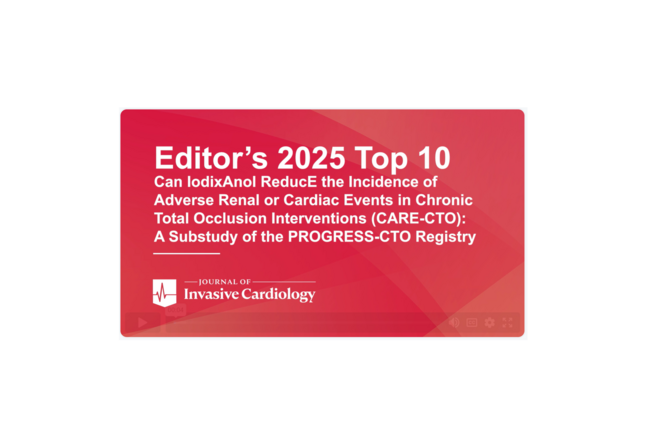
06:01: The next article was one about iodixanol to see if it could reduce adverse renal or cardiac events in CTO interventions from the CARE-CTO study, which is a sub-study of the PROGRESS-CTO registry from Dr Brilakis from Minneapolis Heart Institute and colleagues. What they found in an observational study was that iodixanol did appear to reduce complications. Obviously, randomized clinical trial data would be preferable in this sort of situation, but short of that, encouraging data with respect to that particular contrast agent.
06:39: Number 9 on the list examined the procedural and long-term thromboembolic outcomes after left atrial appendage closure, comparing patients with reduced and preserved ejection fraction. And the bottom line is the procedure seemed to work well in both those types of patients, importantly, also in those with the reduced ejection fraction.
07:02: The final article on our list of Top 10 is one from David Schneider and colleagues. He's from the University of Vermont, though there were colleagues of his from around the country. This examined the prognostic implications over time of platelet FcɣRIIa expression in patients with myocardial infarction. What they found was that this particular, I'll call it platelet assay, was very predictive of ischemic events, and potentially, in the future, could be used to weigh the balance between ischemic and bleeding complications of various therapies.
So, 10 very different articles from all around the country and world, and I believe, articles that advance the field of invasive cardiology broadly across the full age range, across diagnostic and interventional procedures in the coronaries, structural heart, electrophysiology, peripheral intervention, really the full gamut of the modern practice of invasive cardiology. Hopefully these articles will inform your daily practice and be interesting. If you want any details, please do go on to the Journal of Invasive Cardiology website. Thank you very much.
© 2026 HMP Global. All Rights Reserved.
Any views and opinions expressed are those of the author(s) and/or participants and do not necessarily reflect the views, policy, or position of the Journal of Invasive Cardiology or HMP Global, their employees, and affiliates.