Personalized tumor-informed circulating tumor DNA (ctDNA) testing after liver transplantation shows high specificity but limited sensitivity for detecting recurrence in patients with hepatocellular carcinoma (HCC) and cholangiocarcinoma...
Real-world data from 6 US cancer centers show no significant survival differences between atezolizumab/bevacizumab and durvalumab/tremelimumab as first-line therapy for unresectable hepatocellular carcinoma (uHCC), with liver function...
Kishan Patel, MD, discusses results from a study evaluating the cost-effectiveness of atezolizumab plus bevacizumab for advanced HCC, concluding that it may be too costly under current pricing.
Atezolizumab plus bevacizumab was not considered cost-effective compared with sorafenib for the treatment of unresectable or metastatic HCC, although associated with clinical benefit.
Blood Test Predicts Survival Outcomes in Patients With Lung Cancer
A blood-based proteomic test offers prognostic information and optimal second-line treatment guidance for patients with squamous cell...
Blood Test Predicts Survival Outcomes in Patients With Lung Cancer
A blood-based proteomic test offers prognostic information and optimal second-line treatment guidance for patients with squamous cell...
A RNA-based digital polymerase chain reaction (PCR) method for analyzing circulating tumor cells greatly improves accuracy in diagnosing hepatocellular carcinoma (HCC), according to a report published in...
Personalized tumor-informed circulating tumor DNA (ctDNA) testing after liver transplantation shows high specificity but limited sensitivity for detecting recurrence in patients with hepatocellular carcinoma (HCC) and cholangiocarcinoma...
Real-world data from 6 US cancer centers show no significant survival differences between atezolizumab/bevacizumab and durvalumab/tremelimumab as first-line therapy for unresectable hepatocellular carcinoma (uHCC), with liver function...
Atezolizumab plus bevacizumab was not considered cost-effective compared with sorafenib for the treatment of unresectable or metastatic HCC, although associated with clinical benefit.
Blood Test Predicts Survival Outcomes in Patients With Lung Cancer
A blood-based proteomic test offers prognostic information and optimal second-line treatment guidance for patients with squamous cell...
Blood Test Predicts Survival Outcomes in Patients With Lung Cancer
A blood-based proteomic test offers prognostic information and optimal second-line treatment guidance for patients with squamous cell...
A RNA-based digital polymerase chain reaction (PCR) method for analyzing circulating tumor cells greatly improves accuracy in diagnosing hepatocellular carcinoma (HCC), according to a report published in...
A SEER-Medicare analysis in Blood Advances reveals that geographic distance and socioeconomic status significantly shape CAR T access and survival outcomes for US patients with relapsed/refractory diffuse large B-cell lymphoma (DLBCL).
In a large integrated US health system, Asian and Pacific Islander patients with hepatocellular carcinoma (HCC) had lower odds of advanced-stage diagnosis and better 5-year survival, while residence in socioeconomically deprived neighborhoods...
The US Food and Drug Administration (FDA) has approved pembrolizumab in combination with paclitaxel ± bevacizumab for PD-L1–positive platinum-resistant ovarian, fallopian tube, or primary peritoneal carcinoma, based on improved...
Earlier use of trastuzumab deruxtecan (T-DXd) in hormone receptor-positive (HR+)/ human epidermal growth factor receptor 2 (HER2)-low metastatic breast cancer was associated with longer real-world treatment duration and delayed need for...
In a US community-based cohort of young adults with metastatic colorectal cancer, lower neighborhood socioeconomic status was independently associated with significantly higher mortality, highlighting the impact of structural disadvantage on...
In the phase 3 ASCENT-04/KEYNOTE-D19 trial, first-line sacituzumab govitecan plus pembrolizumab significantly improved progression-free survival (PFS) and response durability compared with chemotherapy plus pembrolizumab in programmed...
A mobile app–guided self-acupressure program significantly reduced cancer-related fatigue in women with ovarian cancer, with benefits sustained for up to 24 weeks.
Hospice exclusion among low-income cancer patients is not the result of a single barrier but a reinforcing web of poverty, stigma, and unequal access to knowledge that systematically limits end-of-life care choices, according to study results...
A evaluation at a Washington, DC safety net health system found that patient navigation improved colorectal cancer screening and follow-up completion at a moderate per-patient cost.
Personalized tumor-informed circulating tumor DNA (ctDNA) testing after liver transplantation shows high specificity but limited sensitivity for detecting recurrence in patients with hepatocellular carcinoma (HCC) and cholangiocarcinoma...
In this interview, a guest expert discusses how clinical pathways in EGFR- and ALK-mutated non-small cell lung cancer (NSCLC) must adapt to growing molecular complexity, integrate emerging technologies such as artificial intelligence and...
Drs Tina B. Edmonston and David D. Shersher discuss their findings on how implementing reflex next generation sequencing (NGS) and programmed death-ligand 1 (PD-L1) testing at diagnosis reduced biomarker turnaround time and supported faster...
This interview highlights early clinical findings on rocbrutinib, a dual-binding BTK inhibitor demonstrating promising activity and tolerability in heavily pretreated CLL, including in the presence of common resistance mutations.
In this candid discussion, Joanna Rhodes, MD, MSCE, breaks down the promise and current limitations of MRD testing in chronic lymphocytic leukemia (CLL), exploring how it could one day refine treatment intensity, timing, and outcomes, and...
In this interview, postdoctoral fellow Youngmin Kwon, PhD, discusses recent health care reforms and reveals how bold policy shifts are finally helping to close long-standing gaps in cancer-care access and affordability.
In this episode of Breaking Down Health Care, John Hennessy and Dr. Michael Kolodziej explore the crucial difference between cancer screening and true cancer prevention, highlighting how lifestyle changes, vaccines, and emerging therapies...
Futurist Thomas Koulopoulos explores how “gigatrends”—seismic global shifts like changing demographics and AI—are redefining health care, urging a balance between innovation and trust as the industry evolves toward more human-centered,...
Postdoctoral fellow Youngmin Kwon discusses how Medicare eligibility reduces financial barriers for cancer survivors, and why disparities in access and affordability still persist.
At CPC+CBEx 2025, James Gilmore, PharmD, discussed how the American Oncology Network is elevating pharmacist-driven clinical pathways through data, technology, and collaboration to advance value-based care and enhance patient safety with...
In this episode of Breaking Down Health Care, John Hennessy and Dr Michael Kolodziej explore the evolving landscape of cancer screening—from the advances in imaging and artificial intelligence to the promise and pitfalls of new DNA- and...
Kishan Patel, MD, discusses results from a study evaluating the cost-effectiveness of atezolizumab plus bevacizumab for advanced HCC, concluding that it may be too costly under current pricing.
Robert Coleman, MD, discusses how the phase 3 ROSELLA trial showed that relacorilant plus nab-paclitaxel significantly improved overall survival in patients with platinum-resistant ovarian cancer.
Adam A. Barsouk, MD, discusses how underrepresentation in NSCLC immunotherapy trials continues to influence survival outcomes and what must change to achieve more equitable care.
Houda Hachad, PharmD, discusses how emerging US Food and Drug Administration (FDA) actions and expanding pharmacogenomic insights may soon transform fluoropyrimidine safety and reshape precision oncology from diagnosis through survivorship.
In this episode of Breaking Down Health Care, John Hennessy and Dr. Michael Kolodziej explore the crucial difference between cancer screening and true cancer prevention, highlighting how lifestyle changes, vaccines, and emerging therapies...
Futurist Thomas Koulopoulos explores how “gigatrends”—seismic global shifts like changing demographics and AI—are redefining health care, urging a balance between innovation and trust as the industry evolves toward more human-centered,...
At CPC+CBEx 2025, Lavi Kwiatkowsky discussed how payer frameworks, accreditation requirements, and operational challenges are shaping access to CAR T-cell and bispecific therapies in community oncology—and how technology could bridge the gap...
In this episode of Breaking Down Health Care, John Hennessy and Dr Michael Kolodziej explore the evolving landscape of cancer screening—from the advances in imaging and artificial intelligence to the promise and pitfalls of new DNA- and...
The Predictable Cost of Care (PCC) Working Group is expanding its economic models to include patient-centric metrics by developing a parallel track that measures patient time, healthcare interactions, and variability in coverage, aiming to...
From expanding stakeholder collaboration to tackling data transparency and real-world model testing, the Predictable Cost of Care initiative is transforming how clinical pathways are developed and decisions are driven by data.
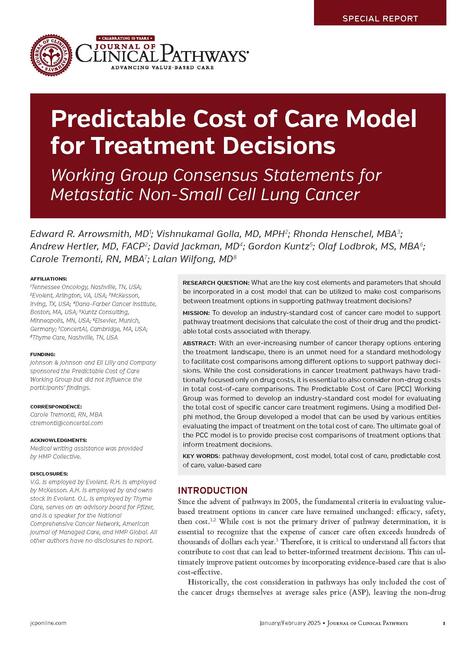
Edward Arrowsmith, MD; Vishnukamal Golla, MD, MPH; Rhonda Henschel, MBA; Andrew Hertler, MD, FACP; David Jackman, MD; Gordon Kuntz; Olaf Lodbrok, MS, MBA; Carole Tremonti, RN, MBA; Lalan Wilfong, MD
The Predictable Cost of Care Working Group developed a model that can be used by various entities evaluating the impact of treatment on the total cost of care.
Edward Arrowsmith, MD; Vishnukamal Golla, MD, MPH; Rhonda Henschel, MBA; Andrew Hertler, MD, FACP; David Jackman, MD; Gordon Kuntz; Olaf Lodbrok, MS, MBA; Carole Tremonti, RN, MBA; Lalan Wilfong, MD
The Predictable Cost of Care Working Group developed a model that can be used by various entities evaluating the impact of treatment on the total cost of care.
Robin T. Zon, MD, FACP, FASCO; Gordon Kuntz; Winston Wong, PharmD
The Journal of Clinical Pathways convened the 2021 Care Pathways Working Group to identify and reconcile the different pathway drivers for each stakeholder now and five years into the future, creating a framework tool based on oncology care...