A study presented at the 2024 ASCO Quality Care Symposium highlights gaps in palliative care access and education for patients with small cell lung cancer and their caregivers, emphasizing the urgent need for improved outreach and support in...
This column describes the findings from 2022 Association of Community Cancer Centers (ACCC) surveys with patients and providers that aimed to define the barriers that patients with small cell lung cancer face. The surveys gathered real-world...
Jennifer R Brown and colleagues presented PFS data from the ALPINE study which compared zanubrutinib with ibrutinib as treatment for R/R CLL/SLL at the 64th ASH Annual Meeting and Exposition.
Jerome Goldschmidt, MD, discusses recent study findings that suggest patients with small cell lung cancer receiving myelosuppressive chemotherapy with or without atezolizumab may experience more clinical burdens and more financial toxicity.
Adding durvalumab to etoposide and platinum is not cost-effective compared with etoposide and platinum alone for patients with newly diagnosed extensive-stage SCLC from a US payer perspective.
Results from a real-world study show anlotinib is beneficial for patients with refractory SCLC as third- or further-line treatment with manageable adverse effects.
True or False: The increase in the use of carboplatin and brain imaging at diagnosis in patients with SCLC from 2000 to 2021 has not demonstrated a significant impact on survival.
True or False: Nivolumab monotherapy is not considered cost-effective compared to commonly prescribed third-line treatment for the treatment of small cell lung cancer.
Study findings suggest that changes in the clinical management of patients with SCLC over the last 20 years have not had a significant impact on survival.
David Chun Cheong Tsui, MD, discusses results from a real-world study exploring the adoption and early clinical outcomes of atezolizumab plus carboplatin and etoposide in patients with extensive-stage SCLC.
A recent study revealed that nivolumab monotherapy is a more cost-effective treatment option compared to topotecan for the third-line treatment of SCLC.
A study presented at the 2024 ASCO Quality Care Symposium highlights gaps in palliative care access and education for patients with small cell lung cancer and their caregivers, emphasizing the urgent need for improved outreach and support in...
Jennifer R Brown and colleagues presented PFS data from the ALPINE study which compared zanubrutinib with ibrutinib as treatment for R/R CLL/SLL at the 64th ASH Annual Meeting and Exposition.
Adding durvalumab to etoposide and platinum is not cost-effective compared with etoposide and platinum alone for patients with newly diagnosed extensive-stage SCLC from a US payer perspective.
Results from a real-world study show anlotinib is beneficial for patients with refractory SCLC as third- or further-line treatment with manageable adverse effects.
Study findings suggest that changes in the clinical management of patients with SCLC over the last 20 years have not had a significant impact on survival.
A recent study revealed that nivolumab monotherapy is a more cost-effective treatment option compared to topotecan for the third-line treatment of SCLC.
Study findings suggest atezolizumab plus etoposide and platinum chemotherapy is superior to durvalumab plus etoposide and platinum chemotherapy for treating extensive-stage SCLC, though neither strategy was cost-effective compared to...
A recent systematic review on real-world treatment patterns and outcomes in patients with SCLC found that studies conducted over the last 20 years have failed to report on the impact of recently approved immune-oncology therapies.
As oncology innovation accelerates and evidence evolves faster than traditional pathway update cycles, stakeholders need clearer insight into how clinical pathways adapt in real time. Clinical Pathways NEXT, a new, free quarterly virtual...
Medicare Advantage (MA) enrollees with colorectal cancer (CRC) and advanced non–small cell lung cancer (NSCLC) were less likely than traditional Medicare (TM) beneficiaries to receive cancer-directed drugs and, when treated, were less likely...
A national Medicare study found that patients enrolled in Medicare Advantage were significantly less likely than those in traditional Medicare to receive major cancer surgery at high-quality hospitals, highlighting potential network-related...
McKesson’s Advancing Community Oncology Report 2025 reveals how community oncology practices across the US are navigating rapid advances in precision medicine, clinical trials, and technology as they care for the majority of cancer patients.
The American Cancer Society’s 2025 report reveals that education level and rural residence drive larger US cancer mortality disparities than race alone, underscoring the central role of socioeconomic and geographic inequities across the...
Real-world data from 6 US cancer centers show no significant survival differences between atezolizumab/bevacizumab and durvalumab/tremelimumab as first-line therapy for unresectable hepatocellular carcinoma (uHCC), with liver function...
Nearly half of patients referred for chimeric antigen receptor T-cell (CAR T) therapy at a major academic cancer center never received treatment, with disease progression, limited product availability, and potential racial disparities...
Minimal residual disease (MRD) status is an increasingly important prognostic marker in multiple myeloma. New data from the phase 3 AURIGA study, presented at ASH 2025, provide detailed insights into MRD dynamics following autologous stem...
New insights into iron biology reveal that continuous suppression of toxic, reactive iron—rather than reduction of total iron stores—is critical for preventing organ damage and improving outcomes across transfusion-dependent hematologic...
True or False: The increase in the use of carboplatin and brain imaging at diagnosis in patients with SCLC from 2000 to 2021 has not demonstrated a significant impact on survival.
True or False: Nivolumab monotherapy is not considered cost-effective compared to commonly prescribed third-line treatment for the treatment of small cell lung cancer.
True or false: Patients with SCLC undergoing radiotherapy twice daily are more likely to have brain metastases after prophylactic cranial irradiation than those given radiotherapy once daily.
True or False: The Rural Health Transformation Program, announced by CMS under the Working Families Tax Cuts Act, will allocate $50 billion beginning in fiscal year 2026, with funding distributed evenly across all states regardless of...
The National Comprehensive Cancer Network (NCCN) Guidelines Navigator is a new interactive digital platform that delivers evidence-based oncology recommendations and is currently available for all 88 NCCN guideline sets.
Between 2018 and 2023, which of the following trends was observed in the delivery of specialty palliative care (PC) among Medicare beneficiaries with poor-prognosis cancers?
Learn more about how clinical pathways are helping multidisciplinary teams standardize cancer care, reduce costs, and improve outcomes—and why aligning them with evidence-based guidelines is essential in today’s value-based healthcare...
Indication
SARCLISA (isatuximab-irfc) is indicated:
In combination with carfilzomib and dexamethasone, for the treatment of adult patients with relapsed or refractory multiple myeloma who have received 1 to 3 prior lines of...
Indication
SARCLISA (isatuximab-irfc) is indicated:
In combination with carfilzomib and dexamethasone, for the treatment of adult patients with relapsed or refractory multiple myeloma who have received 1 to 3 prior lines of...
True or False: Medicaid beneficiaries with advanced non-small cell lung cancer were less likely to receive biomarker testing and biomarker-driven therapies compared to those with commercial insurance.
True or False: Among daratumumab, lenalidomide, and dexamethasone triple therapy (DRd); bortezomib and lenalidomide plus dexamethasone triple therapy (VRd); and Rd, the most cost-effective treatment regimen in patients with newly diagnosed...
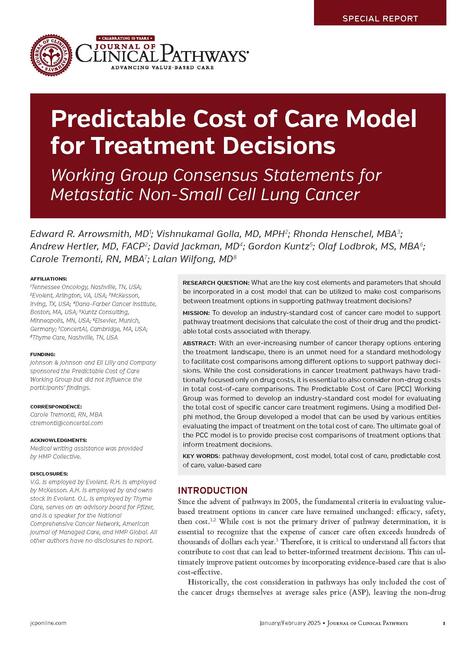
Edward Arrowsmith, MD; Vishnukamal Golla, MD, MPH; Rhonda Henschel, MBA; Andrew Hertler, MD, FACP; David Jackman, MD; Gordon Kuntz; Olaf Lodbrok, MS, MBA; Carole Tremonti, RN, MBA; Lalan Wilfong, MD
The Predictable Cost of Care Working Group developed a model that can be used by various entities evaluating the impact of treatment on the total cost of care.
Edward Arrowsmith, MD; Vishnukamal Golla, MD, MPH; Rhonda Henschel, MBA; Andrew Hertler, MD, FACP; David Jackman, MD; Gordon Kuntz; Olaf Lodbrok, MS, MBA; Carole Tremonti, RN, MBA; Lalan Wilfong, MD
The Predictable Cost of Care Working Group developed a model that can be used by various entities evaluating the impact of treatment on the total cost of care.
Robin T. Zon, MD, FACP, FASCO; Gordon Kuntz; Winston Wong, PharmD
The Journal of Clinical Pathways convened the 2021 Care Pathways Working Group to identify and reconcile the different pathway drivers for each stakeholder now and five years into the future, creating a framework tool based on oncology care...