Study results demonstrated that ‘second adjuvant’ therapy with a BRAF/MEK inhibitor improved recurrence-free survival at the cost of toxicity among patients with BRAF-mutated melanoma who experienced disease recurrence after treatment with an...
Study results demonstrated that ‘second adjuvant’ therapy with a BRAF/MEK inhibitor improved recurrence-free survival at the cost of toxicity among patients with BRAF-mutated melanoma who experienced disease recurrence after treatment with an...
The FDA has granted an accelerated approval to lifileucel for patients unresectable or metastatic melanoma previously treated with a PD-1 blocking antibody, and if BRAF V600-positive, a BRAF inhibitor with or without a MEK inhibitor.
The FDA has granted an accelerated approval to lifileucel for patients unresectable or metastatic melanoma previously treated with a PD-1 blocking antibody, and if BRAF V600-positive, a BRAF inhibitor with or without a MEK inhibitor.
Results from a retrospective cohort study found that antibiotic exposure within 60 days prior to initiation of immune checkpoint blockade was associated with worse PFS and OS among patients with treatment-naïve cutaneous or mucosal melanoma.
Results from a retrospective cohort study found that antibiotic exposure within 60 days prior to initiation of immune checkpoint blockade was associated with worse PFS and OS among patients with treatment-naïve cutaneous or mucosal melanoma.
Robin Yabroff, PhD, MBA, and Michael T. Halpern, MD, PhD, MPH, examine the documentation of cost of care discussions between physicians and patients with non–small cell lung cancer and melanoma.
Robin Yabroff, PhD, MBA, and Michael T. Halpern, MD, PhD, MPH, examine the documentation of cost of care discussions between physicians and patients with non–small cell lung cancer and melanoma.
In adult patients with melanoma, delays in testing for BRAF mutations affect the type of therapeutic intervention and delay initiation of treatment, according to a retrospective study that mapped BRAF testing timelines.
In adult patients with melanoma, delays in testing for BRAF mutations affect the type of therapeutic intervention and delay initiation of treatment, according to a retrospective study that mapped BRAF testing timelines.
Michael McPhee, MD, and Tarek Mekhail, MD, discuss what lead AdventHealth Cancer Institute to adopt Elsevier’s ClinicalPath, and how its implementation has improved melanoma care.
Michael McPhee, MD, and Tarek Mekhail, MD, discuss what lead AdventHealth Cancer Institute to adopt Elsevier’s ClinicalPath, and how its implementation has improved melanoma care.
True or False: Although, compared to high-dose interferon, adjuvant ipilimumab improves survival and decreases toxicity in patients with resected, high-risk melanoma, it is not considered cost-effective.
True or False: Although, compared to high-dose interferon, adjuvant ipilimumab improves survival and decreases toxicity in patients with resected, high-risk melanoma, it is not considered cost-effective.
True or False: Real-world evidence suggests ipilimumab provides real option value, averaging 3.9 months of additional survival for patients with metastatic melanoma.
True or False: Real-world evidence suggests ipilimumab provides real option value, averaging 3.9 months of additional survival for patients with metastatic melanoma.
Study findings revealed that adjuvant ipilimumab may not be a cost-effective treatment option compared to high-dose interferon in patients with resected, high-risk melanoma.
Study findings revealed that adjuvant ipilimumab may not be a cost-effective treatment option compared to high-dose interferon in patients with resected, high-risk melanoma.
Study results demonstrated that ‘second adjuvant’ therapy with a BRAF/MEK inhibitor improved recurrence-free survival at the cost of toxicity among patients with BRAF-mutated melanoma who experienced disease recurrence after treatment with an...
Study results demonstrated that ‘second adjuvant’ therapy with a BRAF/MEK inhibitor improved recurrence-free survival at the cost of toxicity among patients with BRAF-mutated melanoma who experienced disease recurrence after treatment with an...
The FDA has granted an accelerated approval to lifileucel for patients unresectable or metastatic melanoma previously treated with a PD-1 blocking antibody, and if BRAF V600-positive, a BRAF inhibitor with or without a MEK inhibitor.
The FDA has granted an accelerated approval to lifileucel for patients unresectable or metastatic melanoma previously treated with a PD-1 blocking antibody, and if BRAF V600-positive, a BRAF inhibitor with or without a MEK inhibitor.
Results from a retrospective cohort study found that antibiotic exposure within 60 days prior to initiation of immune checkpoint blockade was associated with worse PFS and OS among patients with treatment-naïve cutaneous or mucosal melanoma.
Results from a retrospective cohort study found that antibiotic exposure within 60 days prior to initiation of immune checkpoint blockade was associated with worse PFS and OS among patients with treatment-naïve cutaneous or mucosal melanoma.
Robin Yabroff, PhD, MBA, and Michael T. Halpern, MD, PhD, MPH, examine the documentation of cost of care discussions between physicians and patients with non–small cell lung cancer and melanoma.
Robin Yabroff, PhD, MBA, and Michael T. Halpern, MD, PhD, MPH, examine the documentation of cost of care discussions between physicians and patients with non–small cell lung cancer and melanoma.
In adult patients with melanoma, delays in testing for BRAF mutations affect the type of therapeutic intervention and delay initiation of treatment, according to a retrospective study that mapped BRAF testing timelines.
In adult patients with melanoma, delays in testing for BRAF mutations affect the type of therapeutic intervention and delay initiation of treatment, according to a retrospective study that mapped BRAF testing timelines.
Study findings revealed that adjuvant ipilimumab may not be a cost-effective treatment option compared to high-dose interferon in patients with resected, high-risk melanoma.
Study findings revealed that adjuvant ipilimumab may not be a cost-effective treatment option compared to high-dose interferon in patients with resected, high-risk melanoma.
Findings from a systematic review and meta-analysis support the diagnostic importance of dermoscopic structures associated with melanoma detection and highlight the importance of the overall pattern.
Findings from a systematic review and meta-analysis support the diagnostic importance of dermoscopic structures associated with melanoma detection and highlight the importance of the overall pattern.
While dabrafenib–trametinib may offer incremental QALYs in patients with BRAF-mutant stage III melanoma, it is not considered a cost-effective regimen, according to study findings.
While dabrafenib–trametinib may offer incremental QALYs in patients with BRAF-mutant stage III melanoma, it is not considered a cost-effective regimen, according to study findings.
Using the US Surveillance, Epidemiology, and End Results (SEER)-Medicare linkage database, a study identified potential gaps in geriatric oncology care among Black and Hispanic patients, older age groups, and patients with multimorbidity.
Using the US Surveillance, Epidemiology, and End Results (SEER)-Medicare linkage database, a study identified potential gaps in geriatric oncology care among Black and Hispanic patients, older age groups, and patients with multimorbidity.
Liquid biopsies hold promise for transforming cancer care in older adults—but age-related biological changes may complicate their accuracy and clinical use.
Liquid biopsies hold promise for transforming cancer care in older adults—but age-related biological changes may complicate their accuracy and clinical use.
Join us November 10–11, 2026 at the Four Seasons Hotel Boston as we bring together leaders across the pathways ecosystem for two days focused on turning strategy into action.
Join us November 10–11, 2026 at the Four Seasons Hotel Boston as we bring together leaders across the pathways ecosystem for two days focused on turning strategy into action.
A proactive smoking cessation program for patients with cancer shows high engagement and satisfaction among participants, but low enrollment highlights ongoing challenges with patient identification and outreach.
A proactive smoking cessation program for patients with cancer shows high engagement and satisfaction among participants, but low enrollment highlights ongoing challenges with patient identification and outreach.
A shortened 10-day venetoclax regimen combined with decitabine delivers comparable remission rates with fewer infections in older patients with newly diagnosed acute myeloid leukemia (AML).
A shortened 10-day venetoclax regimen combined with decitabine delivers comparable remission rates with fewer infections in older patients with newly diagnosed acute myeloid leukemia (AML).
The US Food and Drug Administration's (FDA) approval of relacorilant plus nab-paclitaxel offers a new survival-improving option for patients with platinum-resistant ovarian cancer following prior bevacizumab therapy.
The US Food and Drug Administration's (FDA) approval of relacorilant plus nab-paclitaxel offers a new survival-improving option for patients with platinum-resistant ovarian cancer following prior bevacizumab therapy.
A SEER-Medicare analysis in Blood Advances reveals that geographic distance and socioeconomic status significantly shape CAR T access and survival outcomes for US patients with relapsed/refractory diffuse large B-cell lymphoma (DLBCL).
A SEER-Medicare analysis in Blood Advances reveals that geographic distance and socioeconomic status significantly shape CAR T access and survival outcomes for US patients with relapsed/refractory diffuse large B-cell lymphoma (DLBCL).
In a large integrated US health system, Asian and Pacific Islander patients with hepatocellular carcinoma (HCC) had lower odds of advanced-stage diagnosis and better 5-year survival, while residence in socioeconomically deprived neighborhoods...
In a large integrated US health system, Asian and Pacific Islander patients with hepatocellular carcinoma (HCC) had lower odds of advanced-stage diagnosis and better 5-year survival, while residence in socioeconomically deprived neighborhoods...
The US Food and Drug Administration (FDA) has approved pembrolizumab in combination with paclitaxel ± bevacizumab for PD-L1–positive platinum-resistant ovarian, fallopian tube, or primary peritoneal carcinoma, based on improved...
The US Food and Drug Administration (FDA) has approved pembrolizumab in combination with paclitaxel ± bevacizumab for PD-L1–positive platinum-resistant ovarian, fallopian tube, or primary peritoneal carcinoma, based on improved...
True or False: Although, compared to high-dose interferon, adjuvant ipilimumab improves survival and decreases toxicity in patients with resected, high-risk melanoma, it is not considered cost-effective.
True or False: Although, compared to high-dose interferon, adjuvant ipilimumab improves survival and decreases toxicity in patients with resected, high-risk melanoma, it is not considered cost-effective.
True or False: Real-world evidence suggests ipilimumab provides real option value, averaging 3.9 months of additional survival for patients with metastatic melanoma.
True or False: Real-world evidence suggests ipilimumab provides real option value, averaging 3.9 months of additional survival for patients with metastatic melanoma.
True or False: For the treatment of BRAF-mutant stage III melanoma, pembrolizumab is most cost-effective at a conventional willingness-to-pay threshold.
True or False: For the treatment of BRAF-mutant stage III melanoma, pembrolizumab is most cost-effective at a conventional willingness-to-pay threshold.
True or False: Dabrafenib–trametinib offers incremental quality-adjusted life years in patients with BRAF-mutant stage III melanoma, but it is not considered cost-effective.
True or False: Dabrafenib–trametinib offers incremental quality-adjusted life years in patients with BRAF-mutant stage III melanoma, but it is not considered cost-effective.
True or False: The Rural Health Transformation Program, announced by CMS under the Working Families Tax Cuts Act, will allocate $50 billion beginning in fiscal year 2026, with funding distributed evenly across all states regardless of...
True or False: The Rural Health Transformation Program, announced by CMS under the Working Families Tax Cuts Act, will allocate $50 billion beginning in fiscal year 2026, with funding distributed evenly across all states regardless of...
The National Comprehensive Cancer Network (NCCN) Guidelines Navigator is a new interactive digital platform that delivers evidence-based oncology recommendations and is currently available for all 88 NCCN guideline sets.
The National Comprehensive Cancer Network (NCCN) Guidelines Navigator is a new interactive digital platform that delivers evidence-based oncology recommendations and is currently available for all 88 NCCN guideline sets.
Between 2018 and 2023, which of the following trends was observed in the delivery of specialty palliative care (PC) among Medicare beneficiaries with poor-prognosis cancers?
Between 2018 and 2023, which of the following trends was observed in the delivery of specialty palliative care (PC) among Medicare beneficiaries with poor-prognosis cancers?
Learn more about how clinical pathways are helping multidisciplinary teams standardize cancer care, reduce costs, and improve outcomes—and why aligning them with evidence-based guidelines is essential in today’s value-based healthcare...
Learn more about how clinical pathways are helping multidisciplinary teams standardize cancer care, reduce costs, and improve outcomes—and why aligning them with evidence-based guidelines is essential in today’s value-based healthcare...
Indication
SARCLISA (isatuximab-irfc) is indicated:
In combination with carfilzomib and dexamethasone, for the treatment of adult patients with relapsed or refractory multiple myeloma who have received 1 to 3 prior lines of...
Indication
SARCLISA (isatuximab-irfc) is indicated:
In combination with carfilzomib and dexamethasone, for the treatment of adult patients with relapsed or refractory multiple myeloma who have received 1 to 3 prior lines of...
True or False: Medicaid beneficiaries with advanced non-small cell lung cancer were less likely to receive biomarker testing and biomarker-driven therapies compared to those with commercial insurance.
True or False: Medicaid beneficiaries with advanced non-small cell lung cancer were less likely to receive biomarker testing and biomarker-driven therapies compared to those with commercial insurance.
True or False: Among daratumumab, lenalidomide, and dexamethasone triple therapy (DRd); bortezomib and lenalidomide plus dexamethasone triple therapy (VRd); and Rd, the most cost-effective treatment regimen in patients with newly diagnosed...
True or False: Among daratumumab, lenalidomide, and dexamethasone triple therapy (DRd); bortezomib and lenalidomide plus dexamethasone triple therapy (VRd); and Rd, the most cost-effective treatment regimen in patients with newly diagnosed...
Edward Arrowsmith, MD; Alan J. Balch, PhD, MSc; Vishnukamal Golla, MD, MPH; Andrew Hertler, MD, FACP; David Jackman, MD; Olaf Lodbrok, MS, MBA; Lalan Wilfong, MD; Gordon Kuntz; Carole Tremonti, RN, MBA
As cancer therapies expand and costs rise, oncology pathway developers need consistent, transparent methods to compare treatment options beyond drug acquisition costs. Building on Phase I’s consensus on relevant cost domains, the Phase II PCC...
As cancer therapies expand and costs rise, oncology pathway developers need consistent, transparent methods to compare treatment options beyond drug acquisition costs. Building on Phase I’s consensus on relevant cost domains, the Phase II PCC...
Edward Arrowsmith, MD; Vishnukamal Golla, MD, MPH; Rhonda Henschel, MBA; Andrew Hertler, MD, FACP; David Jackman, MD; Gordon Kuntz; Olaf Lodbrok, MS, MBA; Carole Tremonti, RN, MBA; Lalan Wilfong, MD
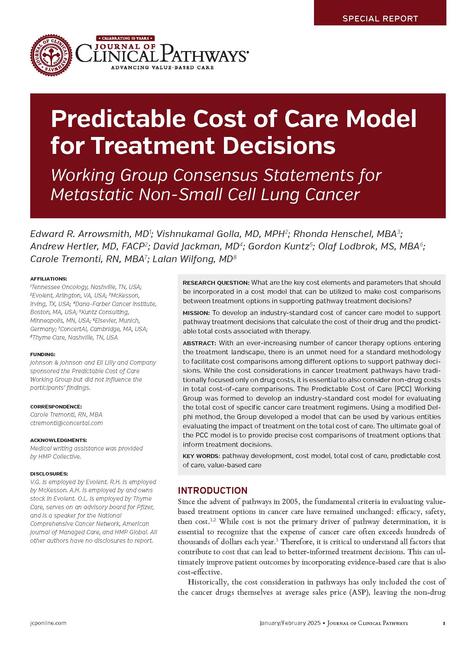
The Predictable Cost of Care Working Group developed a model that can be used by various entities evaluating the impact of treatment on the total cost of care.
The Predictable Cost of Care Working Group developed a model that can be used by various entities evaluating the impact of treatment on the total cost of care.
Edward Arrowsmith, MD; Vishnukamal Golla, MD, MPH; Rhonda Henschel, MBA; Andrew Hertler, MD, FACP; David Jackman, MD; Gordon Kuntz; Olaf Lodbrok, MS, MBA; Carole Tremonti, RN, MBA; Lalan Wilfong, MD
The Predictable Cost of Care Working Group developed a model that can be used by various entities evaluating the impact of treatment on the total cost of care.
The Predictable Cost of Care Working Group developed a model that can be used by various entities evaluating the impact of treatment on the total cost of care.
Robin T. Zon, MD, FACP, FASCO; Gordon Kuntz; Winston Wong, PharmD
The Journal of Clinical Pathways convened the 2021 Care Pathways Working Group to identify and reconcile the different pathway drivers for each stakeholder now and five years into the future, creating a framework tool based on oncology care...
The Journal of Clinical Pathways convened the 2021 Care Pathways Working Group to identify and reconcile the different pathway drivers for each stakeholder now and five years into the future, creating a framework tool based on oncology care...