A large US National Cancer Database study shows neoadjuvant chemotherapy offers better survival than chemoradiation for operable esophageal adenocarcinoma.
Anindya Chatterjee, PhD; Astra M. Liepa, PharmD; Marley Boyd, MS; Scott Paulson, MD; Kathleen M. Aguilar, MPH; Lisa M. Hess, PhD
Abstract: Gastric cancer treatment heterogeneity was assessed over successive updates of clinical pathways. Methods: Patient profiles, treatment patterns, and outcomes were assessed descriptively among adult...
Karyn Goodman, MD, MS; Megan D. Marsh, PA; S. Lindsey Davis, MD; Lisa J. Wingrove, RD; Ashley E. Glode, PharmD, BCOP; Supriya K. Jain, MD; Lindel C.K. Dewberry, MD; Martin D. McCarter, MD; Michelle Bunch, CSW; Tracey E. Schefter, MD; Laura Melton, PhD
Abstract: A standard treatment recommendation for esophageal cancer patients with stage IB-IIIB disease is for neoadjuvant chemoradiation followed by surgery. This trimodality therapy can be difficult for patients...
Patients aged 80 years or older with early-stage esophageal cancer who received treatment had an increased 5-year overall survival (OS) compared with those who received no treatment or observation alone,...
Positron emission tomography (PET) scans during induction chemotherapy for esophageal cancer helps assess patient response to treatment and adjust their therapy, which could lead to an improved complete response rate...
A study published in Nature Genetics claims that esophageal cancer may in fact be 3 distinct diseases, which could pave the way for new methods of diagnosis and spur the development of targeted treatment...
Nutritional status may be a prominent indicator of survival in elderly patients with esophageal cancer, claims a recently published study.
Esophageal cancer is one of the leading causes of cancer-related death...
Nutritional status may be a prominent indicator of survival in elderly patients with esophageal cancer, claims a recently published study.
Esophageal cancer is one of the leading causes of cancer-related death...
A study finding significant variation in the use of positron emission tomography (PET) scans, but no association between the number of scans and improved 2-year survival, suggests that the imaging technique might be...
Drs Tina B. Edmonston and David D. Shersher discuss their findings on how implementing reflex next generation sequencing (NGS) and programmed death-ligand 1 (PD-L1) testing at diagnosis reduced biomarker turnaround time and supported faster...
This interview highlights early clinical findings on rocbrutinib, a dual-binding BTK inhibitor demonstrating promising activity and tolerability in heavily pretreated CLL, including in the presence of common resistance mutations.
In this candid discussion, Joanna Rhodes, MD, MSCE, breaks down the promise and current limitations of MRD testing in chronic lymphocytic leukemia (CLL), exploring how it could one day refine treatment intensity, timing, and outcomes, and...
In this interview, postdoctoral fellow Youngmin Kwon, PhD, discusses recent health care reforms and reveals how bold policy shifts are finally helping to close long-standing gaps in cancer-care access and affordability.
Houda Hachad, PharmD, discusses how emerging US Food and Drug Administration (FDA) actions and expanding pharmacogenomic insights may soon transform fluoropyrimidine safety and reshape precision oncology from diagnosis through survivorship.
In this episode of Breaking Down Health Care, John Hennessy and Dr. Michael Kolodziej explore the crucial difference between cancer screening and true cancer prevention, highlighting how lifestyle changes, vaccines, and emerging therapies...
Futurist Thomas Koulopoulos explores how “gigatrends”—seismic global shifts like changing demographics and AI—are redefining health care, urging a balance between innovation and trust as the industry evolves toward more human-centered,...
Postdoctoral fellow Youngmin Kwon discusses how Medicare eligibility reduces financial barriers for cancer survivors, and why disparities in access and affordability still persist.
At CPC+CBEx 2025, Lavi Kwiatkowsky discussed how payer frameworks, accreditation requirements, and operational challenges are shaping access to CAR T-cell and bispecific therapies in community oncology—and how technology could bridge the gap...
A large US National Cancer Database study shows neoadjuvant chemotherapy offers better survival than chemoradiation for operable esophageal adenocarcinoma.
As oncology innovation accelerates and evidence evolves faster than traditional pathway update cycles, stakeholders need clearer insight into how clinical pathways adapt in real time. Clinical Pathways NEXT, a new, free quarterly virtual...
Medicare Advantage (MA) enrollees with colorectal cancer (CRC) and advanced non–small cell lung cancer (NSCLC) were less likely than traditional Medicare (TM) beneficiaries to receive cancer-directed drugs and, when treated, were less likely...
A national Medicare study found that patients enrolled in Medicare Advantage were significantly less likely than those in traditional Medicare to receive major cancer surgery at high-quality hospitals, highlighting potential network-related...
McKesson’s Advancing Community Oncology Report 2025 reveals how community oncology practices across the US are navigating rapid advances in precision medicine, clinical trials, and technology as they care for the majority of cancer patients.
The American Cancer Society’s 2025 report reveals that education level and rural residence drive larger US cancer mortality disparities than race alone, underscoring the central role of socioeconomic and geographic inequities across the...
Real-world data from 6 US cancer centers show no significant survival differences between atezolizumab/bevacizumab and durvalumab/tremelimumab as first-line therapy for unresectable hepatocellular carcinoma (uHCC), with liver function...
Nearly half of patients referred for chimeric antigen receptor T-cell (CAR T) therapy at a major academic cancer center never received treatment, with disease progression, limited product availability, and potential racial disparities...
Minimal residual disease (MRD) status is an increasingly important prognostic marker in multiple myeloma. New data from the phase 3 AURIGA study, presented at ASH 2025, provide detailed insights into MRD dynamics following autologous stem...
New insights into iron biology reveal that continuous suppression of toxic, reactive iron—rather than reduction of total iron stores—is critical for preventing organ damage and improving outcomes across transfusion-dependent hematologic...
True or False: The Rural Health Transformation Program, announced by CMS under the Working Families Tax Cuts Act, will allocate $50 billion beginning in fiscal year 2026, with funding distributed evenly across all states regardless of...
The National Comprehensive Cancer Network (NCCN) Guidelines Navigator is a new interactive digital platform that delivers evidence-based oncology recommendations and is currently available for all 88 NCCN guideline sets.
Between 2018 and 2023, which of the following trends was observed in the delivery of specialty palliative care (PC) among Medicare beneficiaries with poor-prognosis cancers?
Learn more about how clinical pathways are helping multidisciplinary teams standardize cancer care, reduce costs, and improve outcomes—and why aligning them with evidence-based guidelines is essential in today’s value-based healthcare...
Indication
SARCLISA (isatuximab-irfc) is indicated:
In combination with carfilzomib and dexamethasone, for the treatment of adult patients with relapsed or refractory multiple myeloma who have received 1 to 3 prior lines of...
Indication
SARCLISA (isatuximab-irfc) is indicated:
In combination with carfilzomib and dexamethasone, for the treatment of adult patients with relapsed or refractory multiple myeloma who have received 1 to 3 prior lines of...
True or False: Medicaid beneficiaries with advanced non-small cell lung cancer were less likely to receive biomarker testing and biomarker-driven therapies compared to those with commercial insurance.
True or False: Among daratumumab, lenalidomide, and dexamethasone triple therapy (DRd); bortezomib and lenalidomide plus dexamethasone triple therapy (VRd); and Rd, the most cost-effective treatment regimen in patients with newly diagnosed...
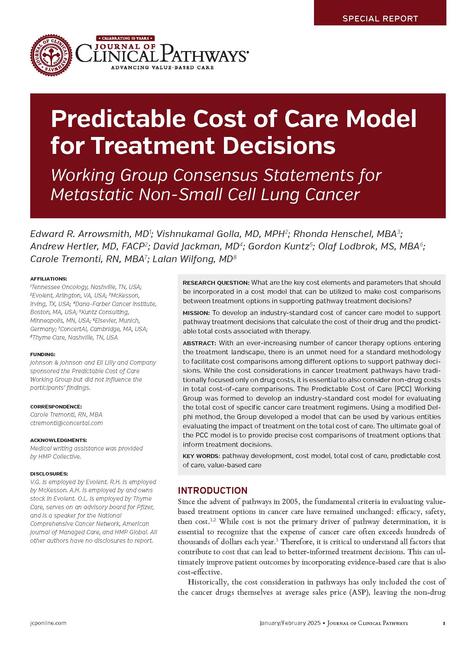
Edward Arrowsmith, MD; Vishnukamal Golla, MD, MPH; Rhonda Henschel, MBA; Andrew Hertler, MD, FACP; David Jackman, MD; Gordon Kuntz; Olaf Lodbrok, MS, MBA; Carole Tremonti, RN, MBA; Lalan Wilfong, MD
The Predictable Cost of Care Working Group developed a model that can be used by various entities evaluating the impact of treatment on the total cost of care.
Edward Arrowsmith, MD; Vishnukamal Golla, MD, MPH; Rhonda Henschel, MBA; Andrew Hertler, MD, FACP; David Jackman, MD; Gordon Kuntz; Olaf Lodbrok, MS, MBA; Carole Tremonti, RN, MBA; Lalan Wilfong, MD
The Predictable Cost of Care Working Group developed a model that can be used by various entities evaluating the impact of treatment on the total cost of care.
Robin T. Zon, MD, FACP, FASCO; Gordon Kuntz; Winston Wong, PharmD
The Journal of Clinical Pathways convened the 2021 Care Pathways Working Group to identify and reconcile the different pathway drivers for each stakeholder now and five years into the future, creating a framework tool based on oncology care...