Volume 19 - Issue 6 - June, 2007

Case Report
08/01/2008
Kimberly A. Skelding, MD, FACC, FAHA, FSCAI; Cleon R. Hubbard, MD
Coronary artery disease (CAD) has been recognized as the leading cause of mortality in women. Previously, it had been thought that estrogen provided a protective CAD effect, explaining the later development of disease in women. The Women’s...
Coronary artery disease (CAD)...
08/01/2008
Journal of Invasive Cardiology
Case Report
08/01/2008
Farrukh Hussain, MD, FRCPC; Tarek Kashour, MD, FRCPC; Roger Philipp, MD, FRCPC
Dislodgement of a coronary stent in a coronary artery is a dreaded complication that occurs in a minority of patients. Factors that can increase the chances of stent detachment from the balloon catheter within a coronary artery can include...
Dislodgement of a coronary stent...
08/01/2008
Journal of Invasive Cardiology
Case Report
08/01/2008
Mazda Biria, MD, Peter Tadros, MD, Kamal Gupta, MD
Mazda Biria, MD, Peter Tadros, MD, ...
Vertebral artery (VA) stenting is an established method to treat occlusive disease in that artery. Available data indicate that it is a low-risk procedure with excellent periprocedural and long-term follow-up results.1–6 In most cases, the...
Vertebral artery (VA) stenting...
08/01/2008
Journal of Invasive Cardiology
Case Report
08/01/2008
Young-Jo Kim, MD, PhD; Geu-Ru Hong, MD; Jong-Seon Park, MD, PhD
The use of drug-eluting stents (DES) has become popular because of their favorable effects on clinical and angiographic outcomes.1–5 However, most clinical results have been reported on simple de novo lesions. In real-world practice, more...
The use of drug-eluting stents...
08/01/2008
Journal of Invasive Cardiology
Case Report
08/01/2008
Yen-Dong Ho, MD; Tomomi Koizumi, MD, PhD; David P. Lee, MD
Case Report. A 46-year-old female presented to a community hospital with acute coronary syndrome. One week prior to presentation, the patient had experienced chest tightness lasting 1 hour, occurring 1 day after lifting furniture. On the day...
Case Report. A 46-year-old...
08/01/2008
Journal of Invasive Cardiology
Case Report
08/01/2008
Tilak Suvarna, MD, DM; Nitin Burkule, MD, DM; Ramakanta Panda, MS, MCh; Prafulla G. Kerkar, MD, DM, FACC
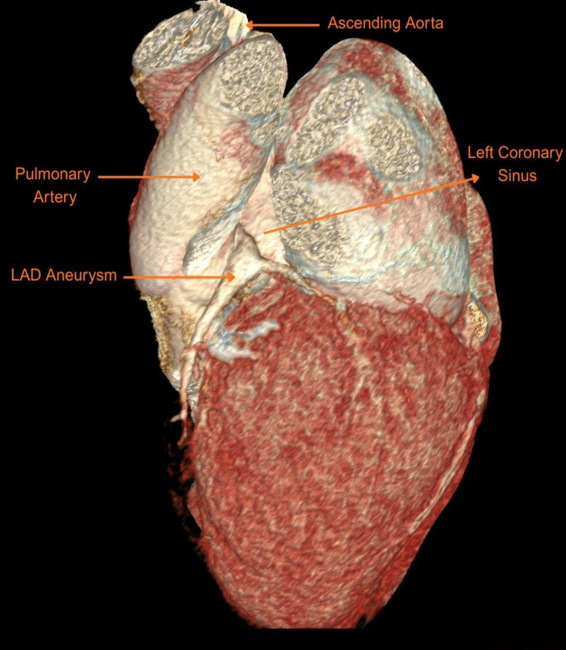
Ruptured sinus of Valsalva aneurysm (SVA) is a well recognized clinical entity that is relatively more common in Asian countries than in the Western world.1,2 The unruptured aneurysm of sinus of Valsalva is usually asymptomatic, however, when...
Ruptured sinus of Valsalva...
08/01/2008
Journal of Invasive Cardiology
Case Report
08/01/2008
Alan J. Simons, MD, FACC, FSCAI, FACP; Ayman S. Iskander, MD; Ronald P. Caputo, MD, FACC, FSCAI
Advancing technologies have allowed percutaneous interventional procedures to safely and efficaciously treat challenging stenoses in the coronary and peripheral vascular systems. The embolization of soft atherosclerotic debris in the...
Advancing technologies have...
08/01/2008
Journal of Invasive Cardiology
08/01/2008
Timothy A. Hacker, PhD; Michael O. Griffin, PhD; Brian Guttormsen, MD; Scott Stoker, BS; Matthew R. Wolff, MD
Polymer-coated stents eluting either rapamycin or paclitaxel, drugs that prevent entry of VSMCs into the proliferative cell cycle and inhibit neointimal formation following arterial injury, have dramatically decreased the risk of restenosis...
Polymer-coated stents eluting...
08/01/2008
Journal of Invasive Cardiology
08/01/2008
Adrian C. Iancu, MD, PhD; Alexandra Lazar, MD
Case Presentation. A 70-year-old male was admitted to our clinic with a diagnosis of severe hypertension, right carotid artery stenosis, recent right sylvian artery ischemic stroke, insulin-dependent diabetes mellitus and bilateral peripheral...
Case Presentation. A 70-year-old...
08/01/2008
Journal of Invasive Cardiology
Clinical Images
08/01/2008
Gary S. Roubin, MD, PhD; Vladimir Jelnin, MD; Lev Lubarsky, DO; Harvey S. Hecht, MD
Case Presentation. This is the first report of spontaneous coronary artery dissection (SCAD) initially diagnosed by 64-slice multidetector computed tomographic angiography (CTA) (Figures 1–3). The patient was a 53-year-old male with prior...
Case Presentation. This is the...
08/01/2008
Journal of Invasive Cardiology
Clinical Images
08/01/2008
Vishal Gupta, MD, MPH; Igor F. Palacios, MD; Kul Aggarwal, MD
Case Presentation. A 52-year-old veteran presented to the emergency department with typical angina. In the hospital, myocardial infarction was ruled out and a myocardial perfusion scan was performed for evaluation of reversible ischemia. The...
Case Presentation. A 52-year-old...
08/01/2008
Journal of Invasive Cardiology
Letters to the Editor
08/01/2008
Nicolas W. Shammas, MD, MS, FACC, FSCAI, FACP, FSVM
We read with interest the manuscript published by Furuichi et al1 in the April 2007 issue of the Journal of Invasive Cardiology. The authors presented their experience with drug-eluting stents (DES) in trifurcation lesions in the coronary...
We read with interest the...
08/01/2008
Journal of Invasive Cardiology
Letters to the Editor
08/01/2008
Flavio Airoldi, MD; Antonio Colombo, MD; Shinichi Furuichi, MD
We thank Dr. Shammas for the interest he has shown our manuscript. We are pleased to see that operators from highly qualified centers share our interest about this complex and rare procedure.1,2 Unfortunately, along with the enthusiasm for...
We thank Dr. Shammas for the...
08/01/2008
Journal of Invasive Cardiology
Letters to the Editor
08/01/2008
Ravi K. Mallavarapu, MD; Talley F. Culclasure, Jr., MD, FACC; Erskine A. James, MD, FACC
In patients presenting with an acute coronary syndrome, intracoronary thrombus removal is often required during percutaneous coronary intervention. The Pronto (Vascular Solutions, Inc., Minneapolis, Minnesota) catheter is a...
In patients presenting with an...
08/01/2008
Journal of Invasive Cardiology
Case Report
08/01/2008
Jun Tanigawa, MD; Carlo Di Mario, MD, PhD, FESC, FACC, FRCP; Peter Barlis, MD, MBBS, MPH, FRACP
Access to severely angulated coronary vessels and branches can represent a challenge, even for experienced interventionalists, and despite the use of modern highly steerable guidewires. Percutaneous treatment of such lesions also confers a...
Access to severely angulated...
08/01/2008
Journal of Invasive Cardiology
Original Contribution
08/01/2008
Yitzhack Schwartz, MD; Avraham Lorber, MD; Sergey Yalonetsky, MD
Patent foramen ovale (PFO) has been identified as a source of paradoxical embolism and cryptogenic stroke.1 Percutaneous PFO closure seems to be a highly efficient and safe procedure for the prevention of interatrial shunting,2 and is...
Patent foramen ovale (PFO) has...
08/01/2008
Journal of Invasive Cardiology
Commentary
08/01/2008
Steven Lorch, MD; P. Syamasundar Rao, MD, FACC
Following the reports by Webster,1 Lechat2 and their colleagues, suggesting a relationship between strokes in young patients and patent foramen ovale (PFO), Bridges and her associates from Boston,3 and we from Madison,4,5 utilized...
Following the reports by...
08/01/2008
Journal of Invasive Cardiology
Original Contribution
08/01/2008
Michael Jerin, PhD; Peter Sharis, MD; Eric J. Dippel, MD; Nicolas W. Shammas, MD, MS, FACC, FSCAI, FACP, FSVM; Ghassan Harb, MD; Gail A. Shammas, BSN, BS , RN, BSc; Stephanie Egts, MD; Penny Stoakes, RN; Jeannette Byrd, RN
Interatrial septal defects (IASD) have been associated with an increased incidence of cryptogenic strokes.1–7 Percutaneous closure of these defects is now widely performed and the safety of this procedure has been established. It is unclear,...
Interatrial septal defects...
08/01/2008
Journal of Invasive Cardiology
Original Contribution
08/01/2008
Andreas Perrot, MSc; Christian Geier, MD; Maximillian G. Posch, MD; Sabine Hassfeld, MD; Wolfgang Derer, MD; Cemil Ozcelik, MD; C. Michael Gross, MD; Rainer Dietz, MD; Sibylle Schmidt, MSc; Jochen Kramer, MD
Despite great progress in reducing death from cardiovascular disease over the past few decades, coronary artery disease (CAD) remains the most common cause of morbidity and mortality in Western countries. Coronary artery bypass grafting...
Despite great progress in...
08/01/2008
Journal of Invasive Cardiology
Original Contribution
08/01/2008
Ji Yon Bang, MS; E. Scott Monrad, MD; V.S. Srinivas, MBBS; Sangeeta Garg, MD; Abdissa Negassa, PhD
Although sex differences in percutaneous coronary intervention (PCI) outcomes have been observed in earlier reports,1–5 these differences were often attributed to the older age of the women.2,3,6 However, coronary disease is increasingly...
Although sex differences in...
08/01/2008
Journal of Invasive Cardiology
Original Contribution
08/01/2008
Yoriyasu Suzuki, MD; Fumiaki Ikeno, MD; Takao Hasegawa, MD; Junya Ako, MD, PhD; Yasuhiro Honda, MD; Peter J. Fitzgerald, MD, PhD; Katsuhisa Waseda, MD, PhD
Drug-eluting stents have substantially reduced the restenosis rate.1–4 However, restenosis after drug-eluting stent (DES) implantation is resistant to repeat percutaneous coronary intervention (PCI), and remains an important clinical...
Drug-eluting stents have...
08/01/2008
Journal of Invasive Cardiology
Original Contribution
08/01/2008
Brian G. Hynes, MB, MD; Gerard King, PhD; Paul Shiels, MD; Angie Brown, MD; David Keane, MD, PhD
Hemodynamically significant left ventricular outflow obstruction occurs in up to 25% of patients diagnosed with hypertrophic cardiomyopathy (HCM).1,2 A resting left ventricular outflow tract (LVOT) obstructive gradient of 30 mmHg or greater,...
Hemodynamically significant left...
08/01/2008
Journal of Invasive Cardiology