Toward a Coherent Strategy for Postdilatation
Postdilatation is the least-studied aspect of current stenting technique, the neglected child in the large family of interventional wunderkinds. In contrast to the high-stakes sirolimus-versus-paclitaxel controversy, which has produced an endless series of trials, there is not much money to be made from postdilatation. If there were, we would be inundated with postdilatation studies as well.
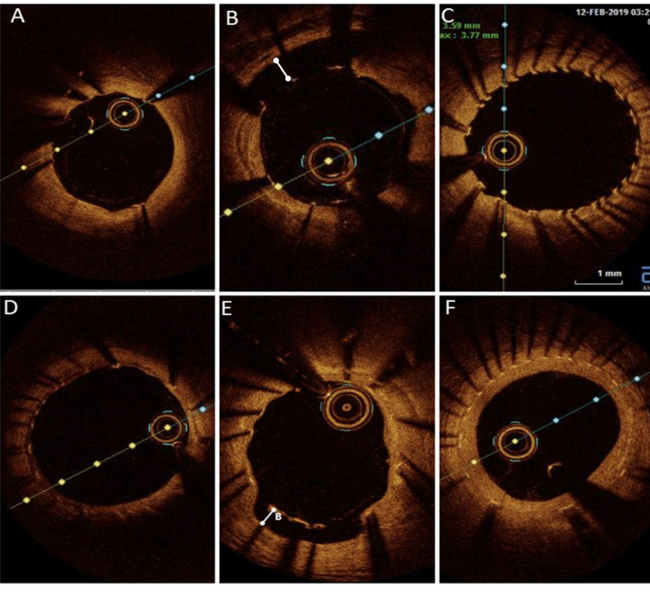
Much of what we know about postdilatation comes from intravascular ultrasound (IVUS) studies. IVUS has demonstrated that underexpansion of stents, relative to an adjacent normal artery, contributes to restenosis.1 Several studies have tested the theory that IVUS-guided stenting, including post-dilatation, would improve outcomes of stenting. A meta-analysis of IVUS-guided stenting trials and registries by Casella et al found that IVUS guidance of stenting (compared to no IVUS) significantly decreased angiographic restenosis (by 25%) and target vessel revascularization (by 38%).1 Underexpansion of stents, identified by IVUS, has also been associated with subacute stent thrombosis.3 As a result, the routine use of IVUS, with additional postdilatation as needed to achieve optimal stent deployment, has been advocated to minimize stent thrombosis.4,5 However, the meta-analysis by Casella et al found that IVUS guidance of stenting did not decrease the risk of death or nonfatal myocardial infarction.1 Perhaps reflecting this real-world experience, in 2006, less than 5% of stent procedures were performed with IVUS. Despite being available for almost 10 years, IVUS has failed to find popularity among interventionists.
What other strategies might help prevent stent under-deployment with its attendant risks of stent thrombosis and restenosis? Routine postdilatation with an oversized balloon has been reported.6–8 Johansson et al found that routine postdilatation with a 0.25 mm oversized balloon improved IVUS measures of optimal stent deployment, but produced only trends toward less restenosis or other ischemic events.6 Mori et al found that routine postdilatation with a 0.5 mm oversized balloon improved minimal lumen diameter and decreased the incidence of restenosis (9%) compared to postdilatation with a nominally-sized balloon (22%, p < 0.05).7 De Quadros found that routine postdilatation with a balloon oversized by 10% (compared to adjacent normal artery) did not decrease restenosis, but did increase the incidence of side-branch occlusions.8 Taken together, these studies provide less than compelling evidence to support routine postdilatation.
An alternative strategy was proposed by Haldis et al.9 They tested a strategy that required an angiographic appearance of a “step-up” at the proximal end of the stent and a “step-down” at the distal end, with uniform stent expansion throughout. Postdilatation was used as needed to achieve this result. This strategy dramatically improved IVUS criteria for optimal stent deployment, compared to a conventional strategy using a 1:1 stent balloon-to-artery ratio. The trial was not powered to assess clinical endpoints.
With this background, the study in this issue of the Journal is relevant.10 Aziz et al prospectively evaluated 490 lesions by quantitative angiography, of which 202 were postdilated. Postdilatation was performed at the discretion of the operators, and was done more frequently in larger arteries and when the residual stenosis after stenting was > 10%. Postdilatation increased the minimal lumen diameter by an average of 0.2 mm (exactly the same increase as reported by Casella et al for IVUS-guided stent deployment with postdilatation).1 Importantly, postdilatation was most effective in increasing minimal lumen diameter for stents deployed at low pressures and for stents with a residual stenosis > 20%. Clinical follow up was not provided. What, then, can we deduce from these studies?
• Routine postdilatation does not reduce ischemic events, may reduce restenosis, but may be harmful in some patients.
• IVUS-guided postdilatation increases minimal lumen diameter and decreases restenosis. While these data from the bare-metal stent era have not been duplicated in the drug-eluting era, IVUS-guided postdilatation remains a reasonable strategy. However, it seems unlikely that it will be widely embraced by interventionists. Obstacles include interventionists’ lack of familiarity and low reimbursement (e.g., Medicare professional reimbursement of $68).
• Angiographically-guided postdilatation has not been shown to improve clinical outcomes, but it does have the advantage of intuitive reasonableness. It can be used to treat arteries that lack an angiographic “step-up, step-down”, or arteries that demonstrate residual stenosis within the stented segment. This may improve minimal lumen diameter, and possibly achieve the clinical benefits seen with IVUS guidance, although all of this remains to be proven.
Thus the search for a coherent strategy for postdilatation, at present, ends in frustration. To postdilate always is overkill; to postdilate never is neglectful. In between these extremes, there may lie a middle ground. Perhaps operator intuition will serve as well as any angiographic or IVUS indicator. Start with stent deployment systems that yield a 1.1:1 balloon-stent-to-artery ratio, and deploy at high pressures (14–18 atm). When a stented lesion looks a little skimpy, give it a high-pressure hit. If you may have undersized the stent, expand it with an oversized balloon. And look forward to the day when stents are coated with such powerful antiplatelet and antiproliferative agents that postdilatation becomes just another footnote in the history of coronary intervention.
References
- Alfonso A, Suarez A, Perez-Vizcayno MJ, et al. Intravascular ultrasound findings during episodes of drug-eluting stent thrombosis. J Am Coll Cardiol 2007;50:2095–2097.
- Casella G, Klauss V, Ottani F, et al. Impact of intravascular ultrasound-guided stenting on long-term clinical outcome: A meta-analysis of available studies comparing intravascular ultrasound-guided and angiographically guided stenting. Catheter Cardiovasc Interv 2003;59:314–321.
- Fujii K, Mintz GS, Kobayashi Y, et al. Contribution of stent underexpansion to recurrence after sirolimus-eluting stent implantation for in-stent restenosis. Circulation 2004;109:1085–1088.
- Holmes DR, Kereiakes DJ, Laskey WK, et al. Thrombosis and drug-eluting stents. An objective appraisal. J Am Coll Cardiol 2007;50:109–118.
- Hodgson J McB, Stone GW, Lincoff AM, et al. Late stent thrombosis: Considerations and practical advice for the use of drug-eluting stents: A report from the Society for Cardiovascular Angiography and Interventions Drug-Eluting Stent Task Force. Catheter Cardiovasc Interv 2007;69:327–333.
- Johansson B, Allared M, Borgencrantz B, et al. Standardized, angiographically-guided “over-dilatation” of stents using high-pressure technique optimizes results without increasing risk: An intravascular ultrasound study. J Invasive Cardiol 2002;14:221–226.
- De Quadros AS, Sarmento-Leite R, Gottschall CAM, et al. Hyperexpansion of coronary stents and clinical outcomes. Tex Heart Inst J 2006;33:437–444.
- Mori F, Tsurumi Y, Hagiwara N, Kasanuki H. Impact of post-dilatation with a focal expanding balloon for optimization of intracoronary stenting. Heart Vessels 2007;22:152–157.
- Haldis YA, Fenster B, Gavlick K, et al. The angiographic step-up and step-down: A surrogate for optimal stent expansion by intravascular ultrasound. J Invasive Cardiol 2007;19:101–105.
- Aziz S, Morris JL, Perry RA, Stables RH. Postdilatation following coronary stent deployment: Lesion and procedural characteristics associated with an increase in stent dimensions. J Invasive Cardiol 2008;20:342–346.