Case Report
Successful Stent Treatment of Pulmonary Vein Stenosis Following Atrial Fibrillation Radiofrequency Ablation<br />
July 2002
Pulmonary vein stenosis (PVS) is a known complication of radiofrequency ablation (RFA) of atrial fibrillation foci.1 Although balloon dilation has been reported to effectively treat PVS following RFA,2,3 restenosis has also been reported.4 We report a case of severe post-RFA PVS with rapid restenosis after acutely successful balloon dilation, and the first reported successful treatment of RFA PVS using percutaneously placed stents, with 1-year follow-up results.
Case Report. A 47-year-old man with a history of recurrent atrial fibrillation refractory to multiple anti-arrhythmic agents underwent attempted focal RFA in August 1998. The procedure was unsuccessful and the patient underwent repeat RFA in October, 1998. The patient’s atrial fibrillation was controlled following the second RFA. In November 1998, the patient began experiencing dyspnea on exertion which progressively worsened.
By June 1999, the patient’s dyspnea on exertion was severe and associated with pallor. He had developed 2–3 pillow orthopnea. On physical examination, blood pressure was 108/70 mmHg, heart rate was 80 beats per minute, and respiratory rate was 20 per minute. The lungs were clear. Cardiac examination demonstrated no murmur, rub or gallop. The abdomen was soft without organomegaly. There was no peripheral edema. Electrocardiogram demonstrated normal sinus rhythm at 76 beats per minute, normal PR, QRS and QT intervals without acute abnormality. Echocardiography demonstrated normal ventricular size and function with trace mitral and tricuspid regurgitation. Chest x-ray was unremarkable. A ventilation-perfusion lung scan demonstrated no perfusion to the right lung, suggestive of occlusion to the right pulmonary artery (Figure 1). Ultrasonography demonstrated no thrombus in the lower extremity, internal jugular or subclavian veins. With the first cases of PVS following RFA recently reported, the patient was taken to the catheterization laboratory to investigate this possibility.
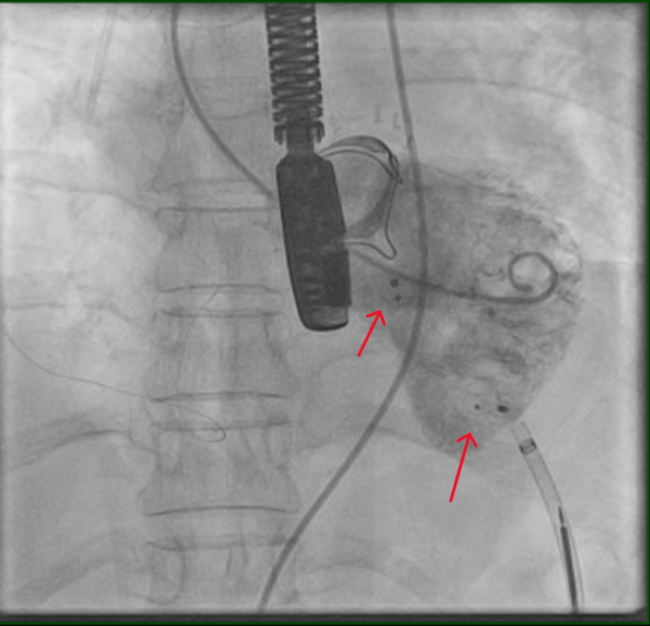
At transseptal cardiac catheterization, severe stenosis of the right upper (Figure 2) and lower pulmonary veins was found. PA pressure was 20/12 mmHg. A Palmaz stent was placed in the right upper vein and was dilated to 8 mm. The stent embolized on withdrawal of the dilation balloon and was placed in the left common iliac artery. Follow-up angiography demonstrated the right upper vein to be widely patent (Figure 3).
The patient underwent recatheterization in July 1999 to address the right lower pulmonary vein stenosis and to re-evaluate the right upper pulmonary vein. The right lower pulmonary vein was severely stenosed (Figure 4) and the upper pulmonary vein demonstrated severe restenosis (Figure 5). The embolized stent that had been placed in the left common iliac artery at the prior catheterization was widely patent. Two overlapping Palmaz 308 stents were delivered transseptally to the right upper pulmonary vein and dilated to 10 mm. A balloon-mounted Palmaz stent would not follow the tortuous catheter course to the right lower pulmonary vein. Two 14 mm self-expanding Symphony stents were successfully delivered to the right lower pulmonary vein. Follow-up angiography demonstrated the stented veins to be widely patent (Figures 6 and 7).
After stent placement, the patient’s dyspnea and orthopnea resolved. A follow-up ventilation-perfusion lung scan in July 2000 (one year after stent placement) demonstrated reperfusion of the right lung (Figure 8).
Discussion. Robbins et al.2 were the first to report PVS following RFA of atrial fibrillation foci. In their 4 cases, angioplasty was acutely effective. Subsequently, similar reports3,4 documented acute resolution of RFA PVS following balloon angioplasty. However, in a case reported by Moak et al.,4 a second balloon dilation was required at 6 months. Although not reported, Robbins et al. have also experienced restenosis (E. Colvin, personal communication). While Scanavacca et al.3 report continued symptomatic improvement 1 year after balloon dilation, they provide no objective evidence of a successful result.
Aware of the possibility of restenosis, we chose to primarily stent the areas of PVS in our patient. Despite a very tight stenosis in the right upper pulmonary vein, the stent we implanted embolized on withdrawal of the delivery balloon. With a good angiographic result obtained from the dilation performed while implanting the stent, we thought it prudent to choose the unknown risk of PV restenosis as opposed to risking embolization of another stent. We decided to re-evaluate the dilated right upper pulmonary vein after 1 month, and address the right lower pulmonary vein with stenting or balloon dilation at that time. The successfully dilated area rapidly restenosed within the month. We concluded that stenting both veins was now clearly indicated. At recatheterization, we placed balloon-expandable stents in the upper pulmonary vein and self-expanding stents in the lower pulmonary vein. Both types of stent proved to be effective in treating post-RFA PVS, with reperfusion of the entire right lung demonstrated by lung scan 1 year after stent placement. It appears that the pulmonary vein stenoses in our patient were very compliant lesions, given that the first stent was not held tightly by an area previously critically stenotic, and that self-expanding stents dilated the right lower pulmonary vein lesion.
In conclusion, while post-RFA PVS may respond acutely to balloon dilation, restenosis can occur. Both balloon-expandable and self-expanding stents were effective in treating RFA PVS acutely and at 1-year follow-up in our patient. Primary stent placement should be considered in post-RFA PVS.
1. Wellens HJJ. Pulmonary vein ablation in atrial fibrillation: Hype or hope? Circulation 2000;21:2562–2564.
2. Robbins IM, Colvin EV, Doyle TP, et al. Pulmonary vein stenosis after catheter ablation of atrial fibrillation. Circulation 1998;17:1769–1775.
3. Scanavacca MI, Kajita LJ, Vieira M, Sosa EA. Pulmonary vein stenosis complicating catheter ablation of focal atrial fibrillation. J Cardiovasc Electrophysiol 2000;6:677–681.
4. Moak JP, Moore HJ, Lee SW, et al. Case report: Pulmonary vein stenosis following RF ablation of paroxysmal atrial fibrillation: Successful treatment with balloon dilation. J Intervent Card Electrophysiol 2000;4:621–631.