Successful Percutaneous Interventions with Limited Crossing of the Penetration Catheter into Severe Coronary Artery Stenoses
The recently FDA-approved Tornus® penetration catheter (Asahi Intecc, Aichi, Japan) has been shown to be effective in the treatment of severe coronary artery lesions and chronic total occlusions when they are first crossed by coronary guidewires but are resistant to balloon catheter passage.1 In the study by Tsuchikane et al,1 the Tornus successfully penetrated difficult coronary stenoses in 14 out of 14 patients without complications, which led to successful balloon catheter crossing and subsequent dilatation. In the present case reports, the Tornus catheter was further demonstrated to be effective in facilitating guidewire exchange and ultimate successful procedural outcomes, despite the lack of complete “penetration” of the stenoses by the catheter into the distal vessel. These cases demonstrated that while crossing difficult lesions with the Tornus is an exceptional feature,1 it was not a prerequisite for its facilitation with guidewire exchange, which ultimately led to rotational atherectomy and successful procedural results. The guidewire exchange capability of the Tornus penetration catheter without fully crossing the lesion is an important capability, and should be explored in complex percutaneous coronary interventions of severe stenoses or chronic occlusions.
Case #1. A 63-year-old male with a history of myocardial infarction and coronary bypass surgery 10 years prior, presented with new-onset angina. A diagnostic cardiac angiogram demonstrated the culprit lesion to be a 90% stenosis in a degenerative saphenous vein graft (SVG) to a moderate-sized obtuse marginal branch (OMB) of the circumflex artery (Figure 1A). The native OMB was heavily calcified and had a severe 99% subtotal stenosis proximal to the site of the SVG distal anastomosis, with TIMI 0-1 antegrade flow (Figure 1B). Either the SVG or the native OMB could have been a target for percutaneous intervention, however, intervening on the SVG would carry higher risks of distal embolization and long-term restenosis. A decision was made to intervene on the native OMB. The approach was made using a 6 Fr EBU 3.5 guiding catheter, a Pilot™ 50 guidewire (Guidant Corp., Indianapolis, Indiana) and a supporting 1.5 mm Maverick™ balloon catheter (Boston Scientific Corp., Natick, Massachusetts). After crossing the lesion with moderate difficulty, the lesion was resistant to crossing with either the 1.5 mm Maverick, the Maverick 2™ or the Voyager™ RX coronary dilatation catheter (Guidant). A second “buddy wire” was unsuccessful in crossing the lesion, and placing it in a proximal branch vessel did not help with the support or pushability of the balloon crossing. Before removing the balloon catheter, an attempt to advance the RotaWire™ floppy through the balloon tip was unsuccessful. The lesion was then rewired with the Pilot™ 50 guidewire.
The balloon catheter was exchanged for a 2.1 Fr Tornus penetration catheter. The tip of the Tornus reached the lesion site and counter-clockwise manual rotation with forward tension was performed at the recommended 15–20 revolutions or less. Passive release of built-up torque and repeated counter-clockwise forward manual rotation were performed several times until there was no further noticeable advancement (Figure 1C). Angiographically, the Tornus appeared to have crossed the lesion in a limited fashion, probably no further than the 1.5 mm balloon catheters. Nonetheless, before aborting the procedure, an attempt to exchange the Pilot 50 for a RotaWire floppy was made. With unexpected ease, the RotaWire was able to be advanced to the distal segment of the vessel (Figure 1D). Further pretreatment with rotational atherectomy and coronary angioplasty were performed, followed by the deployment of several Taxus® Express2™ stents (Boston Scientific) to a final diameter of 2.84 mm based on the compliance chart. Final angiography showed an excellent result (Figure 1E). The patient reported no recurrent angina at 1- and 3-month clinical follow up.
Case #2. An 80-year-old female presented with chest pain and dynamic inferior ST-segment changes. The patient had a history of percutaneous intervention to the left anterior descending artery in the past. During the diagnostic coronary angiogram, the culprit was deemed to be a severely calcified right coronary artery (RCA) with an ostial 80% stenosis, a middle 99% subtotal occlusion and a distal 95% eccentric, long and complex lesion with TIMI 0–1 antegrade flow (Figure 2A). Some left-to-right collateralization was present. The initial approach was made using a 6 Fr JR4 guide, a Pilot 50 guidewire and a supporting 1.5 mm Maverick balloon catheter. The initial guidewire crossing of the middle RCA subtotal occlusion was difficult, but possible, to place into the distal vessel. The 1.5 mm balloon, however, was unable to cross the lesion (Figure 2B). As in the first case, an attempt to place a second “buddy wire” to cross the lesion was not possible, and there was no viable proximal branch to anchor the “buddy wire” for extra support.
The balloon catheter was exchanged for a 2.1 Fr Tornus catheter. The forward counter-clockwise manual rotation alternating with torque release was performed several times. The Tornus penetrated partially through the middle RCA subtotal lesion. However, forward advancement of the catheter came to a halt before the more distal, severely stenotic RCA lesion (Figure 2C). Guidewire exchange was attempted with a RotaWire — extra support at this point — without success. The RotaWire was not able to be advanced past the distal RCA lesion. The Pilot 50 was readvanced into the distal vessel, and the catheter was retracted by clockwise rotation, and was exchanged for a 2.6 Fr Tornus. Partial penetration into the more distal RCA lesion was possible with the larger Tornus, however, complete crossing of the distal stenosis was not achieved (Figure 2D). Despite incomplete crossing of all the stenotic segments, guidewire exchange with the RotaWire was now possible (Figure 2E). Rotational atherectomy and balloon angioplasty followed, and the lesions were successfully stented with multiple Taxus Express2 stents to a final proximal diameter of 3.33 mm based on the compliance chart (Figure 2F). At 1- and 3-month clinical follow up, the patient was free of recurrent angina.
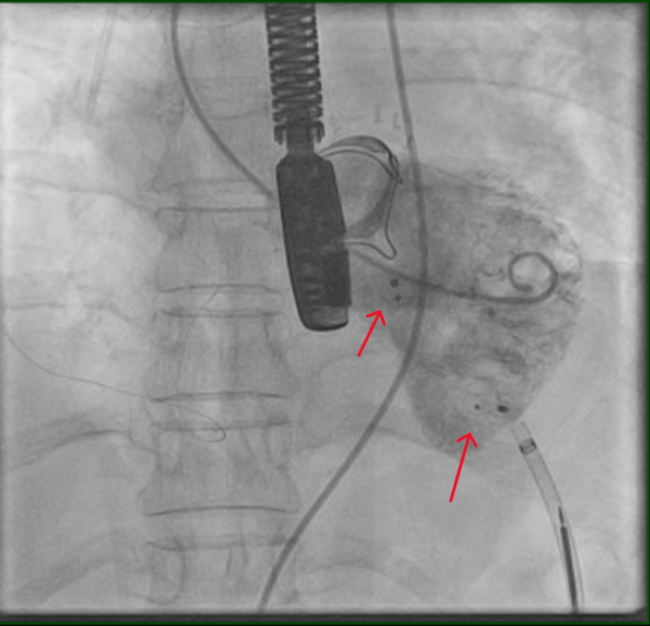
Discussion. The Tornus penetration catheter, which is made from braided stainless-steel microtechnology (Figure 3), is designed for support and exchange of guidewires during percutaneous intervention. Because of its stainless-steel construction, it is designed to provide greater support and pushability as compared with conventional balloon or exchange catheters. Also its tapered threaded-tip design is intended to facilitate lesion entry and penetration. Through the forward counter-clockwise motion, the “threaded” nature of the catheter, along with its tapered tip, allow for antegrade penetration of the resistant lesions. The intended clinical use of the Tornus is for lesions already crossed with a guidewire, but that have failed to be crossed with a balloon or an exchange catheter. The full penetration of the Tornus would allow for guidewire exchange or balloon catheter passage.1 Occasionally, it has been suggested that the Tornus may help to guide the crossing of guidewires.
The cases presented here demonstrate an unintended, as yet unreported use of a penetration catheter — the Tornus catheter — to effectively facilitate successful percutaneous interventions of difficult coronary stenoses, even without fully crossing the lesions. There is scarce published experience regarding successful procedural outcomes in cases where the penetration catheter has completely crossed into the distal vessel.1 Partial or limited lesion penetration, as shown in these two cases, may be sufficient to improve the chances of guidewire exchange to the RotaWire, which was previously impossible to achieve with balloon catheters. High-speed rotational atherectomy and debulking, which had been shown to be efficacious in lesions with severe calcification and heavy plaque burden,4–6 was made possible, leading to ultimate procedural success.
Clinical experience in the current case studies correlated with bench test results (data provided by Asahi Intecc) of the relative catheter support of the 1.5 mm Maverick, 2.1 Fr Tornus and the 2.6 Fr Tornus (Figure 4).2 As shown in Case #2, with the increasing order of relative catheter support, the 1.5 mm Maverick, 2.1 Fr Tornus and the 2.6 Fr Tornus corresponded with increasing penetration into the long segments of RCA stenoses (Figures 2 B, C, D). Interestingly, a converse relationship exists with the crossing profiles (Figure 5), the degree of catheter support (Figure 4) and the degree of lesion penetration observed in Case #2 (Figures 2 B, C, D). This observation may be partly explained by the Tornus’s composition of braided stainless-steel design versus plastic in conventional balloon catheters. Nonetheless, the apparent small extra forward distances gained by the penetration catheter in both cases significantly helped with successful guidewire exchange to the RotaWire. Percutaneous coronary interventions of advanced lesions types such as chronic total, heavily calcified and severe stenotic lesions require experienced technical skills, a full armamentarium of equipment and knowledge of their capabilities. Due to its relatively recent availability, the overall experience with the Tornus catheter is limited at our institution and elsewhere. The cases presented here successfully explore the unique aspects of the penetration catheter, which may offer added options and possibilities for successful procedural outcomes in these difficult subsets of coronary artery lesions.
References
- Tsuchikane E, Katoh O, Shimogami M, et al. First clinical experience of a novel penetration catheter for patients with severe coronary artery stenosis. Catheter Cardiovasc Interv 2005;65:368–373.
- Tornus® Penetration Catheter, Bench test data on file at AVD, Asahi Intecc. Available at http://www.abbottvascular.com.
- Ho PC, Chan SK, Leung CY. Microdissection and rotational atherectomy: An effective combination for the resistant chronic total occlusion. J Invasive Cardiol 2006 (in press).
- Henneke KH, Regar E, Konig A, et al. Impact of target lesion calcification on coronary stent expansion after rotational atherectomy. Am Heart J 1999;137:93–99.
- Moussa I, Di Mario C, Moses J, et al. Coronary stenting after rotational atherectomy in calcified and complex lesions: Angiographic and clinical follow-up results. Circulation 1997;96:128–136.
- Gruberg L, Mehran R, Dangas G, et al. Effect of plaque debulking and stenting on short- and long-term outcomes after revascularization of chronic total occlusions. J Am Coll Cardiol 2000;35:151–156.