Clinical Images
Stent Deformation after Catheter Advancement through a Recently Deployed Self-Expanding Stent: Diagnosis, Mechanism and Correc
Emmanouil S. Brilakis, MD, PhD, Michele Roesle, RN, Subhash Banerjee, MD
January 2007
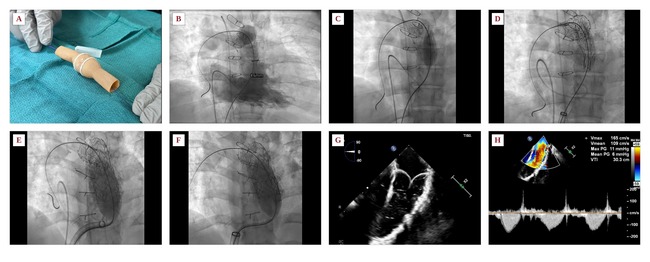
A 70-year-old male presented with left buttock claudication. Diagnostic angiography showed a 90% left external iliac artery stenosis (Figure 1A). The left external iliac artery lesion was crossed with a 0.035 Storq guidewire (Cordis Corp., Miami, Florida), predilated with a 5.0 x 40 mm Powerflex™ balloon (Cordis) and stented using a 8.0 x 40 mm self-expanding S.M.A.R.T.® stent (Cordis), rendering a good result (Figure 1B). Even though there was residual in-stent stenosis, there was no gradient across the stent, and we elected not to postdilate it. After stent deployment, a pigtail and RIM catheter (AngioDynamics, Queensbury, New York) were used to engage the right common iliac artery to obtain a selective diagnostic angiogram. Over-the-wire passage of the catheters through the recently-deployed stent was difficult and resulted in inversion of the distal stent struts (Figure 1C). A 5.0 x 20 mm Powerflex balloon (Cordis) was advanced into the stent, inflated at nominal pressure (Figure 1D), and pulled back, resulting in restoration of the distal stent strut configuration (Figure 1E), and rendering a good final angiographic result (Figure 1F).
Advancement of equipment through a recently-deployed self-expanding stent could cause stent deformation and should be done under fluoroscopic guidance. The mechanism of such deformation is likely entrapment of the terminal portions of the stent struts within the opposite wall struts (Figure 2).
Acknowledgement. We would like to thank Bruce M. Morris from the Medical Media Service at the Dallas VA Medical Center for obtaining the stent images.