Spontaneous Coronary Artery Dissection: Case Series with Extended Follow Up
Spontaneous coronary artery dissection (SCAD) was first described in 1931.1 The average incidence described in case series ranges from 0.1–0.28.3 Coronary artery dissection is termed spontaneous upon exclusion of secondary causes such as cardiac catheterization, chest trauma, aortic root dissection and cardiac surgery.4 SCAD is defined as the separation of intima from media or media from adventitia, creating a false lumen.4 Formation of an intramural hematoma leads to occlusion of the true lumen.4 SCAD can be broadly divided into atherosclerotic and non-atherosclerotic in origin.1 Non-atherosclerotic causes include peripartum state, coronary spasm, connective tissue disorder (Marfan’s syndrome, Ehler Danlos Type 4, fibromuscular hyperplasia) and systemic inflammatory conditions (inflammatory bowel disease and rheumatoid arthritis).5 However, no specific cause is usually identified. Systemic inflammation causes the release of proinflammatory cytokines, causing rupture of vasa vasorum in the arterial media.6 The luminal pressure from intramedial hemorrhage without the buttressing effect of atheroma may lead to SCAD.6 Abdominal aortic aneurysm research shows that intense inflammation, matrix degradation and smooth-muscle cell apoptosis predominantly involves the arterial media and adventitia, while atherosclerotic lesions typically involve the intima.1 Atherosclerosis leads to intimal-medial dissection.1 Eosinophilic infiltrates have been identified in coronary artery adventitia in non-atherosclerotic SCAD.2 The inflammatory substances cause a breakdown of medial-adventitial layers and lead to dissection.2 As shown in the literature, almost half of the patients with SCAD develop recurrence in other vessels within the first month.7 Some of these patients are asymptomatic in the follow-up period, even without medical management. It appears that global arterial weakness is more prominent at some point in life in such patients. Flare-up at a particular time in life is responsible for the clustering of events. We report a series of 13 cases involving patients from ages 26–48, with follow up ranging from 1 month to 13 years. Such extended follow up has been infrequently documented in the literature.
Methods
Between 1997 and 2009, at the University at Buffalo, 13 patients with coronary artery dissection were identified at primary and referring hospitals. Many patients were referred for further care after initial diagnosis at a different hospital, making the incidence interpretation difficult in this study. The primary goal was to study the short- and long-term outcomes of these patients.
Results
Age, traditional CAD risk factors, vessel involvement, mode of presentation and treatment  options are summarized in Table 1. Eleven patients were females (ages 37–48) and 2 were males (both in their 20s). None of the females were in the peripartum state. Seven patients had no traditional risk factors for CAD. Five patients had one or more risk factors including smoking, diabetes and mild hypertension. All patients presented with acute myocardial infarction. Both males had right coronary artery (RCA) involvement. Eight of 11 females had left anterior descending artery (LAD) involvement. The marginal, diagonal and posterior descending artery (PDA) were involved in 1 patient. Linear dissection of the affected vessels was not associated with evidence of
  atherosclerosis in other arteries. Eight patients were treated medically, 3 received stents in the dissected vessel and coronary artery bypass grafting (CABG) was done in 2 patients. As demonstrated in Figure 1, approximately 50% of the patients developed recurrent dissection within 1 month involving a different coronary artery (Table 1) and
  individual patients. Among patients who developed recurrent dissection, 80% had a positive work-up suggestive of acute inflammatory state or connective tissue disorders. A variety of tests were ordered, the most common being: erythrocyte sedimentation rate (ESR), C-reactive protein (CRP), antinuclear antibodies (ANA), rheumatoid arthritis (RA) factor and consideration of Ehler Danlos syndrome (EDS). EDS was evaluated by skin fibroblast biopsy. All symptomatic patients during late follow up had a positive inflammatory work-up during their index event. Table 3 describes the presentation during the index event and details the treatment strategy
  employed during the index event. CK levels and troponin levels were not available for all patients at the time of this review, as most patients were referred from outlying hospitals. Peak CK level ranged from 58–1,265 U/L. Details of medical management and intervention are provided in Table 3. Table 4 describes in fair detail the characteristics of dissection along with the strategy chosen for each patient during the index event and during the recurrent event. It also describes the time of recurrence from the index event and the extent of the dissection. The initial mode of management does
  not correlate with the recurrence rate as per Table 4.
Discussion
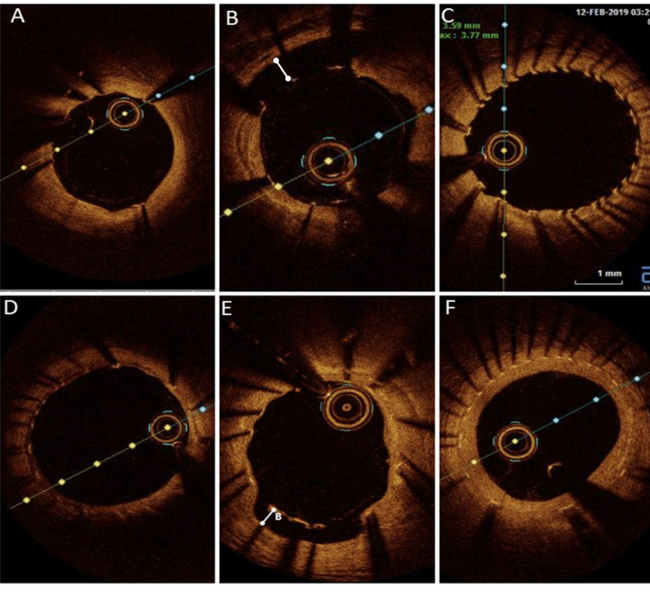
More than 300 cases of SCAD have been reported, which is likely to be an underestimation of the true incidence since SCAD is associated with a higher risk of sudden cardiac death.3 Almost 50% cases are diagnosed on autopsy.3 Approximately 70% of cases occur in females, while 30% occur in males.7 The LAD is commonly involved in females, while the RCA is more commonly involved in males.7 Involvement of the left main stem coronary artery has also been reported.8 The clinical presentations range from unstable angina to sudden cardiac death. Patients in our study presented with acute myocardial infarction. Arterial occlusion can be due to an intimal flap or intramural hematoma, which may compress the true lumen.4 Intramural thrombus is rare with a dissected artery and it seems that the vessel is generally patent.4 Common angiographic findings include: intimal flap; two separate communicating lumens — one of them fills and empties slowly; multiple dissecting lines inside the lumen; or coronary aneurysm communicating with the main lumen via a narrow neck.10 Nitroglycerin-resistant segmentary narrowing of coronary vessels in a young female may be considered presumptive criteria for SCAD.11 Intravascular ultrasound (IVUS) is currently available to clarify the diagnosis. IVUS was not routinely available when the patients in this cohort were diagnosed.
The patients can be divided into four different categories based on etiology: peripartum period, atherosclerosis, connective tissue disorder and idiopathic.9 The peripartum period is a known risk factor for SCAD. Both hormonal and hemodynamic changes associated with pregnancy are thought to play a role in intimal tearing that leads to SCAD.12 Estrogen causes microstructural changes in the arterial wall and loosens the intercellular matrix. This results in rupture of the vasa vasorum.10 Increased cardiac output and shear stress on the arterial wall during labor intensifies these changes.10
Almost half of the patients with SCAD develop recurrence in another vascular bed within a couple of weeks after an index event. Clustering of dissections in other coronary vessels and other vascular beds immediately after the index event has been observed. Once healed, however, most of these patients are asymptomatic during long-term follow up, even without medical management. Eighty percent of patients with recurrent dissection showed a positive work-up for systemic inflammation or connective tissue diseases. It affects the coronary vasculature and compromises the arterial framework, making it susceptible to dissection. Global arterial weakness appears to be more prominent at some point in life in such patients. During a systemic inflammatory state, there is release of proinflammatory cytokines causing rupture of vaso vasorum.1 Activation of matrix metalloproteinase could also play a role in stimulating the collagen degradation and thus jeopardizing structural integrity of the vessel wall.1 Eosinophilic infiltrates have been described in the coronary artery adventitia in non-atherosclerotic SCAD cases.2 Eosinophilic granules contain the lytic substances such as collagenase, peroxidase, major basic proteins and acid phosphatase.2 These lytic substances break down the medial-adventitial layers. Systemic lupus erythematosus has also been linked to SCAD, in which general vasculitis seems to be the underlying mechanism leading to chronic inflammation of the vessel and eventually dissection.3 Crohn’s disease has been described in the literature to be associated with SCAD as well.12
EDS type 4 and Marfan’s syndrome are associated with SCAD.9 In these conditions, cystic medical necrosis is the likely mechanism leading to weakness of arterial walls and increasing susceptibility to SCAD.14 Marfan’s syndrome is associated with a reduced upper-to-lower body ratio, arachnodactyly, hyperlaxity of joints, arm span greater than height, mitral valve prolapse, aortic insufficiency and ectopia lentis.9 Six subtypes of EDS have been described and are characterized by hyperelasticity and fragility of skin and joint hypermobility.9 EDS type 4 (vascular type) is associated with spontaneous rupture of large- and medium-sized arteries. Accurate diagnostic tests are not commercially available for EDS. If EDS type 4 is clinically suspected, the diagnosis can be confirmed by skin biopsy to analyze the collagen obtained from cultured fibroblasts or by measuring type III amino-terminal procollagen propeptide levels in the skin’s interstitial fluid.9 However, genetic testing should be considered in all patients for definite inclusion or exclusion of EDS type 4. EDS type 4 has been linked to mutation in the COL3A1 gene.9 Patient 1 in our study was confirmed for EDS by skin biopsy. Patients 2 and 8 were evaluated for EDS type 4, however, genetic testing was not performed.
No specific guidelines exist to treat SCAD.15 Emergent angiography and early identification seem to be key to survival and recovery. Both primary conventional medical management for acute coronary syndrome and primary stent deployment are associated with early recurrence. We recommend conventional medical management if a small- to medium-sized vessel is involved, if the vessel is patent and the patient is hemodynamically stable. Percutaneous coronary intervention with stent deployment is beneficial if a single medium- to large-sized vessel is involved and if the artery is occluded. CABG can be considered for patients presenting with multivessel dissection, left main dissection, new-onset heart failure or with hemodynamic instability. Physicians should be aware that new spontaneous dissection may recur during the first few days or weeks after presentation. Given the nature of self-limited and seemingly short-lived inflammatory events, based on current data, there does not appear to be a clear preference for one mode of intervention during the index event to prevent recurrent dissection. We recommend individualized supportive care. Symptom management may be challenging during follow up, but patients do well in the long term.
Prognosis
In earlier studies, mortality from SCAD was approximately 50%,4 and independent predictors of mortality included female sex, decade of occurrence and failure to treat.4 If the patient survives the initial event, subsequent survival approaches 90%, and almost 50% experience recurrent dissection within 2 months.4 With early diagnosis and management, survival has increased to approximately 95%.4 In our study recurrent dissection was an early phenomenon, with 100% long-term survival and most patients asymptomatic on follow up.
Conclusion
SCAD should be strongly suspected in younger women presenting with acute coronary syndrome with few or no traditional risk factors for CAD. Diagnostic, invasive or computed tomography-guided angiography will clarify the diagnosis. Initial treatment does not seem to be associated with early recurrence since a new dissection may involve a different vessel. IVUS is very helpful in differentiating SCAD from atherosclerosis and identifying other coronary vessels at risk of dissection. As per our study, recurrent dissection can occur in approximately 50% of the cases in the first 2 weeks after an index event and it may be observed in carotid or vertebral arteries. Late symptoms occurred in
References
1. Weintraub NL. Understanding abdominal aortic aneurysm. N Engl J Med 2009;361:1114–1116.
2. Kearney P, Singh H, Hutter J, et al. Spontaneous coronary artery dissection: A report of three cases and review of the literature. Postgrad Med J 1993;69:940–945.
3. Mazullah K, Amrit G, Monika B. Spontaneous coronary artery dissection: Case series and review. J Invasive Cardiol 2008;20:553–559.
4. Basso C, Morgagni GL, Thiene G. Spontaneous coronary artery dissection: A neglected cause of acute myocardial ischemia and sudden death. Heart 1996;75;451–454.
5. Srinivas M, Basumani P, Muthusamy R, Wheeldon N. Active inflammatory bowel disease and coronary artery dissection. Postgrad Med J 2005;81:68–70.
6. Bateman AC, Gallagher PJ, Vincenti AC. Sudden death from coronary artery dissection. J Clinical Pathol 1995;48:781–784.
7. Thompson EA, Ferraris S, Gress T, Ferraris V. Gender differences and predictors of mortality in spontaneous coronary artery dissection: A review of reported cases. J Invasive Cardiol 2005;17:59–61.
8. Adkins GF, Steele RH. Left coronary artery dissection: An unusual presentation. Heart 1986;55:411–414.
9. Tanis W, Stella PR, Pijlman AH, et al. Spontaneous coronary artery dissection: Current insights and therapy. Neth Heart J 2008;16:344–349.
10. Kamineni R, Sadhu A, Alpert J. Spontaneous coronary artery dissection: Report of two cases and a 50-year review of the literature. Cardiol Rev 2002;10:279–284.
11. Zampieri P, Aggio S, Roncon L, et al. Follow up after spontaneous coronary artery dissection: A report of five cases. Heart 1996;75:206–209.
12. Evangelou D, Letsas KP, Korantzopoulos P, et al. Spontaneous coronary artery dissection associated with oral contraceptive use: A case report and review of the literature. Int J Cardiol 2006;112:380–382.
13. Auer J, Punzengruber C, Berent R, et al. Spontaneous coronary artery dissection involving the left main stem: Assessment by intravascular ultrasound. Heart 2004;90:e39.
14. Khan NA, Miller MJ, Babb JD, et al. Spontaneous coronary artery dissection. Acute Cardiac Care 2006;8:162–171.
15. Fontanelli A, Olivari Z, La Vecchia L, et al. Spontaneous dissection of coronary arteries and acute coronary syndromes: Rationale and design of the DISCOVERY, a multicenter prospective registry with a case-control group. J Cardiovasc Med 2009;10:94–99.
16. Vanzetto G, Berger-Coz E, Barone-Rochette G, et al. Prevalence, therapeutic management and medium-term prognosis of spontaneous coronary artery dissection: Result from a database of 11,605 patients. Eur J Cardiothoracic Surg 2009;35:250–254.
17. Unal M, Korkut AK, Kosem M, et al. Surgical management of spontaneous coronary artery dissection. Tex Heart Inst J 2008;35:402–405.
———————————————————— From the Departments of *Internal Medicine and †Cardiology, The State University of New York at Buffalo, Buffalo, New York. The authors report no conflicts of interest regarding the content herein. Manuscript submitted July 1, 2010, provisional acceptance given August 10, 2010, final version accepted November 22, 2010. Address for correspondence: Pranav Kansara, MD, MS, Department of Internal Medicine, The State University of New York at Buffalo, Buffalo, NY 14221. E-mail: pkansara@buffalo.edu