Percutaneous Site-Specific Pharmacomechanical Thrombolysis-Thrombectomy System for Bilateral Acute Limb Ischemia
ABSTRACT: Acute limb ischemia (ALI) remains a life-threatening condition. Studies with catheter-directed thrombolysis and percutaneous mechanical thrombectomy systems show modest improvements in mortality compared to surgery but with pitfalls of major bleeding, distal embolization, recurrent thrombosis, prolonged thrombolytic infusion and increased overall cost. We present a unique and therapeutically challenging case of bilateral acute lower limb ischemia that was managed percutaneously in one setting by a novel technique using site-specific (isolated) pharmaco-mechanical thrombolysis-thrombectomy (IPMT) system.
J INVASIVE CARDIOL 2011;23:81–83
Key words: acute limb ischemia; thrombolysis; Trellis; percutaneous thrombectomy
————————————————————
Case Presentation
A 50-year-old male with a history of smoking and pancreatic adenocarcinoma status-post Whipple surgery a year ago and currently undergoing chemotherapy, presented with 2 days of severe pain in the bilateral lower extremities. Both feet were pale, cool and tender, with loss of motor function being more in the distal right lower extremity. Sensory loss was observed up to the mid-calf in the right lower extremity (RLE) and was absent in the left lower extremity (LLE). Absent distal pulses were confirmed by Doppler on the RLE, while pulses were not palpable but were discernable on Doppler in the LLE. His clinical category was determined to be llb in the RLE and lla in the LLE based on the Rutherford criteria.1 Surgical thrombo-embolectomy was discussed with the patient but with the likelihood of both extremities being involved, the intraoperative mortality risk was extremely high and the duration of time to revascularization for at least one limb could be delayed. This led to the decision to pursue percutaneous management, which complied with the patient’s preference.
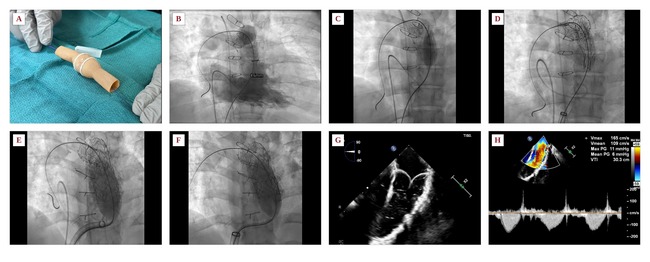
The patient was immediately given a bolus of intravenous (IV) unfractionated heparin and taken to the catheterization laboratory where right superficial femoral artery (SFA) occlusion  was diagnosed in the Hunter’s canal (Figure 1A) by passing a Quick-Cross catheter (Spectranetics, Colorado Springs, Colorado) over the 0.035 inch Wholey wire (Mallinckrodt, Hazelwood, Missouri) through a retrograde sheath in the left common femoral artery (CFA) and performing selective SFA injection. A 6 Fr 45 cm Pinnacle Destination sheath (Terumo Medical, Somerset, New Jersey) was passed up and over the bifurcation into the right limb. The decision was made to treat the lesion with an FDA-approved isolated pharmaco-mechanical thrombolysis-thrombectomy (IPMT) system (Trellis™ peripheral infusion system, Covidien, Mansfield, Massachusetts) (Figure 1B and 1G). We administered 15 mg of rtPA (recombinant tissue plasminogen activator) over 30 minutes through a 6 Fr 30 cm treatment zone Trellis peripheral infusion system (PIS) followed by balloon dilatation of the residual focal popliteal stenosis with 5 x 40 mm over-the-wire balloon (Agiltrac 035, Abbott Vascular, Redwood City, California). The result was a straight-line flow to the distal foot with three-vessel run-off (Figure 1C). In order to evaluate the severity of disease in the LLE, angiography was performed, which revealed a focal severe thrombotic occlusion of the left SFA (Figure 1D). It was deemed important to be treated in the same setting rather than resorting to catheter-directed thrombolysis (CDT), as the same IPMT device can be used and it would also decrease the risk of hemorrhage from systemic thrombolytic exposure with CDT. Access-site hemostasis was achieved in the left CFA with a Perclose™ (Abbott Vascular) closure device.
Next, anterograde access to the left CFA was obtained with a micropuncture system (Navilyst, Glens Falls, New York) and the left SFA occlusion (Figure 1D) was confirmed angiographically and crossed using a Hi-Torque Wholey wire and Quick-Cross catheter. A total dose of 15 mg of rtPA was administered through the 6 Fr 30 cm treatment zone Trellis PIS with excellent results, although we identified a relatively higher baseline stenotic lesion in the left proximal popliteal artery. This was managed by deploying a 6 x 79 mm Sentinol® self-expanding stent (Boston Scientific Corp., Natick, Massachusetts) (Figure 1E), resulting in excellent flow. A massive amount of thrombus was aspirated (Figure 1F). The patient’s distal ischemia totally resolved and he had palpable distal pulses at the end of the procedure. Intraprocedure anticoagulation was managed by IV unfractionated heparin infusion after a bolus load in the emergency room in addition to 600 mg of clopidogrel and 325 mg of aspirin given in the catheterization laboratory.
The patient was kept under close observation and was discharged without any signs of compartment syndrome or any other complications after 2 days in the hospital. Discharge medications included aspirin, clopidogrel and enoxaparin, considering possible paraneoplastic thrombophilic association. At 1 and 3 months’ follow up, he has been free of claudication and his femoral and distal pulses remain palpable.
Discussion
ALI is a life-threatening condition with 9% and 15% in-hospital and 30-day mortality rates, respectively, and 15% and 25% amputation rates at discharge and 30 days.2,3 The 5-year survival rate after ALI caused by thrombosis is approximately 45%.4 Percutaneous mechanical thrombectomy (PMT) systems, although mostly successful, come with pitfalls of vessel wall damage, distal embolization and early and late recurrent thrombosis.3 Catheter-directed intra-arterial thrombolysis (CDT) is the initial treatment option for patients presenting with Rutherford category l or ll ALI5 but major bleeding, including intracranial hemorrhage resulting from systemic dispersion of a lytic agent, can dramatically increase morbidity.2 An increased overall cost eminates from prolonged infusion times combined with intensive care requirement and a possible repeat catheterization procedure.
IPMT systems (described here is the Trellis™ PIS, Figure 1G), are designed to improve on the shortcomings of both mechanical thrombectomy and catheter-based thrombolysis. This hybrid catheter device uniquely isolates the thrombolytic agent between two balloons (diameter 3–10 mm) inflated proximal and distal to the thrombotic lesion. For arterial use, it is available in a 6 Fr size and with treatment zone lengths (length between two balloons for isolation of the desired lesion from systemic circulation) of 10 and 30 cm. Next, a battery-powered compliant sinusoidal wire is inserted through the catheter and produces oscillations at 500–3,000 rpm only in the isolated zone. This process mechanically mixes the clot with the thrombolytic agent (1 mg recombinant tissue plasminogen activator/min, total 5–10 mg) and enhances rapid dissolution of the thrombus by increasing the surface area of clot exposed to the lytic agent. Lysed thrombus is then aspirated via an integral port while deflating the proximal balloon, and the inflated distal balloon prevents distal embolization. This reduces systemic dispersion of the thrombolytic agent and therefore bleeding complications and achieves rapid revascularization, avoiding prolonged infusions. The Trellis PIS has successfully proved its mettle in treating deep venous thrombosis for some time.6 However, IPMT systems in general have only rarely been used in de-novo suprainguinal arterial lesions or infrainguinal peripheral arterial bypass graft thrombosis.7,8 To our knowledge, this is the first report of its use in acute de-novo occlusion of infrainguinal arteries.
In regard to our case, the additional challenging aspect was the bilateral nature of the acute limb ischemia in the same setting, as any access through the recently treated right lower arterial tree would be proinflammatory, atherogenic and with an increased propensity to bleeding and possibly reocclusion. At the beginning of the procedure, the preference was to treat the more severely affected limb emergently and impeccably; with that in mind, the best approach was to utilize the contralateral limb for vascular access due to ease of maneuverability and familiarity. Moreover, the possibility of a higher occlusion of the right SFA involving its bifurcation from the right CFA could not be excluded and could have created complications or delay in gaining vascular access. We chose not to use CDT for either limb due to a major hemorrhagic complication rate of 11.9% in the NATALI (National Audit of Thrombolysis for Acute Limb Ischemia) registry,9 and 12.5% in the thrombolytic cohort from the TOPAS (Thrombolysis or Peripheral Arterial Surgery) trial.2 By instilling the thrombolytic agent between the proximal and distal balloons, which isolates the area receiving the thrombolytic agent, protection from hemorrhagic complications was afforded by preventing systemic thrombolysis. Another possible traditional approach would be to use percutaneous mechanical thrombectomy devices such as the Angiojet rheolytic thrombectomy system (Medrad Interventional/Possis, Minneapolis, Minnesota). With bilateral lower-extremity vascular compromise, it was prudent and more judicious to try to prevent the smallest probability of distal embolization, thus the decision was made not to use mechanical thrombectomy. as it carries a greater than 14% risk of ipsilateral vessel wall damage resulting in relatively limited short- and long-term patency.10
Conclusion
We report the first case of de-novo infrainguinal arterial occlusion successfully treated with the Trellis IPMT system, the only device that has the ability to isolate lytic infusion in combination with mechanical thrombus fragmentation. In addition, the bilateral nature of the disease was a therapeutic challenge, which was well managed by the chosen approach, allowing adequate limb revascularization in a single interventional setting while preventing major bleeding, prolonged intensive care unit stay and distal embolization.
References
1. Rutherford RB, Baker JD, Ernst C, et al. Recommended standards for reports dealing with lower extremity ischemia: Revised version. J Vasc Surg 1997;26:517.
2. Ouriel K, Veith FJ, Sasahara AA. A comparison of recombinant urokinase with vascular surgery as initial treatment for acute arterial occlusion of the legs. Thrombolysis or Peripheral Arterial Surgery (TOPAS) Investigators. N Engl J Med 1998;338:1105–1111.
3. Dormandy J, Heeck L, Vig S. Acute limb ischemia. Semin Vasc Surg 1999;12:148–153.
4. Aunes, Trippestad A. Operative mortality and long term survival of patients operated on for acute lower limb ischemia. Eur J Vasc Endovasc Surg 1998;15:143–146.
5. Ourial K. Acute arterial occlusion. In: Creager MA, Dzau VJ, Loscalzo J (eds). Vascular Medicine: A Companion to Braunwald’s Heart Disease. Philadelphia: Elsevier, 2006, pp. 669–676.
6. Arko FR, Davis CM 3rd, Murphy EH, et al. Aggressive percutaneous mechanical thrombectomy of deep venous thrombosis: Early clinical results. Arch Surg 2007;142:513–518; discussion 518–519.
7. Sarac TP, Hilleman D, Arko FR, et al. Clinical and economic evaluation of the Trellis thrombectomy device for arterial occlusions: Preliminary analysis. J Vasc Surg 2004;39:556–559.
8. Kasirajan K, Ramaiah VG, Diethrich. The Trellis thrombectomy system in the treatment of acute limb ischemia. J Endovasc Ther 2003;10:317–321.
9. Thomas SM, Gaines PA. Vascular surgical society of Great Britain and Ireland: Avoiding the complications of thrombolysis. Br J Surg 1999;86:710.
10. Kasirajan K, Haskal Z, Ouriel K. The use of mechanical thrombectomy devices in the management of acute peripheral arterial occlusive disease. J Vasc Interv Radiol 2001;12:405–411.
———————————————————
From the Cardiovascular Section, University of Oklahoma Health Sciences Center, Oklahoma City, Oklahoma.
Disclosures: Dr. Hennebry discloses that he has been a carotid stenting proctor for Abbott Vascular.
Manuscript submitted July 6, 2010, provisional acceptance given August 9, 2010, final version accepted September 13, 2010.
Address for correspondence: Thomas A Hennebry, MB, BCh, BAO, FACC, FSCAI, 920 S.L. Young Blvd., W.P. 3010, Oklahoma City, OK 73104. E-mail:thomas-hennebry@ouhsc.edu