Review
Coronary Artery Dissection and Perforation Complicating Percutaneous Coronary Intervention
September 2004
Percutaneous coronary intervention (PCI) is increasingly utilized in the treatment of coronary artery disease. Despite its numerous benefits, serious and potentially life-threatening complications of PCI can occur, including iatrogenic coronary dissection and perforation. Up to 30% of all conventional balloon angioplasties result in angiographically significant coronary artery dissection.1,2 In recent registries, perforation has been reported to occur in 0.3–0.6% of all patients undergoing PCI.3–6 The incidence of these complications has been augmented by the development of coronary interventional devices intended to remove or ablate tissue, such as transluminal extraction coronary atherectomy, directional coronary atherectomy, excimer laser coronary angioplasty and high-speed mechanical rotational atherectomy. We herein review the incidence, pathogenesis, clinical sequelae and management of coronary artery dissection and perforation in the current era.
Coronary artery dissection. Percutaneous coronary intervention, which depends upon mechanical dilatation of the artery or ablation of atherosclerotic plaque, is requisitely associated with plaque fracture, intimal splitting and localized medial dissection — these tears may extend into the media for varying distances, and may even extend through the adventitia resulting in frank perforation.
The National Heart, Lung and Blood Institute (NHLBI) classification system for intimal tears, developed by the Coronary Angioplasty Registry, was put forth in the pre-stent era for the classification of dissection types after balloon angioplasty. Dissections in this scheme are graded based upon their angiographic appearances as types A through F7 (Figure 1).
Type A dissections represent minor radiolucent areas within the coronary lumen during contrast injection with little or no persistence of contrast after the dye has cleared. Type B dissections are parallel tracts or a double lumen separated by a radiolucent area during contrast injection, with minimal or no persistence after dye clearance. Type C dissections appear as contrast outside the coronary lumen (“extraluminal cap”) with persistence of contrast after dye has cleared from the lumen. Type D dissections represent spiral (“barber shop pole”) luminal filling defects, frequently with excessive contrast staining of the dissected false lumen. Type E dissections appear as new, persistent filling defects within the coronary lumen. Type F dissections represent those that lead to total occlusion of the coronary lumen without distal antegrade flow. In rare cases, a coronary artery dissection my propagate retrograde and involve the ascending aorta.8
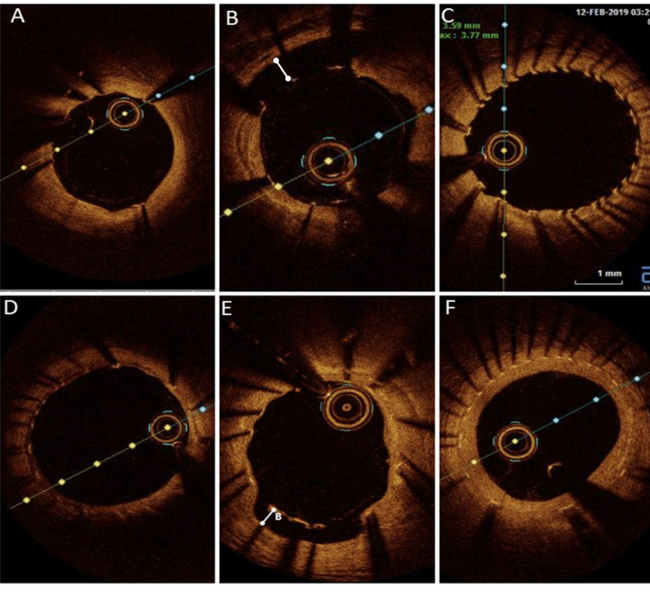
Numerous studies performed prior to the common use of stents found that, in general, type A and B dissections are clinically benign and do not adversely affect procedural outcome. However, types C through F are considered major dissections and carry a significant increase in morbidity and mortality.1,9 Acute vessel closure is the most feared complication due to coronary artery dissection, and in the pre-stent era occurred in up to 11% of all elective PTCAs.10–13 With the advent of coronary stents, the incidence of acute closure in elective PCI is now less than 1%.14 Ischemic complications in the current era usually occur as manifestations of edge dissections after stenting, which may predispose to stent thrombosis. Given the uncertainty of predicting the behavior of edge dissections after PCI, it is considered prudent to treat these with additional stent deployment, if technically feasible (Figure 2).
Assuming a guidewire may be passed into or resides concurrently within the true lumen of a dissected coronary artery, dissections in the current era can usually be managed by deployment of stents sufficient to “tack-up” the dissection flap. Given the propensity of dissections to propagate distal with antegrade coronary flow, the operator should seek to contain and cover the distal extent of the dissection as soon as possible with a stent to prevent further extension. If a dissection extends into a terminal branch too small to accommodate a stent, it may be impossible to rescue the entire artery.
Multiple studies in the pre-stent era have identified risk factors for the development of coronary artery dissection. Angiographic predictors include calcified lesions,15 eccentric lesions,16 long lesions,15 complex lesion morphology (ACC/AHA type B or C)17 and vessel tortuosity.16 Patients with acute myocardial infarction or unstable angina have evidence of coronary dissection in as many as 28% of cases, which despite prolonged balloon inflations, predisposes to subsequent subacute thrombosis.18 A balloon to artery ratio > 1.2 also predisposes to dissection.16 In addition, Amplatz guide catheters are often used for better support during PCI; however, they appear to have a higher rate of coronary dissection, likely due to “deep seating” during engagement of the coronary ostium.8
Although rare, it is worth mentioning that coronary artery dissection can occur spontaneously and may involve single or multiple coronary arteries. The incidence of spontaneous coronary dissection occurs at rates of 0.1–0.28% of all angiographic studies.19,20 Blunt trauma,21 cocaine use22 and extension of aortic dissection23 have also been reported to result in coronary dissection. There are over fifty cases in the literature reporting spontaneous coronary dissection during late pregnancy and the early postpartum period.24,25 Systemic illnesses may also predispose to coronary dissection such as connective tissue disorders,26 Marfan’s syndrome,27 Kawasaki’s disease26 and alpha-1-antitrypsin deficiency.28 In general, spontaneous coronary dissection is a life-threatening condition; however, in those surviving the initial event, the survival rate is reported to be 78%–82%.29,30
Specifically, DeMaio et al published a review of 83 cases of spontaneous coronary dissection reported in English language journals. Of these, 62 were diagnosed postmortem, yielding a presumed acute mortality rate of 75%. They subsequently characterized 32 patients with an antemortem diagnosis of spontaneous coronary dissection (21 from the aforementioned published cases and 11 from regional telephone enquiries in the Atlanta, Georgia area). Follow-up was available in 28 patients. At a mean follow up of 38 months (range 1.5–144), 23 patients were alive (82% survival).29
More recently, Tsimikas et al reviewed the clinical presentation of 65 cases of spontaneous coronary dissection reported in the literature since 1993 and suggested that outcomes have improved due to earlier recognition of this entity. Of the 65 patients reported,51 78% were described as surviving the acute event. Therefore, the inferred acute mortality rate was 22%. This may represent an actual decrease in acute mortality due to earlier detection, or could merely represent recent underreporting of acute mortality cases.30
Of note, beta irradiation appears to impair healing of coronary dissections during PCI as determined by intravascular ultrasound follow-up.31 This is an important implication in our era of in-stent restenosis. Although unproven, it may be prudent to stent any angiographically apparent dissections after brachytherapy, provided an extended course of antiplatelet therapy is administered.32
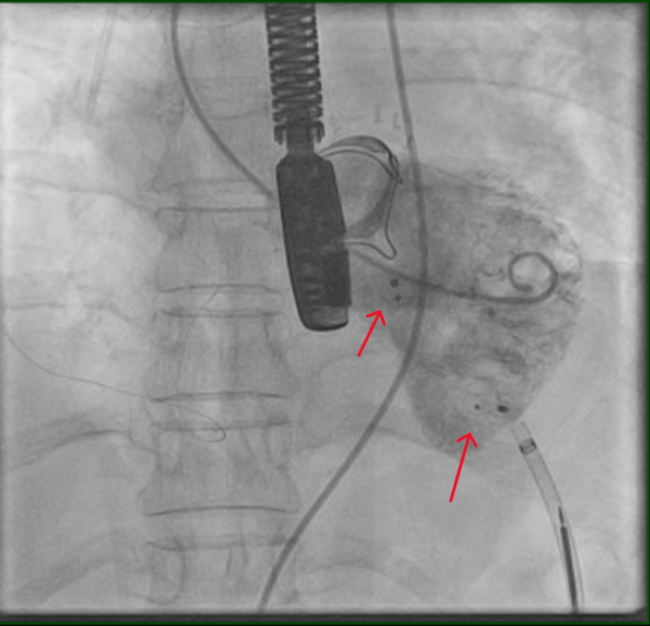
Coronary artery perforation. Coronary perforation occurs when a dissection or intimal tear propagates outward sufficient to completely penetrate the arterial wall. A significant risk factor for perforation during PTCA is the balloon to artery ratio. In the report by Ajluni et al balloon perforations occurred from a measured balloon to artery ratio of 1.3 ± 0.3, which was significantly larger than the balloon to artery ratio of 1.0 ± 0.3 for other lesions in which perforation did not occur (p 1.1 was shown to result in a 2–3 fold increase in severe dissection leading to abrupt closure compared to a balloon/artery ratio 1 mm) perforation; or Type III “cavity spilling” (CS) referring to Type III perforations with contrast spilling directly into either the left ventricle, coronary sinus or other anatomic circulatory chamber. (Figures 4 and 5) Interestingly, the Ellis Type I perforation is angiographically identical to the previously described NHBLI Type C dissection, reinforcing the notion that a continuum exists between dissection and perforation. The use of devices intended to remove or ablate tissue were associated with higher perforation rates than PTCA alone (1.3% vs. 0.1%). Women and the elderly were also at increased relative risk. The investigators reported that Type I perforations were associated with no deaths or myocardial infarction, and tamponade in 8%. Type II perforations, when treated with a prolonged balloon inflation, resulted in no deaths and a low incidence of adverse sequelae (myocardial infarction in 14%, tamponade in 13%). Type III perforations were associated with the rapid development of cardiac tamponade (63%), the need for urgent bypass surgery (63%) and a high mortality (19%). Type III “cavity spilling” perforations, however, were associated with less catastrophic consequences (no deaths, myocardial infarction or tamponade resulted).
In another large retrospective analysis, Ajluni et al reviewed 8,932 PCIs in which coronary artery perforation was reported in 35 (0.4%).3 Perforations were classified angiographically as a: 1) free perforation, defined as free contrast extravasation into the pericardium (Ellis Type III); or 2) contained perforation, defined as a contained extraluminal blush or localized rounded crater of contrast extending outside the contrast-filled vascular lumen (Ellis Type I or II). Concurrent with prior reports, Ajluni et al. found that overall clinical outcomes were worse for patients with free perforations (tamponade 20%, CABG 60%, death 20%) than with contained perforations (tamponade 6%, CABG 24%, death 6%). The presence of complex (ACC/AHA type B2 or C) lesion morphology was more frequent in lesions associated with perforation, as were chronic total occlusions, bifurcation lesions, and moderate-severe angulation or tortuousity. Again, the use of devices intended to remove or ablate tissue were associated with higher perforation rates than PTCA alone. Two recent registries of cutting balloon angioplasty report a low incidence of perforation with this device.36,37
Both Ellis and Ajluni reported that in some cases of perforation, sudden cardiovascular collapse could ensue in the 24 hours after PCI from the development of delayed hemorrhagic pericardial effusions. Thus, vigilance and in-hospital observation is warranted for any patient with coronary perforation.
The largest consecutive series from a single center, the Washington Hospital Center, by Gruberg et al reported that out of 30,746 patients who underwent PCI during a 9-year period, 88 (0.29%) were complicated by coronary artery perforations.6 Perforations were more common in complex lesions and those with moderate to severe vessel tortuousity. Although the severity of perforations was not classified angiographically as in the reports by Ellis and Ajluni, the overall morbidity and mortality associated with coronary perforation was comparable: tamponade 31%, myocardial infarction 35%, emergency surgery 39%, and death 10%.
Contemporary incidence of perforation in setting of GP IIb/IIIa inhibitors. The reports by Ellis and Ajluni and to some degree Gruberg were published before the widespread use of adjunctive glycoprotein IIb/IIIa inhibitors during percutaneous intervention. To evaluate the impact of these adjunctive antiplatelet regimens in concert with new atheroablative devices on the incidence and management of coronary perforation, Dippel et al examined 6,214 PCIs from 1995 to 1999,6 36 (0.58%) perforations occurred and were graded by the Ellis criteria outlined above. Those patients with perforation more often had congestive heart failure (22.2% vs. 11.1%, p = 0.028), but coronary lesion angiographic characteristics including calcification, eccentricity, angulation and ACC/AHA lesion class were not predictive of perforation. The use of atheroablative techniques resulted in a higher incidence of perforation (odds ratio of 16.3) and an increased severity of perforation type (odds ratio 28.9 for development of Type III perforation in atheroablative versus nonatheroablative techniques). Surprisingly, no association existed between abciximab use with either the incidence or the angiographic classification of coronary perforation. Concurrent with report by Ellis, Type I and Type II perforations were associated with low complication rates (Type I, 0% tamponade, urgent CABG and death; Type II, tamponade 5.3%, 0% death and urgent CABG). Conversely, patients with Type III perforations had significant morbidity and mortality (tamponade 42.9%, urgent CABG 50.0% and death 21.4%,). Type III cavity spilling perforations resulted in no tamponade, urgent CABG or death.
Dippel et al conclude that the therapeutic strategy employed to treat coronary perforation is best determined by the specific angiographic classification for perforation. An algorithm for the management of coronary perforation complicating PCI with adjunctive abciximab administration is proposed, but this has not been prospectively evaluated. It involves an approach similar to that outlined in the management section of this review. They also advise against the deployment of a noncovered stent at the site of the perforation, given that it may prevent the vessel’s normal ability to vasoconstrict and seal the perforation. The clinical outcomes of the aforementioned studies as categorized by perforation type are summarized in Table 1.
Management. An algorithm outlining the management of coronary artery dissection and perforation as detailed below may be found in Figure 6.
The management of coronary artery dissection in the current era consists primarily of stent deployment. Stenting remains the most important measure used for the treatment of coronary dissection, abrupt vessel closure and minimizing ischemic complications.38 As mentioned previously, the operator should seek to contain and cover the distal extent of the dissection as soon as possible with a stent to prevent further extension. This is accomplished more readily if a guidewire resides within the true lumen at the time of dissection. If not, there are several techniques that are useful in rewiring the true lumen. If the dissection occurs at an ostial location, one must often disengage the guide in an attempt to rewire the true lumen from the aorta. If a wire is passed into the false lumen, it may be prudent to leave it in place, and bring down a second wire — the wire in the false lumen may deflect the tip of the second wire into the true lumen. In fact, any technique which alters the wire bias (such as an over-the-wire balloon or “wiggle wire”) may aid in the wiring of a true lumen. If attempts to wire the true lumen are unsuccessful, and a sizeable territory of myocardium remains ischemic, urgent bypass surgery must be considered.
In the advent of a coronary perforation, conservative management should be attempted initially and is achieved with prolonged balloon inflation, and reversal of anticoagulation for severe perforations. A balloon (with a balloon to artery ratio ~1.0) should initially be positioned over the site of contrast extravasation and inflated for at least 10 minutes. If the patient is unable to tolerate ischemia during balloon inflation, a perfusion balloon should be used. Perfusion balloons allow distal vessel perfusion, thereby reducing ischemia during prolonged inflations.39
Emergent echocardiography should be performed at the first sign of perforation, and if clinical evidence of tamponade is apparent, immediate pericardiocentesis should be performed. Given the evidence that frank perforation with pericardial tamponade may occur in the first 24 hours after a threatened perforation that is apparently sealed in the catheterization laboratory, close clinical observation and repeat echocardiography within 12 to 24 hours is warranted or sooner if hemodynamic compromise is manifest.
Although hemodynamic collapse after coronary artery perforation is generally caused by the rapid development of cardiac tamponade from blood extravasation into the pericardial space, cardiogenic shock has been reported to occur from a localized subepicardial hematoma. This is felt to occur more commonly in patients with previous coronary artery bypass surgery, in whom epicardial-pericardial adhesions exist.40
Initial efforts to seal a perforation should be undertaken while the patient remains anticoagulated with heparin to prevent vessel thrombosis, although platelet IIb/IIIa receptor antagonists should be discontinued once perforation occurs. If reversal of anticoagulation is clinically warranted in the setting of a major perforation, the pharmacologic reversal of heparin should be performed. This is most commonly achieved through the intravenous administration of protamine sulfate. In the absence of prior NPH-insulin use, the incidence of adverse reactions to protamine (such as hypotension and bradycardia) are minimal. Platelet transfusion should be employed for reversal of abciximab antiplatelet effect. In the presence of normal renal function, infusions of small molecule glycoprotein IIb/IIIa inhibitors such as eptifibatide and tirofiban may be stopped with prompt reversal given their short half-lives.
There have been numerous reports describing the use of polytetrafluoethylene (PTFE)-covered stents to treat coronary perforations which fail to seal despite prolonged balloon inflations and reversal of anticoagulation.41–43 In hemodynamically compromising perforations complicating coronary interventions, PTFE-covered stents can be used emergently with a high success rate and may be life-saving where other conventional treatment modalities are associated with high morbidity and mortality (Figure 7).
Briguori et al reported a high success rate using the PTFE-covered Jostent (Abbott Laboratories, Abbott Park, Ill.) in a series of patients (n = 12) with perforations during PCI compared to a matched control group (n = 17) treated with bare stent implantation.44 The in-hospital MACE rate was significantly lower in the PTFE group, and PTFE-covered stent implantation resulted in decreased cardiac tamponade and need for bypass surgery. Because of the small size of the study and lack of routine angiographic follow-up, no firm conclusions could be drawn as to the incidence of restenosis or late stent thrombosis (2 of 7 in PTFE group had restenosis equaling 29% at 6 ± 2 months). There is to date no published report establishing the long-term patency rates of the PTFE-covered Jostent. The use of autologous vein-covered stents has been reported but remains impractical due to the prolonged time required for vein harvest and suturing of the vein graft to a stent prior to deployment.45
Although proximal or mid-vessel perforations are generally amenable to covered stent placement, distal perforations may occur, often as a result of guidewire trauma, which are not easily approached by covered stents. Hydrophilic-coated guidewires may confer an increased risk of perforation due to their low coefficient of friction and ease of distal migration.46 Surgical ligation remains a therapeutic option, although other methods have been reported. Microcoils have been deployed distally to achieve thrombosis and thus closure of the perforation.47–49 An obvious drawback of this approach is permanent loss of the vessel lumen beyond the site of microcoil placement and subsequent infarction. Therefore, this approach should be limited to life-threatening circumstances in which no other options are readily available, or for the treatment of very distal perforations where the amount of myocardium jeopardized is minimized.
Other approaches for distal vessel perforations reported include the injection of autologous clotted blood50 injection of polyvinyl alcohol form51 or Gelfoam35 through the balloon catheter lumen. For the reasons outlined previously, this technique is best reserved for distal small vessel (Conclusion. Coronary artery dissection remains a common occurrence during PCI but clinical sequelae have been minimized by the routine use of coronary stents. Perforation, although rare, can often be a life-threatening complication. Rapid recognition and attention to the angiographic appearance of the perforation is essential to the successful management of this complication. As outlined, those perforations which are “contained” angiographically carry a more benign prognosis that those which are freely extravasating contrast into the pericardium. Treatment should be aimed at sealing the perforation with prolonged conventional or perfusion balloon inflation, prudent reversal of anticoagulation and use of covered stents. Echocardiography should be performed in all cases of coronary perforation and emergent pericardiocentesis if tamponade develops. In cases where sealing of the perforation by conservative measures cannot be achieved, urgent bypass surgery must be performed.
1. Huber MS, Moony JF, Madison J & Mooney MR. Use of a Morphologic Classification to Predict Clinical Outcome After Dissection from Coronary Angioplasty. Am J Cardiol 1991;68:467-471.
2. Cowley MJ, Dorros G, Kelsey SF, et al. Acute Coronary Events Associated with Percutaneous Transluminal Coronary Angioplasty. Am J Cardiol 1984;53:12C-16C.
3. Ajluni SC, Glazier S, Blankenship L, et al. Perforations after percutaneous coronary interventions: clinical, angiographic, and therapeutic observations. Cathet Cardiovasc Diagn 1994;32(3):206-12.
4. Ellis SG, Ajluni S, Arnold AZ, et al. Increased coronary perforation in the new device era. Incidence, classification, management, and outcome. Circulation 1994;90:2725-2730.
5. Gruberg L, Pinnow E, Flood R, et al. Incidence, management, and outcome of coronary artery perforation during percutaneous coronary intervention. Am J Cardiol 2000;86(6):680-2, A8.
6. Dippel EJ, Kereiakes DJ, Tramuta DA, et al. Coronary perforation during percutaneous coronary intervention in the era of abciximab platelet glycoprotein IIb/IIIa blockade: an algorithm for percutaneous management. Cathet Cardiovasc Intervent 2001;52(3):279-86.
7. Coronary Artery angiographic changes after PTCA: Manual of Operations NHBLI PTCA Registry 1985-6:9.
8. Goldstein JA, Casserly IP, Katsiyiannis WT, et al. Aortocoronary Dissection Complicating a Percutaneous Coronary Intervention. J Invas Cardiol 2003;15:89-92.
9. Ferguson JJ, Barasch E, Wilson JM, et al. The relation of clinical outcome to dissection and thrombus formation during coronary angioplasty. J Invas Cardiol 1995;7:2-10.
10. Ramee SR, White CJ, Jain A, et al. Percutaneous coronary angioscopy versus angiography in patients undergoing coronary angioplasty. J Am Coll Cardiol 1991;17:125A.
11. Tan K, Sulke N, Taub N & Sowton E. Clinical and lesion morphologic determinants of coronary angioplasty success and complications: current experience. J Am Coll Cardiol 1995;25(4):855-65.
12. Van Belle E, Bauters C, Lablanche J-M, et al. Angiographic determinants of acute outcome after coronary angioplasty: A prospective quantitative coronary angiographic study of 3679 procedures. J Am Coll Cardiol 1994:223A.
13. Lincoff AM, Popma JJ, Ellis SG, et al. Abrupt vessel closure complicating coronary angioplasty: clinical, angiographic and therapeutic profile. J Am Coll Cardiol 1992;19(5):926-35.
14. Mehta S, Popma JJ, Margolis JR, et al. Complications with new angioplasty devices. Are these device specific? J Am Coll Cardiol 1996; March Special Issue.
15. Sharma SK, Israel DH, Kamean JL, et al. Clinical, angiographic, and procedural determinants of major and minor coronary dissection during angioplasty. Am Heart J 1993;126(1):39-47.
16. Hermans WR, Rensing BJ, Foley DP, et al. Therapeutic dissection after successful coronary balloon angioplasty: no influence on restenosis or on clinical outcome in 693 patients. The MERCATOR Study Group. J Am Coll Cardiol 1992; 20(4):767-80.
17. Bansal A, Choksi NA, Levine AB, et al. Determinants of arterial dissection during PTCA: Lesion type versus inflation rate. J Am Coll Cardiol 1989;12:229A.
18. Lincoff AM, Popma JJ, Ellis SG, et al. Abrupt vessel closure complicating coronary angioplasty: clinical, angiographic and therapeutic profile. J Am Coll Cardiol 1992;19:926-935.
19. Jorgensen MB, Aharonian V, Mansukhani P & Mahrer PR. Spontaneous coronary dissection: a cluster of cases with this rare finding. Am Heart J 1994;127:1382-1387.
20. Nishikawa H, Nakanishi S, Nishiyama S, et al. Primary coronary artery dissection observed at coronary angiography. Am J Cardiol 1988;61:645-648.
21. Masuda T, Akiyama H, Kurosawa T & Ohwada T. Long-term follow-up of coronary artery dissection due to blunt chest trauma with spontaneous healing in a young woman. Intensive Care Med 1996;22(5):450-2
22. Steinhauer JR & Caulfield JB. Spontaneous coronary artery dissection associated with cocaine use: a case report and brief review. Cardiovasc Pathol 2001;10(3):141-5.
23. Virmani R, Forman MB, Robinowitz M & McAllister HA Jr. Coronary artery dissections. Cardiol Clin 1984;2(4):633-46.
24. Koul AK, Hollander G, Moskovits N, et al. Coronary artery dissection during pregnancy and the postpartum period: two case reports and review of literature. Cathet Cardiovasc Interv 2001;52(1):88-94.
25. McKechnie RS, Patel D, Eitzman DT, et al. Spontaneous coronary artery dissection in a pregnant woman. Obstet Gynecol 2001;98(5 Pt 2):899-902.
26. Borczuk AC, van Hoeven KH & Factor SM. Review and hypothesis: the eosinophil and peripartum heart disease (myocarditis and coronary artery dissection)--coincidence or pathogenetic significance? Cardiovasc Res 1997;33(3):527-32.
27. Bonacchi M, Prifti E, Giunti G, et al. Emergency management of spontaneous coronary artery dissection. J Cardiovasc Surg 2002;43(2):189-93.
28. Davila FM, Portela MD, Rojo MG, et al. Coronary artery dissection in alpha-1-antitrypsin deficiency. Histopathology 1999;34(4):376-378.
29. DeMaio SJ, Kinsella SH & Silverman ME. Clinical Course and Long-Term Prognosis of Spontaneous Coronary Dissection. Am J Cardiol 1989;64:471-474.
30. Tsimikas S, Giordano FJ, Tarazi RY, et al. Spontaneous Coronary Dissection in Patients with Renal Transplantation. J Invas Cardiol 1999;11:316-21.
31. Kay IP, Sabate M, Van Langenhove G, et al. Outcome from balloon induced coronary artery dissection after intracoronary beta radiation. Heart 2000;83(3):332-7.
32. Waksman R, Ajani AE, White RL, et al. Prolonged antiplatelet therapy to prevent late thrombosis after intracoronary gamma-radiation in patients with in-stent restenosis: Washington Radiation for In-Stent Restenosis Trial plus 6 months of clopidogrel (WRIST PLUS). Circulation 2001;103(19):2332-5.
33. Roubin GS, Douglas JS Jr, King SB 3rd, et al. Influence of balloon size on initial success, acute complications, and restenosis after percutaneous transluminal coronary angioplasty. A prospective randomized study. Circulation 1988;78(3):557-65.
34. Ellis SG, Vandormael MG, Cowley MJ, et al. Coronary morphologic and clinical determinants of procedural outcome with angioplasty for multivessel coronary disease. Implications for patient selection. Multivessel Angioplasty Prognosis Study Group. Circulation 1990;82(4):1193-202.
35. Dixon SR, Webster MW, Ormiston JA, et al. Gelfoam embolization of a distal coronary artery guidewire perforation. Cathet Cardiovasc Intervent 2000;49(2):214-7.
36. Orford JL, Fasseas P, Denktas AE, et al. Safety and efficacy of cutting balloon angioplasty: the Mayo Clinic experience. J Invas Cardiol 2002;14(12):720-4.
37. Kondo T, Kawaguchi K, Awaji Y & Mochizuki M. Immediate and chronic results of cutting balloon angioplasty: a matched comparison with conventional angioplasty. Clinical Cardiol 1997;20(5):459-63.
38. Bergelson BA, Fishman RF & Tommaso CL. Abrupt vessel closure: changing importance, management, and consequences. Am Heart J 1997;134:362-381.
39. Stack RS, Quigley PJ, Collins G & Phillips HR 3rd. Perfusion balloon catheter. Am J Cardiol 1988;61:77G-80G.
40. Furushima H, Matsubara T, Tamura Y, et al. Coronary Artery Perforation With Subepicardial Hematoma. Cathet Cardiovasc Diagn 1997;41:59-61.
41. Ramsdale DR, Mushahwar SS & Morris JL. Repair of coronary artery perforation after rotastenting by implantation of the JoStent covered stent. Cathet & Cardiovasc Diagn 1998;45(3):310-3.
42. Cassella G, Werner F, Klauss V & Mudra H. Successful Treatment of Coronary Artery Perforation During Angioplasty Using a New Membrane-Coated Stent. J Invas Cardiol 1999;11:622-26.
43. Lansky AJ, Stone GW, Grube E, et al. A Multicenter Registry of the Jostent Coronary Stent Graft for the Treatment of Arterial Perforations Complicating Percutaneous Coronary Interventions. J Am Coll Cardiol 2000;25(2):Supplement A, 26A.
44. Briguori C, Nishida T, Anzuini A, et al. Emergency Polytetrafluoethylene-Covered Stent Implantation to Treat Coronary Ruptures. Circulation 2000;102:3028-3031.
45. Kaplan BM, Stewart RE, Sakwa MP & OíNeill WW. Repair of a coronary pseudoaneurysm with percutaneous placement of a saphenous vein allograft attached to a biliary stent. Cathet Cardiovasc Diagn 1996;37:208-212.
46. Wong CM, Kwong Mak GY & Chung DT. Distal coronary artery perforation resulting from the use of hydrophilic coated guidewire in tortuous vessels. Cathet Cardiovasc Diagn 1998;44(1):93-6.
47. Gaxiola E & Browne KF. Coronary Artery Perforation Repair Using Microcoil Embolization. Cathet Cardiovasc Diagn 1998;43:474-476.
48. Assali AR, Moustapha A, Sdringola S, et al. Successful treatment of coronary artery perforation in an abciximab-treated patient by microcoil embolization. Cathet Cardiovasc Intervent 2000;51(4):487-9.
49. Mahmud E & Douglas JS Jr. Coil embolization for successful treatment of perforation of chronically occluded proximal coronary artery. Cathet Cardiovasc Intervent 2001;53(4):549-52.
50. Hadjimiltiades S, Paraskevaides S, Kazinakis G & Louridas G. Coronary vessel perforation during balloon angioplasty: a case report. Cathet Cardiovasc Diagn 1998;45(4):417-20.
51. Yoo BS, Yoon J, Lee SH, et al. Guidewire-induced coronary artery perforation treated with transcatheter injection of polyvinyl alcohol form. Cathet Cardiovasc Intervent 2001;52(2):231-234.
52. Loubeyre C, Morice MC, Berzin B, et al. Emergency coronary artery bypass surgery following coronary angioplasty and stenting: Results of a French multicenter registry. Cathet Cardiovasc Intervent 1999;47:441-448.