Minimal residual disease (MRD) status is an increasingly important prognostic marker in multiple myeloma. New data from the phase 3 AURIGA study, presented at ASH 2025, provide detailed insights into MRD dynamics following autologous stem...
New insights into iron biology reveal that continuous suppression of toxic, reactive iron—rather than reduction of total iron stores—is critical for preventing organ damage and improving outcomes across transfusion-dependent hematologic...
Pre-apheresis lenalidomide significantly improved T-cell fitness and pharmacodynamic activity of idecabtagene vicleucel (ide-cel) in newly diagnosed multiple myeloma (NDMM), according to a KarMMa-2 cross-cohort analysis.
Cilta-cel continues to deliver high response rates in RRMM, yet early relapse remains a critical challenge. A multicenter analysis across 15 US academic institutions evaluated high-risk disease biology to identify predictors of suboptimal...
An intensified Isa-VRDc regimen achieved an 88% 18-month progression-free survival rate in newly diagnosed, double-hit multiple myeloma patients in the UK RADAR trial, signaling strong early efficacy in this ultra-high-risk population.
Immunotherapy advancements across leukemia, lymphoma, and myeloma are reshaping treatment pathways, demonstrating deeper responses, improved survival, and expanding earlier-line options for patients.
Emerging molecular diagnostics are redefining how clinicians evaluate cytopenias, bone marrow failure, and hereditary anemias, enabling more accurate diagnoses and better-informed treatment decisions.
In a panel presentation at ASH 2025, experts highlight current data on complement activity, B-cell–directed therapies, and personalized approaches for difficult-to-treat immune cytopenias.
Experts spotlight new evidence shaping the prevention and treatment of cancer-associated thrombosis, with growing emphasis on direct oral anticoagulants (DOACs) and risk-guided care.
A presentation at ASH 2025 explored recent treatment options for diffuse large B-cell lymphoma (DLBCL), highlighting the targeting of molecular subtypes using genomic profiling, monitoring techniques including PET and evaluation of minimal...
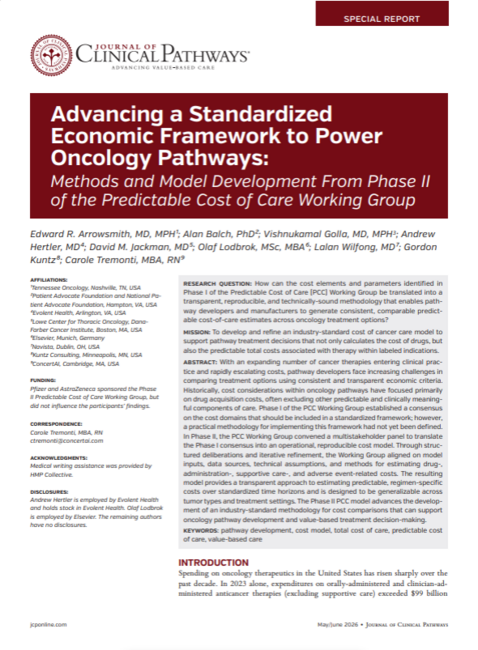
Edward Arrowsmith, MD; Vishnukamal Golla, MD, MPH; Rhonda Henschel, MBA; Andrew Hertler, MD, FACP; David Jackman, MD; Gordon Kuntz; Olaf Lodbrok, MS, MBA; Carole Tremonti, RN, MBA; Lalan Wilfong, MD
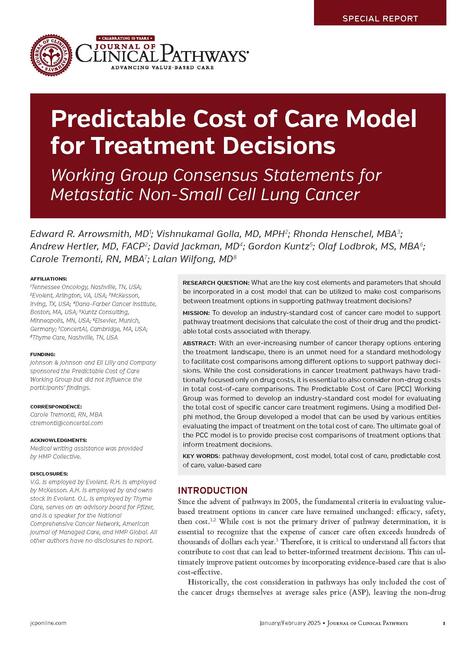
The Predictable Cost of Care Working Group developed a model that can be used by various entities evaluating the impact of treatment on the total cost of care.
Edward Arrowsmith, MD; Vishnukamal Golla, MD, MPH; Rhonda Henschel, MBA; Andrew Hertler, MD, FACP; David Jackman, MD; Gordon Kuntz; Olaf Lodbrok, MS, MBA; Carole Tremonti, RN, MBA; Lalan Wilfong, MD
The Predictable Cost of Care Working Group developed a model that can be used by various entities evaluating the impact of treatment on the total cost of care.
Robin T. Zon, MD, FACP, FASCO; Gordon Kuntz; Winston Wong, PharmD
The Journal of Clinical Pathways convened the 2021 Care Pathways Working Group to identify and reconcile the different pathway drivers for each stakeholder now and five years into the future, creating a framework tool based on oncology care...