Study results demonstrated that ‘second adjuvant’ therapy with a BRAF/MEK inhibitor improved recurrence-free survival at the cost of toxicity among patients with BRAF-mutated melanoma who experienced disease recurrence after treatment with an...
The FDA has granted an accelerated approval to lifileucel for patients unresectable or metastatic melanoma previously treated with a PD-1 blocking antibody, and if BRAF V600-positive, a BRAF inhibitor with or without a MEK inhibitor.
Results from a retrospective cohort study found that antibiotic exposure within 60 days prior to initiation of immune checkpoint blockade was associated with worse PFS and OS among patients with treatment-naïve cutaneous or mucosal melanoma.
Robin Yabroff, PhD, MBA, and Michael T. Halpern, MD, PhD, MPH, examine the documentation of cost of care discussions between physicians and patients with non–small cell lung cancer and melanoma.
In adult patients with melanoma, delays in testing for BRAF mutations affect the type of therapeutic intervention and delay initiation of treatment, according to a retrospective study that mapped BRAF testing timelines.
Study findings revealed that adjuvant ipilimumab may not be a cost-effective treatment option compared to high-dose interferon in patients with resected, high-risk melanoma.
Findings from a systematic review and meta-analysis support the diagnostic importance of dermoscopic structures associated with melanoma detection and highlight the importance of the overall pattern.
While dabrafenib–trametinib may offer incremental QALYs in patients with BRAF-mutant stage III melanoma, it is not considered a cost-effective regimen, according to study findings.
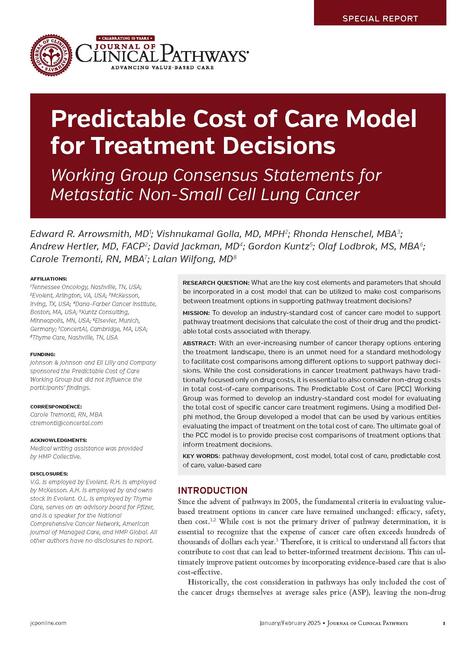
Edward Arrowsmith, MD; Vishnukamal Golla, MD, MPH; Rhonda Henschel, MBA; Andrew Hertler, MD, FACP; David Jackman, MD; Gordon Kuntz; Olaf Lodbrok, MS, MBA; Carole Tremonti, RN, MBA; Lalan Wilfong, MD
The Predictable Cost of Care Working Group developed a model that can be used by various entities evaluating the impact of treatment on the total cost of care.
Edward Arrowsmith, MD; Vishnukamal Golla, MD, MPH; Rhonda Henschel, MBA; Andrew Hertler, MD, FACP; David Jackman, MD; Gordon Kuntz; Olaf Lodbrok, MS, MBA; Carole Tremonti, RN, MBA; Lalan Wilfong, MD
The Predictable Cost of Care Working Group developed a model that can be used by various entities evaluating the impact of treatment on the total cost of care.
Robin T. Zon, MD, FACP, FASCO; Gordon Kuntz; Winston Wong, PharmD
The Journal of Clinical Pathways convened the 2021 Care Pathways Working Group to identify and reconcile the different pathway drivers for each stakeholder now and five years into the future, creating a framework tool based on oncology care...