Why Payers Have Pathways—and What “Quality Care” Really Means
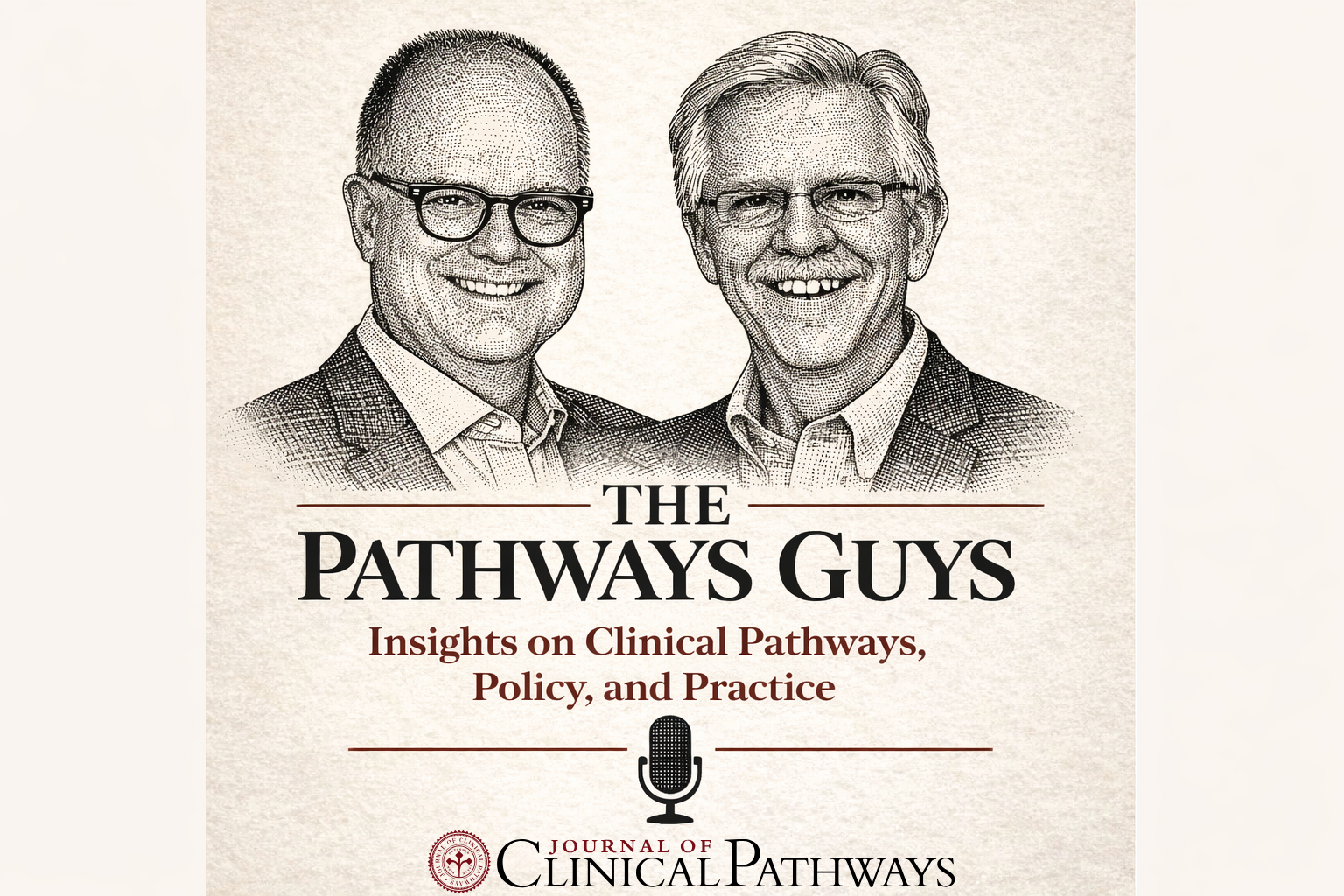
Journal of Clinical Pathways is proud to introduce The Pathways Guys podcast, hosted by Gordon Kuntz and Bryan Loy—a new podcast series exploring the real-world impact of clinical pathways on oncology policy, payment, and practice.
In this episode, Gordon and Bryan kick off the podcast with insights on clinical pathways, policy, and practice. Together, they unpack:
- Why payers have pathway programs
- How pathways balance cost, quality, and innovation
- The relationship between pathways, medical policy, and formularies
- What "quality care" really means in the payer context
Why this matters:
- For pharma market access teams: Understand the framework shaping your strategy
- For oncology practices: See the payer perspective on pathway adoption
- For medical science liaisons (MSLs) and product leaders: Provide context for your stakeholder conversations
- For pathway developers: Gain insight into payer decision-making
The following is an edited excerpt from the podcast for clarity and brevity.
Gordon Kuntz: Hi, welcome to The Pathway Guys podcast. I'm Gordon Kuntz, a consultant with 20 years of experience in the business of oncology and oncology clinical pathways.
Bryan Loy: I’m Bryan Loy, and I’m a hematopathologist who has payer experience in Medicare, Medicare Advantage, and commercial health plans.
Kuntz: Bryan and I have worked together for about 10 or 15 years. We talk frequently about all sorts of things, but often about what's happening in health care and the ecosystem of oncology. So, we decided to share our thoughts with everybody.
Every 3 weeks throughout the year, we'll be discussing a different topic in the business of oncology and pathways, payers, practices, and other relevant subjects. Sometimes we'll have guests, and sometimes it'll just be the 2 of us. We hope you enjoy the conversation and follow along.
Kuntz: Bryan, we've been talking about this for a while, and I'm really excited to be doing this podcast finally. There’s always so much to discuss. And our topic for today may be one that we continue to revisit over time. We brought this up a couple of months ago and I'm looking forward to your answer: Why do payers have pathways?
Loy: Payers don't want to delay care, and providers don't like to have unnecessary administrative burden. If you can be proactive and have accountability—meaning, you can tell your customers we're paying for good quality care and standards of care, etc—this is a way to mechanize much of that. We have the luxury of guidelines and policies, which provides a forum and a platform to be able to accomplish that.
One of the unique things about oncology relative to other disciplines of specialty medicine is that there are a lot of players. But over the last decade, it's largely been in the Part B medical oncology space. It's usually not a drug with an indication, but it's a combination of drugs, which may or may not change over time. This simplifies the process and helps all parties to accomplish what needs to be accomplished in the most efficient way. But again, it's evolved over time.
Kuntz: One of the challenges is that it's efficient maybe for the payer. For example, Bruce Gould in Georgia said he had to follow 6 or 8 pathways because he worked with different payers. And not everybody agrees. When payers have variations—or even if they agree—and providers have to go through the process on different portals, that creates a real barrier to care. Practices view it that way.
How do you reconcile a payer wanting to be more efficient and help everybody be more efficient when there are inefficiencies in the process?
Loy: What you're describing is that we have variation among payers. My sense is that has been reduced over time. If you're relying on the same compendia or the same professional association guidelines, you're going to arrive at the same universe. There may be preferences to use particular regimens in one clinical situation over another, but by and large, they're probably now more alike than they are different. But that's been an evolution.
For the scenario you described of following separate pathways for 6 different payers, if you can embed that into an electronic medical record (EMR), for example, standardize it, and let payers know what you're up to, rather than having to jump out of your EMR and into a separate portal, that barrier can be solved.
Listen to the full episode on Spotify.
Clinical Pathway Category: Business
In the inaugural episode of The Pathways Guys podcast, Gordon Kuntz and Bryan Loy examine why payers implement oncology clinical pathways and how these programs balance quality, cost, innovation, and administrative efficiency. Drawing on payer and provider perspectives, the discussion explores the relationship between pathways, medical policy, and formularies, while highlighting ongoing challenges around variation, workflow integration, and real-world adoption.