Balancing Biomechanics and Biology: TheraMicro Highlights Innovative Soft Tissue and Bone Repair Solutions at ACFAS
In the exhibit hall at the 2026 American College of Foot and Ankle Surgeons (ACFAS) Annual Scientific Conference, TheraMicro, a Memphis-based orthopedic device company, presented two product platforms centered on the principles of effective healing, biomechanical balance, and biologic activation.
In discussions at the meeting, company representatives emphasized a mechanobiological approach; restoring controlled motion in soft tissue repair and initiating organized bone regeneration where structural healing is required. The two featured technologies, TeKBrace™ Engineered Scaffold and the soon-to-be released ZOrigin™ Injectable, were positioned as unique solutions addressing ligament, tendon, and bone repair challenges frequently encountered in foot and ankle surgery.
TeKBrace™: Reinforcement Designed Around Physiologic Motion
In ligament and tendon reconstruction in the foot and ankle, particularly in procedures such as lateral ankle ligament reconstruction, deltoid repair, and Achilles augmentation, surgeons increasingly seek mechanical reinforcement that protects the repair without disrupting the biology of healing.
Traditional reinforcement strategies each present unique challenges,1-4 For example, variability in mechanical properties with allografts. In addition, rigid synthetic constructs can provide high tensile strength, but risk excessive stiffness and stress shielding. Bioabsorbable matrices may degrade before sufficient remodeling has occurred.
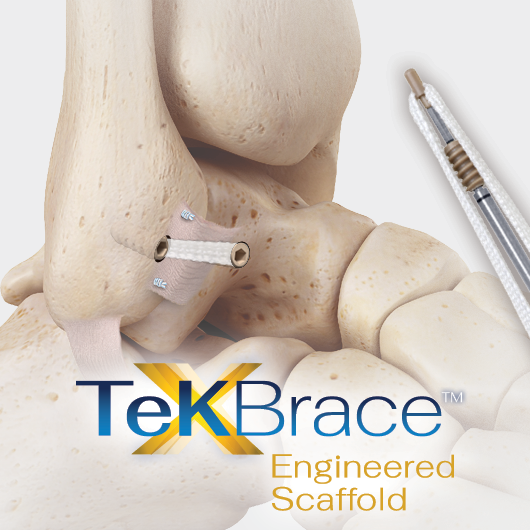
TheraMicro developed TeKBrace™ as a non-absorbable, high-porosity scaffold constructed from polyethylene terephthalate (polyester), engineered to provide controlled elongation within the physiologic range of native ligaments. The company reports that mechanical testing demonstrated stiffness values closely aligned with those published for the native anterior talofibular ligament (ATFL),3,5,6 supporting load sharing while preserving micromotion.
The importance of controlled elongation is central to the scaffold’s design philosophy. Tendons and ligaments typically tolerate elongation in a narrow physiologic window before microstructural damage occurs. According to a biomechanical overview from the company, excessive stiffness can inhibit the mechanical cues necessary for organized remodeling, while excessive elongation may compromise stability.
TeKBrace’s open-weave, hydrophilic mesh architecture is intended to facilitate cellular infiltration and nutrient diffusion while maintaining tensile strength under load. Rather than functioning solely as a mechanical patch, the scaffold is designed to serve as a biologically receptive framework during healing.
In addition to mechanical characteristics, workflow integration was emphasized in their discussions in the ACFAS exhibit hall. TeKBrace™ is available in procedure-ready kits and incorporates corded ends for controlled intraoperative tensioning and a pre-formed EasyThread tip to streamline passage through bone tunnels or anchor eyelets. The company also highlights a low-profile configuration designed to maximize contact area while minimizing bulk, an attribute particularly relevant in anatomically constrained foot and ankle procedures.
Collectively, TheraMicro shared that the scaffold reflects a design intent focused not only on strength metrics, but on restoring mechanical balance within the biologic environment of tendon and ligament healing.
ZOrigin Injectable: Initiating the Bone Healing Cascade Through Osteoinduction
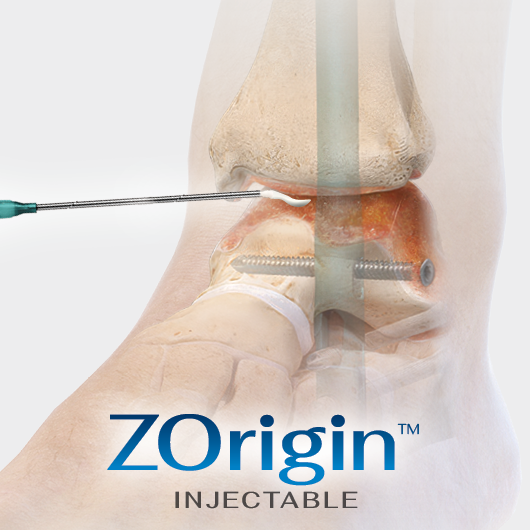
Where TeKBrace™ focuses on soft tissue reinforcement, ZOrigin™ Injectable, releasing in Mid-March, addresses the initiation of bone healing.
Described in the product brochure, ZOrigin™ is a combination injectable implant engineered around osteoinductive and osteomimetic elements intended to support organized regeneration. TheraMicro states that each production lot is verified through in vivo bioassay to confirm osteoinductive activity.
The company’s messaging centers on a foundational principle: osteoinduction represents the earliest critical step in bone repair. Without signaling that recruits osteoprogenitor cells and drives osteogenic differentiation, subsequent architectural remodeling may be unpredictable.
ZOrigin’s design integrates three coordinated elements:
• Osteoinductivity to initiate and support progenitor cell differentiation
• An osteomimetic microarchitecture intended to facilitate organized bone development
• A controlled composite structure that enables cohesive, injectable handling
The porous architecture is meant to permit cellular infiltration and gradual replacement by native bone as remodeling progresses.
From a procedural standpoint, ZOrigin™ is non-water-soluble and deliverable through an 18-gauge blunt-tip cannula. The implant may be hydrated intraoperatively with sterile saline or bone marrow aspirate (BMA), allowing surgeons to adjust viscosity while incorporating autologous biologic elements. Both open and percutaneous applications are supported.
At the ACFAS exhibit hall, TheraMicro’s discussion surrounding ZOrigin™ emphasized not simply structural fill, but the initiation of osteogenic signaling coupled with a scaffold designed to guide organized bone formation. Surgeon feedback emphasized the material’s injectable delivery, positional stability once placed, and lot-specific in vivo confirmation of osteoinductive potential.
A Coordinated Approach to Repair
A consistent theme across TheraMicro’s messaging was the integration of biomechanics and biology rather than reliance on a single performance attribute.
TeKBrace™ addresses the mechanical environment of soft tissue repair, aiming to restore near-native stiffness and controlled elongation while supporting biologic receptivity. ZOrigin™ focuses on the earliest phase of bone healing, emphasizing verified osteoinductive signaling and osteomimetic structure to initiate and guide regeneration.
For foot and ankle surgeons navigating increasing procedural complexity, minimally invasive techniques, and heightened patient expectations, this coordinated framework reflects a broader shift in musculoskeletal care. Rather than maximizing strength alone or prioritizing biologic materials without structural durability, these platforms aim to balance load-sharing mechanics with regenerative biology.
As interest grows in mechanobiologic repair strategies, the emphasis may continue to move toward technologies engineered not only to reinforce tissue, but to engage actively in the healing process itself.
For more information, navigate to TheraMicro.com.
References
1. Ratcliffe A, Butler DL, Dyment NA, et al. Scaffolds for tendon and ligament repair and regeneration. Ann Biomed Eng. 2015;43(3):819-831. doi:10.1007/s10439-015-1263-1.
2. Killian ML, Cavinatto L, Galatz LM, Thomopoulos S. The role of mechanobiology in tendon healing. J Shoulder Elbow Surg. 2012;21(2):228-237. doi:10.1016/j.jse.2011.11.002.
3. Pedowitz D, Ingwer SJ, Rigby R, et al. Native anterior talo-fibular ligament tensile characteristics compared to allograft, suture tape, and copolymer augmentation elements: a biomechanical study. J Foot Ankle Surg. 2025;64:49-53. doi:10.1053/j.jfas.2024.08.016.
4. Stańczak M, Kacprzak B, Gawda P. Tendon cell biology: effect of mechanical loading. Cell Physiol Biochem. 2024;58:677-701. doi:10.33594/000000743.
© 2026 HMP Global. All Rights Reserved.
Any views and opinions expressed are those of the author(s) and/or participants and do not necessarily reflect the views, policy, or position of Podiatry Today or HMP Global, their employees, and affiliates.