Tafasitamab Plus Lenalidomide Improves Frontline Outcomes in High-Risk Diffuse Large B-Cell Lymphoma
Clinical Summary:
- Design/Population: The global, double-blind, phase 3 FrontMIND trial randomized adult patients with previously untreated high-risk diffuse large B-cell lymphoma (DLBCL) or high-grade B-cell lymphoma to receive tafasitamab plus lenalidomide and R-CHOP or placebo plus R-CHOP.
- Key Outcomes: Tafasitamab plus lenalidomide and R-CHOP significantly improved progression-free and event-free survival compared with R-CHOP while achieving deeper molecular responses, with consistent benefit across germinal center B-cell–like and activated B-cell–like molecular subtypes. The regimen demonstrated a manageable safety profile despite a higher incidence of grade ≥3 adverse events.
- Clinical Relevance: These findings support tafasitamab plus lenalidomide and R-CHOP as a potential new frontline treatment option for patients with newly diagnosed high-risk DLBCL or high-grade B-cell lymphoma regardless of molecular subtype.
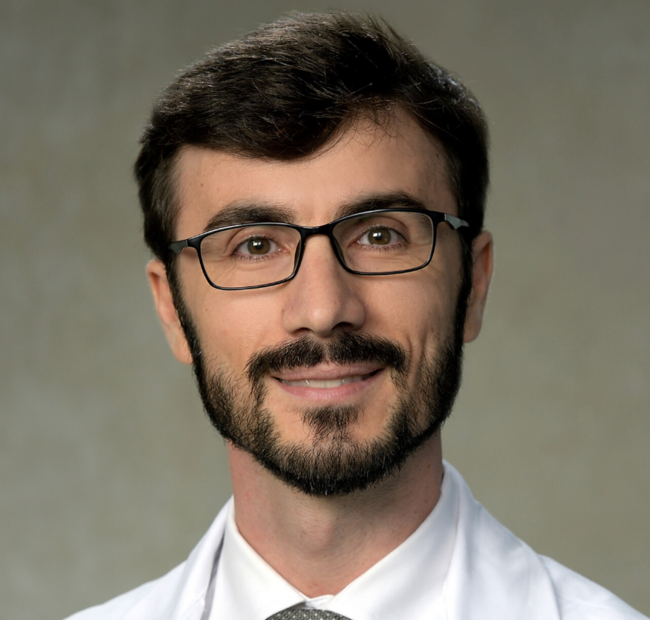
Umberto Vitolo, MD, Candiolo Cancer Institute, Turin, Italy, discusses results from the phase 3 FrontMIND trial evaluating the addition of tafasitamab and lenalidomide to R-CHOP in patients with newly diagnosed high-risk diffuse large B-cell lymphoma (DLBCL) and high-grade B-cell lymphoma.
The study demonstrated a significant improvement in progression-free survival (PFS) with the addition of tafasitamab and lenalidomide while maintaining high chemotherapy dose intensity and a manageable safety profile. Importantly, clinical benefit was observed across both germinal center B-cell–like and activated B-cell–like molecular subtypes, distinguishing FrontMIND from previous frontline studies and supporting broader applicability of this regimen.
These results were presented by Georg Lenz, MD, University Hospital Münster and German Lymphoma Alliance, Münster, Germany, at the European Hematology Association (EHA) Congress in Stockholm, Sweden.
Transcript:
Hello, good afternoon everybody. I'm Dr Vitolo from Candiolo Cancer Institute in Candiolo, in Turin, Italy, and I would like to present the results from our study. The study was recently presented in the Plenary Session at EHA and published in The Lancet.
This is a study in newly diagnosed diffuse large B-cell lymphoma at high risk, defined as patients with an IPI of 3 to 5 or patients with a short interval from diagnosis, from the time of biopsy to the start of treatment. As you know, the standard treatment for these patients is R-CHOP or Pola-R-CHP, but we still need to improve outcomes.
The goal of this study was to compare, in a phase 3, double-blind, placebo-controlled trial, standard treatment—which in this case was R-CHOP—with the addition of tafasitamab and lenalidomide, compared with placebo. Approximately 900 patients were enrolled, 899 to be exact. The primary end point of the study was progression-free survival. Secondary end points included complete response and overall survival. The study was conducted across many countries, and the results were presented a couple of weeks ago at EHA.
The primary end point of the study, progression-free survival, was met. Patients treated with tafasitamab and lenalidomide in addition to R-CHOP had significantly better progression-free survival, with a hazard ratio of 0.75. This means a 25% reduction in the risk of progression or death in patients with high-risk diffuse large B-cell lymphoma. This translated into an improvement in progression-free survival at 2 years of 8.3%, from 71% in the control arm to 82% in the experimental arm. Regarding overall survival, there was a trend toward better overall survival in patients treated with R-CHOP plus tafasitamab and lenalidomide with a hazard ratio of 0.1.
Some important points are interesting to highlight. The benefit of adding tafasitamab and lenalidomide was observed across many different subgroups. This included young and elderly patients, patients with IPI 4 to 5, as well as those with IPI 3 or age-adjusted IPI 2—that is, both intermediate-high-risk and high-risk patients. Most importantly, the benefit of adding tafasitamab and lenalidomide was observed in both the ABC subtype and the GCB subtype, based on gene expression profiling to assess cell of origin. This is an important difference compared with other trials, such as the POLARIX trial, where the benefit of polatuzumab vedotin appeared to be almost exclusively limited to patients with the ABC subtype.
It's also important to highlight the safety of this study. Of course, whenever you add additional drugs to R-CHOP, tolerability is a little worse. Indeed, we observed a higher percentage of grade 3/4 neutropenia in the experimental arm and a higher risk of infections, mainly viral infections, including COVID-19 infections, as this trial was conducted during the COVID-19 pandemic. However, despite the slight increase in toxicity, there was no impact on delivery of R-CHOP, which was superimposable between the control and experimental arms. Overall, the safety profile was reasonably good, and patients were able to complete treatment.
The complete response rate, as in the POLARIX trial, was around 62% in both arms, so there was no difference in complete response rate. However, when we assessed circulating tumor DNA, or minimal residual disease, we observed a significantly higher rate of MRD negativity, over 80% in the experimental arm compared with the control arm. This probably explains the progression-free survival benefit observed in the experimental arm because it highlights the deeper responses achieved with the addition of tafasitamab and lenalidomide to R-CHOP.
In conclusion, I would say that this study may introduce a novel standard-of-care regimen for patients with newly diagnosed high-risk diffuse large B-cell lymphoma. The addition of tafasitamab and lenalidomide to R-CHOP appears to be effective in both cell-of-origin subgroups, GCB and ABC, in both intermediate-high-risk and high-risk patients, and in both younger and older patients.
Source:
Lenz G, Trneny M, Burke JM, et al. Tafisitamab plus lenalidomide and R-CHOP for patients with previously untreated diffuse large B-cell lymphoma (DLBCL): Results from the phase 3 FRONTMIND study. Presented at EHA Congress. June 11 - June 14, 2026. Stockholm, Sweden. Abstract EHA-2190.