Volume 24 - Issue 3 - March 2012

03/01/2012
Elaleh Malakan Rad, MD; Paridokht Nakhostin Davari, MD; Hojjat Mortezaeian, MD
ABSTRACT: We report embolization of a bioabsorbable immediate-release patch for closure of atrial septal defect into left atrium with forward movement into and out of the mitral valve during each cardiac cycle. The dislodged device was...
ABSTRACT: We report embolization...
03/01/2012
Journal of Invasive Cardiology
03/01/2012
Emmanouil S. Brilakis, MD, PhD, FACC, FAHA, FESC, FSCAI; Subhash Banerjee, MD, FSCAI; Tesfaldet T. Michael, MD, MPH
ABSTRACT: We describe a novel distal “open sesame” and “hairpin wire” technique application in a right coronary artery (RCA) chronic total occlusion intervention. Antegrade wiring was successful in entering an acute marginal branch distal to...
ABSTRACT: We describe a novel...
03/01/2012
Journal of Invasive Cardiology
03/01/2012
Anupam Bhambhani, MD, DM; H. S. Somanath, MD, DM
ABSTRACT: Most cases of combination congenital cardiac anomalies are treated with open-heart surgeries because the coexisting anomalies change the cardiac anatomy in an adverse way, making catheter manipulations complex. Lutembacher syndrome...
ABSTRACT: Most cases of...
03/01/2012
Journal of Invasive Cardiology
03/01/2012
Chadi Dib, MD; Thomas A. Hennebry, MB, BCh, BAO, MD
ABSTRACT: We report 2 cases of superior vena cava (SVC) syndrome treated using isolated pharmacomechanical thrombolysis with angioplasty alone. We also propose a new staged treatment strategy to optimally manage such patients, taking into...
ABSTRACT: We report 2 cases of...
03/01/2012
Journal of Invasive Cardiology
03/01/2012
Dibya Kumar Baruah, MD; Adi Lakshmi, MD; Vidya Chandrashekaran, MD
ABSTRACT: Although uncommon, coronary artery perforation is one of the most dreadful complications of percutaneous coronary intervention, which requires prompt, aggressive, and effective management. Perforations induced by coronary guidewires...
ABSTRACT: Although uncommon,...
03/01/2012
Journal of Invasive Cardiology
03/01/2012
Jassim Al Suwaidi, MBChB; Awad Al-Qahtani, MBChB
ABSTRACT: Simultaneous occlusion of multiple epicardial coronary arteries is an uncommon finding in patients presenting with ST-segment elevation myocardial infarction (STEMI). We describe a 41-year-old male Asian patient who presented with...
ABSTRACT: Simultaneous occlusion...
03/01/2012
Journal of Invasive Cardiology
Editor's Message
03/01/2012
Richard E. Shaw, PhD, FACC
Dear Readers,The goal of the Journal of Invasive Cardiology is to provide state-of-the-art information that will support clinicians in the effective management of patients with cardiovascular disease. There are many selections in this issue...
Dear Readers,The goal of the...
03/01/2012
Journal of Invasive Cardiology
Complex Case Intervention
03/01/2012
M.P. Girish, MD, DM; Sanjay Tyagi, MD, DM; Mohit D. Gupta, MD, DM
Abstract: Patients with large intracoronary thrombi represent a difficult management problem for the interventional cardiologist. Deep guide catheter engagement and thrombus aspiration have been described but are associated with serious risk...
Abstract: Patients with large...
03/01/2012
Journal of Invasive Cardiology
Commentary
03/01/2012
Rajinder Marok, MD; Lloyd W. Klein, MD
Primary cardiac tumors are a rare clinical entity. Neoplasms of the heart include both benign and malignant histological types. With an incidence of 0.001%-0.03%, they are much less prevalent than secondary neoplasms.1 Diagnosis is frequently...
Primary cardiac tumors are a...
03/01/2012
Journal of Invasive Cardiology
Tips and Techniques
03/01/2012
Thomas W. Smith, MD; Jason H. Rogers, MD; Usman Javed, MD
Abstract: A 59-year-old male underwent coronary artery bypass grafting and mitral ring annuloplasty 4 years ago. The procedure was complicated by sternal wound infection. Recently, he presented with multiple admissions for decompensated heart...
Abstract: A 59-year-old male...
03/01/2012
Journal of Invasive Cardiology
Clinical Images
03/01/2012
Avinash Murthy, MD; Ankit Jain, MD, MBBS; Anthony G. Nappi, MD
Abstract: A fifty-year-old male had an echocardiogram for an abnormal electrocardiogram; it revealed a left ventricular mass. A cardiac catheterization revealed normal coronary arteries and a fine tumor blush of the cardiac tumor with feeding...
Abstract: A fifty-year-old male...
03/01/2012
Journal of Invasive Cardiology
03/01/2012
Kentaro Meguro, MD, PhD; Emmanuel Teiger, MD, PhD
Abstract: After transcatheter aortic valve implantation (TAVI) in a 75-year-old male, chronic wide left bundle branch block (LBBB) developed. He experienced repeated episodes of decompensated systolic heart failure with severe systolic left...
Abstract: After transcatheter...
03/01/2012
Journal of Invasive Cardiology
03/01/2012
Arik Wolak, MD; Reuben Ilia, MD; Jean Marc Weinstein, MRCP
Abstract: Objectives. The infarct-related artery (IRA) in inferior wall myocardial infarction (IMI) may be problematic to identify due to occasional instances in which the right coronary (RCA) and left circumflex (CX) arteries are both...
Abstract: Objectives. The...
03/01/2012
Journal of Invasive Cardiology
Radial Access Technique
03/01/2012
Harvey Hahn, MD; Abdul Basit, MD; Raja Nazir, MD
Abstract: A 69-year-old male presented with inferior wall ischemia. Transradial coronary angiogram with an Optitorque Jacky shape catheter showed unobstructed coronary arteries (Terumo Medical Corporation). Left ventriculography was...
Abstract: A 69-year-old male...
03/01/2012
Journal of Invasive Cardiology
Radial Access Technique
03/01/2012
Adhir R. Shroff, MD, MPH, FACC, FSCAI; Hannah Asghar, MD
Transradial coronary angiography (TRA) was introduced over 2 decades ago and has been adopted by many clinicians worldwide.1 It is becoming increasingly popular in elective and emergency situations because of lower vascular access site...
Transradial coronary angiography...
03/01/2012
Journal of Invasive Cardiology
Radial Access Technique
02/29/2012
Chirayu Vyas, MD, DM; Tejas M. Patel, MD, DM; Surya Dharma, MD, PhD; Sanjay C. Shah, MD, DM; Rajnikant Radadiya, MD; Samir B. Pancholy, MD, FACP, FACC, FSCAI
Abstract: Objectives. The aim of this study was to compare the efficacy of nitroglycerin and diltiazem versus nitroglycerin alone in preventing radial artery spasm (RAS) during transradial coronary procedures. Background. Spasm after...
Abstract: Objectives. The aim of...
02/29/2012
Journal of Invasive Cardiology
Original Contribution
02/29/2012
Yangsoo Jang, MD, PhD; Myeong-Ki Hong, MD; Byeong-Keuk Kim, MD, PhD; Jung-Sun Kim, MD; Dong-Ho Shin, MD; Young-Guk Ko, MD; Donghoon Choi, MD, PhD
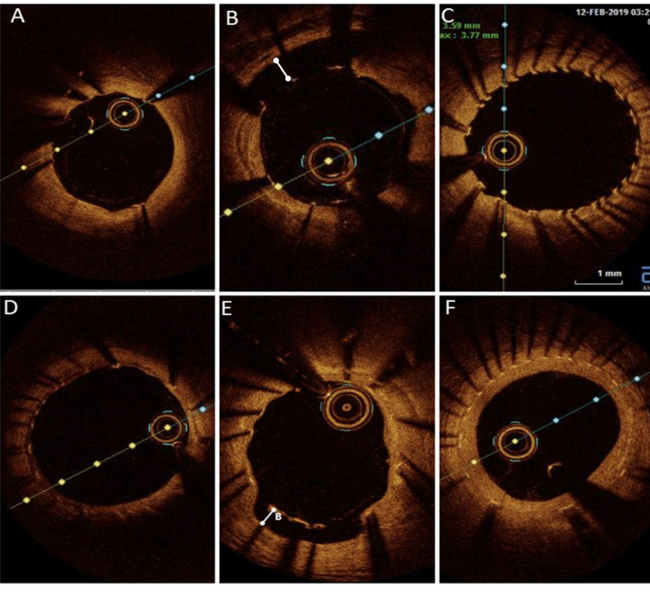
Abstract: Objective. We sought to evaluate the characteristics of in-stent restenosis (ISR) lesions with microvessels, detected by an optical coherence tomography (OCT). Background. No sufficient in vivo data exist regarding microvessel...
Abstract: Objective. We sought...
02/29/2012
Journal of Invasive Cardiology
Original Contribution
02/29/2012
Subhash Banerjee, MD, FSCAI; Emmanouil S. Brilakis, MD, PhD, FACC, FAHA, FESC, FSCAI; Aristotelis C. Papayannis, MD; Abdul-Rahman Abdel-Karim, MD; Sathyadeepak Ramesh
Abstract: Background. We sought to evaluate the findings of Fourier-domain optical coherence tomography (FD-OCT) and intravascular ultrasonography (IVUS) used for the in vivo assessment of coronary lesions. Methods. We identified 19 lesions...
Abstract: Background. We sought...
02/29/2012
Journal of Invasive Cardiology
Commentary
02/29/2012
Nicolas W. Shammas, MD, MS, FACC, FSCAI, FACP, FSVM
In a post hoc gender-based analysis of the TITAX-AMI trial,1 Tuomainen et al noted that at 3-year follow-up, females had a higher trend of major adverse events than males for the composite endpoint of cardiac death, recurrent myocardial...
In a post hoc gender-based...
02/29/2012
Journal of Invasive Cardiology
Original Contribution
02/29/2012
Matti Niemela, MD, PhD; Kari Kervinen, MD, PhD; Mikko Pietila, MD, PhD; Jussi Sia, MD; Kai Nyman, MD; Wail Nammas, MD, PhD; Antti Ylitalo, MD, PhD; Pasi P. Karjalainen, MD, PhD; Juhani K.E. Airaksinen, MD, PhD, FESC; Petri O. Tuomainen, MD, PhD
Abstract: Background. The TITAX-AMI trial demonstrated a better clinical outcome of titanium-nitride-oxide-coated bioactive stents (BAS) as compared with paclitaxel-eluting stents (PES) in patients with acute myocardial infarction (MI)...
Abstract: Background. The...
02/29/2012
Journal of Invasive Cardiology
Original Contribution
02/29/2012
Saurav Chatterjee, MD; Debabrata Mukherjee, MD, MS; Kirk N. Garratt, MD, MSc; Partha Sardar, MD
Stent restenosis remains a common complication of bare-metal stent (BMS) implantation. Even in the drug-eluting stent (DES) era, there remains a significant proportion of patients who may not be eligible for DES due to inability to comply...
Stent restenosis remains a...
02/29/2012
Journal of Invasive Cardiology
Commentary
02/29/2012
Hitinder S. Gurm, MBBS, MD, FSCAI; Michael P. Thomas, MD
Vascular access complications from diagnostic coronary angiography and percutaneous intervention are a major cause of morbidity and mortality. The use of vascular closure devices is common practice and their use to decrease complications is...
Vascular access complications...
02/29/2012
Journal of Invasive Cardiology
Original Contribution
02/29/2012
Alessandro Lupi, MD; Andrea Rognoni, MD; Gioel Gabrio Secco, MD; Maurizio Lazzero, MD; Laura Plebani, MD; Giuseppe Cossa, MD; Danilo Reale, MD; Federico Nardi, MD; Mara Sansa, MD; Angelo Sante Bongo, MD
Abstract: Background. Reported complication rates after vascular closure device deployment or femoral manual compression (MC) are similar. However, the features and severity of such complications have never been thoroughly evaluated. Methods...
Abstract: Background. Reported...
02/29/2012
Journal of Invasive Cardiology
Original Contribution
02/29/2012
Christian W. Hamm, MD, PhD, FESC; Jurrien M. ten Berg, MD, PhD; Arnoud W.J. van't Hof, MD, PhD; Renicus S. Hermanides, MD; A.T. Marcel Gosselink, MD, PhD; Gert van Houwelingen, MD; Jan-Henk E. Dambrink, MD, PhD; Pieter R. Stella, MD, PhD; Jan Paul Ottervanger, MD, PhD
Abstract: Aims. The aim of this subanalysis was to assess the net clinical effect of prehospital administration of tirofiban in ST-elevation myocardial infarction (STEMI) patients with high risk of bleeding. Methods. This is a retrospective...
Abstract: Aims. The aim of this...
02/29/2012
Journal of Invasive Cardiology