Volume 24 - Issue 11 - November 2012
Original Contribution
11/01/2012
Florim Cuculi, MD; Mabelle Young, MD; Remo Beeler, MD; Paul Erne, MD, FESC
Abstract: Introduction. Drug-coated balloons (DCBs) are increasingly used in percutaneous coronary intervention (PCI). The sequential use of DCB and bare-metal stent (BMS) represents a novel approach and results of pilot studies have been...
Abstract: Introduction. Drug-coated balloons (DCBs) are increasingly used in percutaneous coronary intervention (PCI). The sequential use of DCB and bare-metal stent (BMS) represents a novel approach and results of pilot studies have been...
Abstract: Introduction....
11/01/2012
Journal of Invasive Cardiology
Original Contribution
11/01/2012
Anna-Maria Spognardi; James R.L. Stanley, MS, DVM; Hirosada Yamamoto, MD; Emile Mehanna, MD; Wei Wang, MS; Hiram G. Bezerra, MD, PhD; Wenda C. Carlyle, PhD; Marco A. Costa, MD, PhD; James B. McClain, PhD; Guilherme F. Attizzani, MD; Daniel Chamié, MD, PhD; Yusuke Fujino, MD
Abstract: Background. Novel vascular scaffolds aim at equipoise between safety and efficacy. Intravascular optical coherence tomography (OCT) allows in-vivo serial assessment of stent-vessel interactions with high resolution and frequent...
Abstract: Background. Novel vascular scaffolds aim at equipoise between safety and efficacy. Intravascular optical coherence tomography (OCT) allows in-vivo serial assessment of stent-vessel interactions with high resolution and frequent...
Abstract: Background. Novel...
11/01/2012
Journal of Invasive Cardiology
Original Contribution
11/01/2012
Byeong-Keuk Kim, MD, PhD; Jung-Sun Kim, MD; Dong-Ho Shin, MD; Young-Guk Ko, MD; Seung-Yul Lee, MD; Donghoon Choi, MD, PhD; Yangsoo Jang, MD, PhD; Myeong-Ki Hong, MD
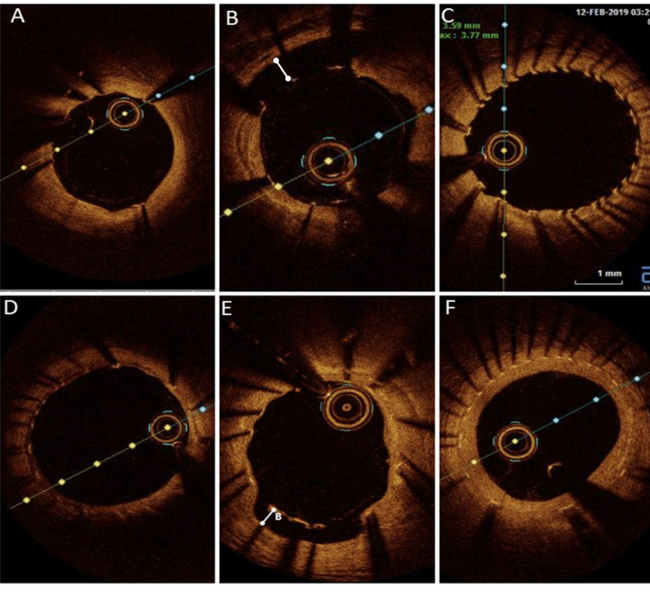
Abstract: Background. Serial changes in strut coverage of drug-eluting stents (DESs), which are placed across side-branch vessels, remain unclear. Methods. The changes in strut coverage of DESs crossing side-branch vessels (size ≥2.0 mm) were...
Abstract: Background. Serial changes in strut coverage of drug-eluting stents (DESs), which are placed across side-branch vessels, remain unclear. Methods. The changes in strut coverage of DESs crossing side-branch vessels (size ≥2.0 mm) were...
Abstract: Background. Serial...
11/01/2012
Journal of Invasive Cardiology
Original Contribution
11/01/2012
Kennosuke Yamashita, MD; Tadayuki Yakushiji, MD; Seitarou Ebara, MD; Toshitaka Okabe, MD; Myong Hwa Yamamoto, MD; Masahiko Ochiai, MD, PhD; Shigeo Saito, MD; Koichi Hoshimoto, MD; Naoei Isomura, MD; Hiroshi Araki, MD, PhD; Chiaki Obara, MD, PhD
Abstract: Objective. To investigate the efficacy and safety of a second-generation drug-eluting stent (DES) for in-stent restenosis (ISR) after first-generation DES implantation. Background. The everolimus-eluting stent is a second-generation...
Abstract: Objective. To investigate the efficacy and safety of a second-generation drug-eluting stent (DES) for in-stent restenosis (ISR) after first-generation DES implantation. Background. The everolimus-eluting stent is a second-generation...
Abstract: Objective. To...
11/01/2012
Journal of Invasive Cardiology
Original Contribution
11/01/2012
Rasha I. Ammar, MD; Ranya A. Hegazy, MD
11/01/2012
Journal of Invasive Cardiology
Original Contribution
11/01/2012
Wilma Rademacher, MD; Daniel Kretzschmar, MD; Hans-Rainer Figulla, MD; Markus Ferrari, MD; Björn Goebel, MD; Alexander Lauten, MD; Philipp Lauten, MD
Abstract: Background. Intra-aortic counterpulsation (IABP) is frequently applied to provide hemodynamic support in patients with refractory cardiogenic shock (CS) of ischemic and non-ischemic cause. However, clinical data comparing outcomes...
Abstract: Background. Intra-aortic counterpulsation (IABP) is frequently applied to provide hemodynamic support in patients with refractory cardiogenic shock (CS) of ischemic and non-ischemic cause. However, clinical data comparing outcomes...
Abstract: Background....
11/01/2012
Journal of Invasive Cardiology
Original Contribution
11/01/2012
A. Garvey Rene, MD; George D. Dangas, MD, PhD; Adam J. Saltzman, MD; Yehuda E. Paz, MD; Phillip Green, MD; Ahmed Hassanin, MD; Michael G. Argenziano, MD; Leroy Rabbani, MD
Abstract: Objective. We sought to investigate the outcomes for different treatments of pericardial effusions. Background. The optimal initial management for symptomatic pericardial effusions remains controversial. Methods. We performed a...
Abstract: Objective. We sought to investigate the outcomes for different treatments of pericardial effusions. Background. The optimal initial management for symptomatic pericardial effusions remains controversial. Methods. We performed a...
Abstract: Objective. We sought...
11/01/2012
Journal of Invasive Cardiology
Original Contribution
11/01/2012
David Black, MBBCh; Zek Lim, MD; Anthony Salmon, MD; Gruschen Veltdman, MD; Joseph J. Vettukattil, MD, MBBS, DNB, FRCPCH, FRCP; Zaheer Ahmad, MD, MBBS, MRCPCh
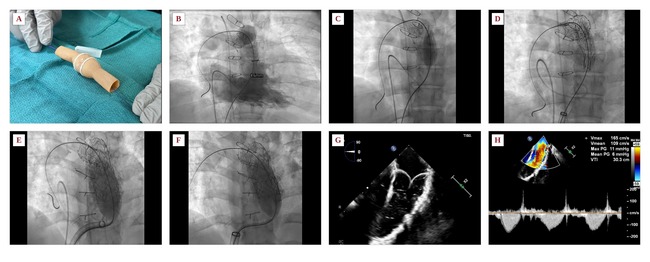
Abstract: Objective. To review the use of three-dimensional echocardiography (3DE) with multiplanar reformatting (MPR) in children with congenital aortic stensosis undergoing percutaneous balloon aortic valvuloplasty to assess its accuracy in...
Abstract: Objective. To review the use of three-dimensional echocardiography (3DE) with multiplanar reformatting (MPR) in children with congenital aortic stensosis undergoing percutaneous balloon aortic valvuloplasty to assess its accuracy in...
Abstract: Objective. To review...
11/01/2012
Journal of Invasive Cardiology
Radial Access Technique
11/01/2012
Mark D. Glazer, MD; Joseph G. Salloum, MD; John H. Cleator, MD, PhD; Robert L. Huang, MD, MPH; David X. Zhao, MD; Ehab S. Kasasbeh, MD; Babar Parvez, MD; Michele Marie Hasselblad, MSN, RN
Abstract: Objectives. To determine whether radial artery access is associated with a reduction in fluoroscopy time, procedure time, and other procedural variables over a 27-month period during which the radial artery approach was incorporated...
Abstract: Objectives. To determine whether radial artery access is associated with a reduction in fluoroscopy time, procedure time, and other procedural variables over a 27-month period during which the radial artery approach was incorporated...
Abstract: Objectives. To...
11/01/2012
Journal of Invasive Cardiology
Radial Access Technique
10/31/2012
Ji-Hyuck Rhee, MD; Sung-Woo Kwon, MD; Jung-Joon Cha, MD
Abstract: We report a case of prone position coronary angiography due to intractable back pain via left transradial approach. When a patient cannot lie down in a supine position, prone position coronary angiography can be performed...
Abstract: We report a case of prone position coronary angiography due to intractable back pain via left transradial approach. When a patient cannot lie down in a supine position, prone position coronary angiography can be performed...
Abstract: We report a case of...
10/31/2012
Journal of Invasive Cardiology
Review
10/31/2012
Rajesh Sachdeva, MD; Barry F. Uretsky, MD; Jeffrey Cook, MD
Abstract: Total occlusion of a saphenous vein graft (SVG) can present as abrupt thrombotic occlusion in an atherosclerotic graft with resultant acute cardiac events or chronic total occlusion (CTO) with resultant angina symptoms. The risks of...
Abstract: Total occlusion of a saphenous vein graft (SVG) can present as abrupt thrombotic occlusion in an atherosclerotic graft with resultant acute cardiac events or chronic total occlusion (CTO) with resultant angina symptoms. The risks of...
Abstract: Total occlusion of a...
10/31/2012
Journal of Invasive Cardiology
Rapid Communication
10/31/2012
Kathryn A. Stackhouse, BS; Athar M. Qureshi, MD, FSCAI; Lourdes R. Prieto, MD; Sachin S. Goel, MD; Samir R. Kapadia, MD; E. Murat Tuzcu, MD; Richard A. Krasuski, MD
Abstract: Background. The role of percutaneous closure of patent foramen ovale (PFO) in patients with cryptogenic stroke or transient ischemic attack remains controversial. Registry data have suggested considerable benefit of closure over...
Abstract: Background. The role of percutaneous closure of patent foramen ovale (PFO) in patients with cryptogenic stroke or transient ischemic attack remains controversial. Registry data have suggested considerable benefit of closure over...
Abstract: Background. The role...
10/31/2012
Journal of Invasive Cardiology
10/30/2012
Naveen Garg, MD, DM, DNB; Pravin Kumar Goel, MD, DM; Nagaraja Moorthy, MD, DM
ABSTRACT: Accidental introduction of air into veins can occur during a variety of surgical operations or diagnostic procedures. High mortality rate results without early diagnosis and appropriate treatment. This is due to “air lock” at the...
ABSTRACT: Accidental introduction of air into veins can occur during a variety of surgical operations or diagnostic procedures. High mortality rate results without early diagnosis and appropriate treatment. This is due to “air lock” at the...
ABSTRACT: Accidental...
10/30/2012
Journal of Invasive Cardiology
Tips and Techniques
10/30/2012
Akihiko Takahashi, MD, PhD; Shingo Sakamoto, MD; Norimasa Taniguchi, MD, PhD
Abstract: We describe a new technique for removing distal emboli that became visible on angiography during percutaneous coronary intervention for acute myocardial infarction. Three patients presented with distal embolization as a filling...
Abstract: We describe a new technique for removing distal emboli that became visible on angiography during percutaneous coronary intervention for acute myocardial infarction. Three patients presented with distal embolization as a filling...
Abstract: We describe a new...
10/30/2012
Journal of Invasive Cardiology
Clinical Images
10/30/2012
Ilana Spokoyny, MD; Marina Trilesskaya, MD; Matthew LaBarbera, MD
A 25-year-old athletic man had a ventricular fibrillation arrest while running. Electrocardiogram after defibrillation showed ST-segment elevations in leads V1 and V2 and incomplete right bundle branch block, which then normalized. Personal...
A 25-year-old athletic man had a ventricular fibrillation arrest while running. Electrocardiogram after defibrillation showed ST-segment elevations in leads V1 and V2 and incomplete right bundle branch block, which then normalized. Personal...
A 25-year-old athletic man had a...
10/30/2012
Journal of Invasive Cardiology
10/30/2012
Yoshihisa Shimada, MD, PhD; Naoto Kino, MD; Hitoshi Fukumoto, MD, PhD
ABSTRACT: A large thrombus load on the culprit coronary artery of patients with acute myocardial infarction (MI) is associated with increased procedural complications and adverse coronary events following angioplasty. This case series...
ABSTRACT: A large thrombus load on the culprit coronary artery of patients with acute myocardial infarction (MI) is associated with increased procedural complications and adverse coronary events following angioplasty. This case series...
ABSTRACT: A large thrombus load...
10/30/2012
Journal of Invasive Cardiology
10/30/2012
Ming Zhang, MD, PhD; Ranjith Shetty, MD, DM; Joshua P. Leitner, MD
ABSTRACT: We report an 88-year-old male with coronary artery disease, previously placed left main coronary artery drug-eluting stent, and atrial fibrillation unable to tolerate anticoagulation with warfarin in addition to dual antiplatelet...
ABSTRACT: We report an 88-year-old male with coronary artery disease, previously placed left main coronary artery drug-eluting stent, and atrial fibrillation unable to tolerate anticoagulation with warfarin in addition to dual antiplatelet...
ABSTRACT: We report an...
10/30/2012
Journal of Invasive Cardiology
10/29/2012
Anna G. Kostopoulou, MD; Stamatios D. Kyrzopoulos, MD; Efthimios G. Livanis, MD
ABSTRACT: We present a case of pacemaker lead dislodgment in an 83-year-old patient with a pacemaker infection. Initially, the generator and the proximal part of the leads were removed, and the remaining leads were severed and abandoned....
ABSTRACT: We present a case of pacemaker lead dislodgment in an 83-year-old patient with a pacemaker infection. Initially, the generator and the proximal part of the leads were removed, and the remaining leads were severed and abandoned....
ABSTRACT: We present a case of...
10/29/2012
Journal of Invasive Cardiology
10/29/2012
Luiz Fernando Ybarra, MD, PhD, MBA; Henrique B. Ribeiro, MD; Whady Hueb, MD, PhD
ABSTRACT: Fistulas between coronary artery and bronchial artery may be present from birth, with few hemodynamic consequences, and may remain closed due to similarity of the filling pressures at these 2 sites.1 They can also be secondary to...
ABSTRACT: Fistulas between coronary artery and bronchial artery may be present from birth, with few hemodynamic consequences, and may remain closed due to similarity of the filling pressures at these 2 sites.1 They can also be secondary to...
ABSTRACT: Fistulas between...
10/29/2012
Journal of Invasive Cardiology
10/29/2012
Keiji Tanaka, MD; Kyoichi Mizuno, MD, PhD; Hideki Miyachi, MD
ABSTRACT: Catheter-induced coronary dissection is a very rare and serious complication. We report a case of a 44-year-old man with catheter-induced bilateral coronary dissection that occurred during diagnostic coronary angiography for angina....
ABSTRACT: Catheter-induced coronary dissection is a very rare and serious complication. We report a case of a 44-year-old man with catheter-induced bilateral coronary dissection that occurred during diagnostic coronary angiography for angina....
ABSTRACT: Catheter-induced...
10/29/2012
Journal of Invasive Cardiology
Editor's Message
10/29/2012
Richard E. Shaw, PhD, FACC
This issue of the Journal of Invasive Cardiology coincides with the Annual Scientific Sessions of the American Heart Association.
This issue of the Journal of Invasive Cardiology coincides with the Annual Scientific Sessions of the American Heart Association.
This issue of the Journal of...
10/29/2012
Journal of Invasive Cardiology
10/29/2012
Halil Ibrahim Erdogan, MD; Enes Elvin Gul, MD; Hasan Gok, MD
ABSTRACT: Myocardial bridge (MB) is defined as compression of coronary artery during systole while it is normal in diastole. In angiographic series, the prevalence of this anomaly was reported between 0.5% and 2.5%. It is occasionally seen in...
ABSTRACT: Myocardial bridge (MB) is defined as compression of coronary artery during systole while it is normal in diastole. In angiographic series, the prevalence of this anomaly was reported between 0.5% and 2.5%. It is occasionally seen in...
ABSTRACT: Myocardial bridge (MB)...
10/29/2012
Journal of Invasive Cardiology