Volume 23 - Issue 12 - December 2011
Addendum
05/07/2012
Journal of Invasive Cardiology
Journal of Invasive Cardiology
In the November issue, the first author in the article listed below was inadvertently misspelled. The correct spelling is Abhishek Deshmukh. We regret this error. Commentary: Utility of Adenosine Sequelae in Primer Balloon Aortic...
In the November issue, the first author in the article listed below was inadvertently misspelled. The correct spelling is Abhishek Deshmukh. We regret this error. Commentary: Utility of Adenosine Sequelae in Primer Balloon Aortic...
In the November issue, the first...
05/07/2012
Journal of Invasive Cardiology
Editor's Message
12/02/2011
Richard E. Shaw, PhD, FACC
Dear Readers,The goal of the Journal of Invasive Cardiology is to provide state-of-the-art information that will support clinicians in the effective management of patients with cardiovascular disease. There are many selections in this issue...
Dear Readers,The goal of the Journal of Invasive Cardiology is to provide state-of-the-art information that will support clinicians in the effective management of patients with cardiovascular disease. There are many selections in this issue...
Dear Readers,The goal of the...
12/02/2011
Journal of Invasive Cardiology
12/02/2011
Aditya Kapoor, MD, DM, FACC; Pravin Kumar Goel, MD, DM; Aditya Batra, MD
ABSTRACT: We report a case of cardiac tamponade caused by a coronary microleak from an unapparent site that was successfully managed by sealing of the pericardial space with intrapericardial injection of sterile synthetic glue which, to the...
ABSTRACT: We report a case of cardiac tamponade caused by a coronary microleak from an unapparent site that was successfully managed by sealing of the pericardial space with intrapericardial injection of sterile synthetic glue which, to the...
ABSTRACT: We report a case of...
12/02/2011
Journal of Invasive Cardiology
12/02/2011
Michael P. Chrissoheris, MD; Konstantinos Spargias, MD, PhD; Angeliki Ferti, MD
ABSTRACT: Transcatheter aortic valve implantation is emerging as a promising, effective therapy for high-risk patients not eligible to undergo surgical aortic valve replacement. Infection complications have only rarely been reported. We...
ABSTRACT: Transcatheter aortic valve implantation is emerging as a promising, effective therapy for high-risk patients not eligible to undergo surgical aortic valve replacement. Infection complications have only rarely been reported. We...
ABSTRACT: Transcatheter aortic...
12/02/2011
Journal of Invasive Cardiology
12/02/2011
Hisaaki Ishiguro, MD; Toyoaki Murohara, MD, PhD; Yuji Ikari, MD, PhD, FACC, FESC
ABSTRACT: Dextrocardia with situs inversus is a rare cardiac anomaly, and the incidence of ischemic heart disease is the same as the general population. In most of these patients, interventionalists may encounter technical difficulties while...
ABSTRACT: Dextrocardia with situs inversus is a rare cardiac anomaly, and the incidence of ischemic heart disease is the same as the general population. In most of these patients, interventionalists may encounter technical difficulties while...
ABSTRACT: Dextrocardia with...
12/02/2011
Journal of Invasive Cardiology
12/02/2011
Ravi Kalaga, MD; Rajesh Sachdeva, MD; Barry F. Uretsky, MD
ABSTRACT: Because of its durability and patency, the left internal mammary artery (LIMA) is preferentially used to bypass obstructive lesions in the left main coronary artery (LMCA) and/or the left anterior descending coronary artery (LAD)....
ABSTRACT: Because of its durability and patency, the left internal mammary artery (LIMA) is preferentially used to bypass obstructive lesions in the left main coronary artery (LMCA) and/or the left anterior descending coronary artery (LAD)....
ABSTRACT: Because of its...
12/02/2011
Journal of Invasive Cardiology
12/02/2011
Danny Dvir, MD; Eyal Porat, MD; Abid R. Assali, MD; Ran Kornowski, MD
ABSTRACT: Apical complications are considered the “Achilles’ heel” of transapical aortic valve implantation, in which laceration and hemorrhage are potentially fatal. We describe the case of a rare complication of the transapical aortic valve...
ABSTRACT: Apical complications are considered the “Achilles’ heel” of transapical aortic valve implantation, in which laceration and hemorrhage are potentially fatal. We describe the case of a rare complication of the transapical aortic valve...
ABSTRACT: Apical complications...
12/02/2011
Journal of Invasive Cardiology
12/02/2011
Corrado Tamburino, MD, PhD, FESC, FSCAI; Alessio La Manna, MD; Salvatore Geraci, MD
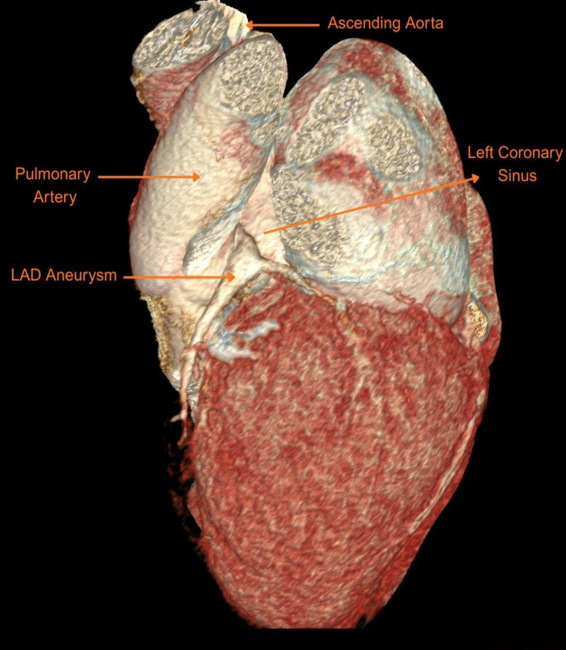
ABSTRACT: Coronary artery aneurysm is a relatively uncommon disorder characterized by coronary artery dilatation with diameter that exceeds 50% of the normal adjacent segments with atherosclerosis being the most common etiology.1 Aneurysms...
ABSTRACT: Coronary artery aneurysm is a relatively uncommon disorder characterized by coronary artery dilatation with diameter that exceeds 50% of the normal adjacent segments with atherosclerosis being the most common etiology.1 Aneurysms...
ABSTRACT: Coronary artery...
12/02/2011
Journal of Invasive Cardiology
12/01/2011
Michael C. Kim, MD; Jennifer E. Taylor-Sutton, PhD
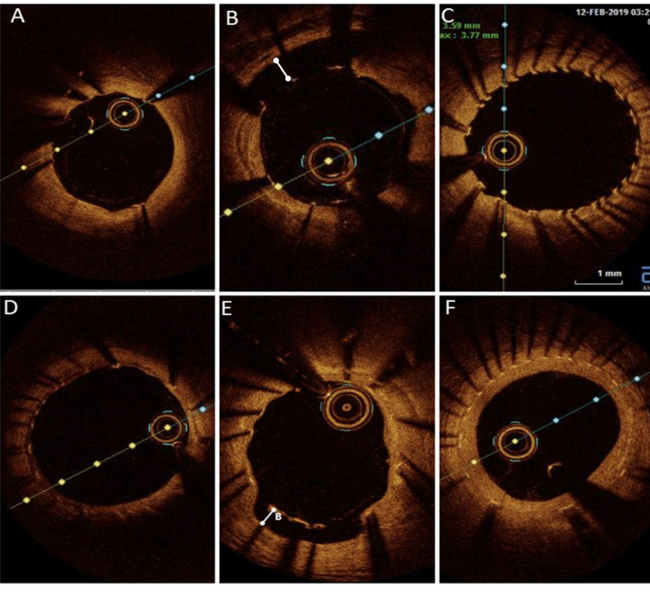
ABSTRACT: This work describes the longest reported interval between drug-eluting stent (DES) placement and very late stent thrombosis (VLST). A 69-year-old male presented with substernal chest pain associated with ST-segment myocardial...
ABSTRACT: This work describes the longest reported interval between drug-eluting stent (DES) placement and very late stent thrombosis (VLST). A 69-year-old male presented with substernal chest pain associated with ST-segment myocardial...
ABSTRACT: This work describes...
12/01/2011
Journal of Invasive Cardiology
New Techniques
12/01/2011
Faisal Latif, MD; Jigar Patel, MD; Jimmy A. Thomas, MD
Abstract: Anomalous coronary arteries pose a great challenge during percutaneous intervention due to various technical factors. Inadequate guide support leads to significant obstacles for delivery of interventional devices to stenotic areas....
Abstract: Anomalous coronary arteries pose a great challenge during percutaneous intervention due to various technical factors. Inadequate guide support leads to significant obstacles for delivery of interventional devices to stenotic areas....
Abstract: Anomalous coronary...
12/01/2011
Journal of Invasive Cardiology
Clinical Images
12/01/2011
Juergen Kammler, MD; Clemens Steinwender, MD; Franz Leisch, MD
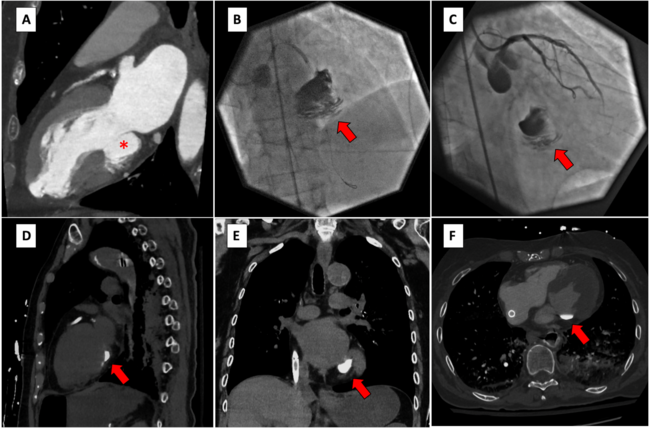
Abstract: We report on a case of a false aneurysm at the access site after transapical aortic valve replacement. Although this is not the first case report about this issue, our case emphasizes the importance of follow-up echocardiography...
Abstract: We report on a case of a false aneurysm at the access site after transapical aortic valve replacement. Although this is not the first case report about this issue, our case emphasizes the importance of follow-up echocardiography...
Abstract: We report on a case of...
12/01/2011
Journal of Invasive Cardiology
12/01/2011
Lida P. Papavasileiou, MD, PhD; Giovanni B. Forleo, MD, PhD; Francesco Romeo, MD
Abstract: Although myocardial ischemia monitored by some implantable cardioverter-defibrillators has the potential to improve patient care, no clinical experience with this novel technology has been described yet. We report for the first time...
Abstract: Although myocardial ischemia monitored by some implantable cardioverter-defibrillators has the potential to improve patient care, no clinical experience with this novel technology has been described yet. We report for the first time...
Abstract: Although myocardial...
12/01/2011
Journal of Invasive Cardiology
Review
12/01/2011
Ivica Kristic, MD; Josip Lukenda, MD, PhD
Abstract: Although transradial access (TRA) for coronary procedures has many advantages over the transfemoral approach, it’s still not the dominant route used in coronary interventions. Radial artery spasm (RAS) is an important limitation of...
Abstract: Although transradial access (TRA) for coronary procedures has many advantages over the transfemoral approach, it’s still not the dominant route used in coronary interventions. Radial artery spasm (RAS) is an important limitation of...
Abstract: Although transradial...
12/01/2011
Journal of Invasive Cardiology
Commentary
12/01/2011
Dean Ferrera, DO; Adhir R. Shroff, MD, MPH, FACC, FSCAI
The elderly are often poorly represented in major clinical trials of percutaneous coronary intervention (PCI).1 An exact definition for “elderly” varies; for instance, the 2002 ACC/AHA practice guideline for the management of acute coronary...
The elderly are often poorly represented in major clinical trials of percutaneous coronary intervention (PCI).1 An exact definition for “elderly” varies; for instance, the 2002 ACC/AHA practice guideline for the management of acute coronary...
The elderly are often poorly...
12/01/2011
Journal of Invasive Cardiology
Original Contribution
12/01/2011
Alberto Hendler, MD; Izhak Zyssman, MD; Yosef Gurevich, MD; Alex Blatt, MD; Meir Reicher, MD; Zvi Vered, MD; Ricardo Krakover, MD; Mark Katz, MD; Zyad Gabara, MD
Abstract: Background. Nonagenarians have been systematically excluded from randomized trials dealing with invasive coronary strategies, resulting in a lack of evidence-based guidelines regarding the optimal approach in this population. Aim....
Abstract: Background. Nonagenarians have been systematically excluded from randomized trials dealing with invasive coronary strategies, resulting in a lack of evidence-based guidelines regarding the optimal approach in this population. Aim....
Abstract: Background....
12/01/2011
Journal of Invasive Cardiology
Commentary
12/01/2011
P. Syamasundar Rao, MD, FACC
Since the description of successful surgical ligation of patent ductus arteriosus (PDA) by Gross and Hubbard in 1939,1 surgery has been the procedure of choice in the treatment of PDA. Surgical treatment has been shown to be safe and...
Since the description of successful surgical ligation of patent ductus arteriosus (PDA) by Gross and Hubbard in 1939,1 surgery has been the procedure of choice in the treatment of PDA. Surgical treatment has been shown to be safe and...
Since the description of...
12/01/2011
Journal of Invasive Cardiology
Original Contribution
12/01/2011
Ana Spillman, MD; Nora Bueno, MD; Ernesto Juaneda, MD; Alejandro R. Peirone, MD; Juan Diaz, MD; Alejandro Contreras, MD; Edgardo Banille, MD; Marcelo Cabrera, MD
Abstract: Purpose. To review the initial clinical outcomes of patent ductus arteriosus (PDA) closure using the new Nit-Occlud PDA-R device (NOPDA-R). Materials and methods. The NOPDA-R is a self-expandable, nitinol-made, premounted and...
Abstract: Purpose. To review the initial clinical outcomes of patent ductus arteriosus (PDA) closure using the new Nit-Occlud PDA-R device (NOPDA-R). Materials and methods. The NOPDA-R is a self-expandable, nitinol-made, premounted and...
Abstract: Purpose. To review the...
12/01/2011
Journal of Invasive Cardiology
Commentary
12/01/2011
Anjan K. Chakrabarti, MD; C. Michael Gibson, MS, MD
In 2009, the landmark Synergy between PCI with Taxus and Cardiac Surgery (SYNTAX) trial sought to establish whether coronary artery bypass grafting (CABG) or percutaneous coronary intervention (PCI) was the standard of care for patients with...
In 2009, the landmark Synergy between PCI with Taxus and Cardiac Surgery (SYNTAX) trial sought to establish whether coronary artery bypass grafting (CABG) or percutaneous coronary intervention (PCI) was the standard of care for patients with...
In 2009, the landmark Synergy...
12/01/2011
Journal of Invasive Cardiology
Original Contribution
12/01/2011
Tiziano Moccetti, MD; Giovanni B. Pedrazzini, MD; Frank Scherff, MD; Daniel Sürder, MD; Antonio Mantovani, MD; Carlo Corbacelli, MD; Elena Pasotti, MD; Catherine Klersy, MD, MSc; Angelo Auricchio, MD, PhD
Abstract: Background. The SYNTAX score (SXscore), an angiographic score reflecting coronary lesion complexity, predicts clinical outcomes in patients with left main or multivessel disease, and in patients with ST-segment elevation myocardial...
Abstract: Background. The SYNTAX score (SXscore), an angiographic score reflecting coronary lesion complexity, predicts clinical outcomes in patients with left main or multivessel disease, and in patients with ST-segment elevation myocardial...
Abstract: Background. The SYNTAX...
12/01/2011
Journal of Invasive Cardiology
Original Contribution
12/01/2011
Zhaojun Xiong, MD; Xiaoxian Qian, MD; Jieming Zhu, MD; Zhen Wu, MD; Lin Chen, MD
Abstract: Background. High serum uric acid (SUA) has been well demonstrated to be associated with morbidity and mortality in the general population as well as in patients with coronary artery disease (CAD). Recent studies show that the...
Abstract: Background. High serum uric acid (SUA) has been well demonstrated to be associated with morbidity and mortality in the general population as well as in patients with coronary artery disease (CAD). Recent studies show that the...
Abstract: Background. High serum...
12/01/2011
Journal of Invasive Cardiology
Original Contribution
12/01/2011
Rui Compante Teles, MD; Pedro de Araújo Gonçalves, MD, PhD; Manuel de Sousa Almeida, MD, PhD; João Brito, MD; Pedro Sousa, MD; Miguel Mendes, MD; Luís Raposo, MD
Abstract: Background. The SYNTAX score is a useful tool to evaluate percutaneous coronary intervention risk regarding the number, complexity, and location of lesions. Despite its proven value in the prognosis of three-vessel disease, there...
Abstract: Background. The SYNTAX score is a useful tool to evaluate percutaneous coronary intervention risk regarding the number, complexity, and location of lesions. Despite its proven value in the prognosis of three-vessel disease, there...
Abstract: Background. The SYNTAX...
12/01/2011
Journal of Invasive Cardiology