Volume 22 - Issue 8 - August, 2010

Complex Case Intervention
08/09/2010
Shinichiro Miyazaki, MD; Yoshikazu Hiasa, MD; Koichi Kishi, MD
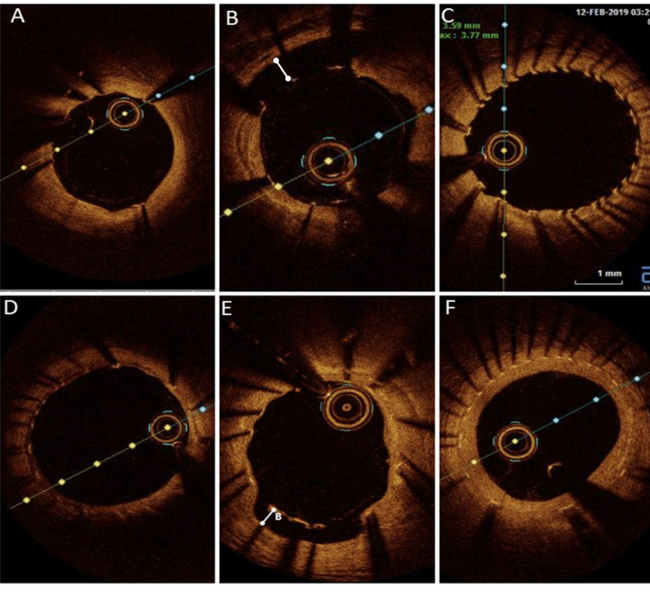
FULL TITLE: Very Late Thrombosis After Subintimal Sirolimus-Eluting Stent Implantation During Percutaneous Coronary Intervention for Chronic Total Occlusion ABSTRACT: The clinical significance of late-acquired incomplete stent apposition...
FULL TITLE: Very Late...
08/09/2010
Journal of Invasive Cardiology
Case Report
08/09/2010
Muhammad Bilal Quraishi, MD; Omar Mufti, MD; Abdul Wase, FACC, FACP, FHRS, MD, CCDS
ABSTRACT: We report a case of a complicated vascular access secondary to systemic venous defects which have not been previously reported. Further evaluation revealed congenital absence of superior vena cava with two brachiocephalic veins...
ABSTRACT: We report a case of a...
08/09/2010
Journal of Invasive Cardiology
Case Report
08/09/2010
Matthew LaBarbera, MD; Gary Milechman, MD; Fiona Dulbecco, MD
ABSTRACT: The glycogen storage diseases are a rare form of inherited metabolic disease affecting intracellular glycogen metabolism, and several studies suggest glycogen storage disease (GSD) III predisposes patients to dyslipidemia and...
ABSTRACT: The glycogen storage...
08/09/2010
Journal of Invasive Cardiology
Case Report
08/09/2010
Francesco Cappelli, MD; Simone Vignini, MD; Giorgio Jacopo Baldereschi, MD
ABSTRACT: Percutaneous placement of an inferior vena cava (IVC) filter is indicated in patients affected by pulmonary embolism or proximal deep venous thrombosis when anticoagulation therapy is contraindicated or there is evidence of...
ABSTRACT: Percutaneous...
08/09/2010
Journal of Invasive Cardiology
Case Report
08/09/2010
Stavros Hadjimiltiades, MD; George Efthimiades, MD; Panagiotis Spanos, MD
ABSTRACT: In a case of constrictive pericarditis post coronary artery bypass surgery we describe the diastolic compression of venous and arterial conduits and the timing of compression, as demonstrated during angiography, before and after...
ABSTRACT: In a case of...
08/09/2010
Journal of Invasive Cardiology
Case Report
08/06/2010
Ziad A. Jaradat, MD; Sameh M. Sayfo, MD, MBA, FABVM; Jeffrey A. Breall, MD, PhD
ABSTRACT: Background. The management strategy for hypertrophic obstructive cardiomyopathy generally begins with medical therapy. When this fails to control symptoms, consideration is given to mechanically eliminate the obstruction caused by a...
ABSTRACT: Background. The...
08/06/2010
Journal of Invasive Cardiology
Case Report
08/06/2010
Anil Dhall, MD, DM; S. K. Malani, MD, DM; Davinder S. Chadha, MD, DM
ABSTRACT: Carotid endarterectomy in the presence of an occluded contralateral artery is associated with a high risk of perioperative stroke. Carotid stenting with neuroprotection devices has emerged as a safe procedure for revascularization...
ABSTRACT: Carotid...
08/06/2010
Journal of Invasive Cardiology
Review
08/06/2010
Albert W. Chan, MD, FRCPC
ABSTRACT: Carotid stenosis is often present in patients who need cardiac surgery and is predictive of post-operative stroke. A strategy of combined carotid endarterectomy and cardiac surgery had been adopted in the past. Staged carotid...
ABSTRACT: Carotid stenosis is...
08/06/2010
Journal of Invasive Cardiology
Clinical Images
08/06/2010
David Dobarro, MD; Raúl Moreno-Gómez, MD, PhD; Santiago Jimenez-Valero, MD, PhD
J INVASIVE CARDIOL 2010;22:385 ____________________________________________________________ We present the case of a 64-year-old male who underwent cardiac catheterization because of a positive stress test. No severe narrowings were...
J INVASIVE CARDIOL...
08/06/2010
Journal of Invasive Cardiology
Editorial
08/06/2010
Gerald Dorros, MD, DSc, FACC, ScD
J INVASIVE CARDIOL 2010;22:382–384 _________________________________________________ The Department of Health and Human Services’ (DHHS) Food and Drug Administration (FDA) is well known to Americans, as are their terms “FDA approval” and...
J INVASIVE CARDIOL...
08/06/2010
Journal of Invasive Cardiology
Tips and Techniques
08/06/2010
John P. Sweeney, MD; Floyd David Fortuin, MD; B. Scott Chism, MD; Richard W. Lee, MD
ABSTRACT: The buddy wire is a useful technique for difficult-to-cross lesions that are typically identified by poor guide support, vessel tortuosity, calcification and/or prior stent placement. We present 5 cases of percutaneous coronary...
ABSTRACT: The buddy wire is a...
08/06/2010
Journal of Invasive Cardiology
Original Contribution
08/06/2010
Takashi Matsukage, MD, PhD; Toshiharu Fujii, MD, PhD; Yuji Ikari, MD, PhD, FACC, FESC; Makiyoshi Shima, MD; Yoshihiro Morino, MD; Eri Toda, MD; Teruhisa Tanabe, MD, PhD; Daiki Ito, MD; Naoki Masuda, MD; Nobuhiko Ogata, MD, PhD; Seiji Tamiya, MD
ABSTRACT: Objectives. To determine the optimal radial puncture point, we analyzed the anatomy and luminal diameter of the right radial artery (RA) by quantitative angiography. Background. Difficulty of radial puncture has impeded the...
ABSTRACT: Objectives. To...
08/06/2010
Journal of Invasive Cardiology
Commentary
08/06/2010
Navin Kumar Kapur, MD; Pranav Loyalka, MD; Duc Thinh Pham, MD
Acute right ventricular (RV) failure is a major cause of morbidity and mortality, yet is largely ignored by clinical practice guidelines. In the setting of left-sided heart failure, inferior myocardial infarction, chronic lung disease,...
Acute right ventricular (RV)...
08/06/2010
Journal of Invasive Cardiology
Original Contribution
08/06/2010
Vilem Rohn, MD, PhD; Pavel Jansa, MD; Jan Tosovsky, MD, PhD; Jan Kunstyr, MD, PhD; Michal Semrad, PhD, MD; Michal Lips, MD; Frantisek Mlejnsky; Martin Balik, MD, PhD; Jaroslav Lindner, MD, PhD; Jan Horak, MD, PhD; Andrew J.P. Klein, MD, FACC, FSCAI; Jan Belohlavek, MD, PhD; Ales Linhart, MD, PhD
ABSTRACT: Extracorporeal membrane oxygenation (ECMO) is an effective rescue method for severe respiratory and cardiac failure. Right ventricular (RV) failure with cardiogenic shock is a critical condition with generally poor prognosis unless...
ABSTRACT: Extracorporeal...
08/06/2010
Journal of Invasive Cardiology
Original Contribution
08/06/2010
Shahrzad Shareghi, MD; Joseph L. Thomas, MD, FACC, FSCAI; Christina H. Economides, MD, MM, FSCAI; Hazim Al-Ameri, MD; Guy S. Mayeda, MD; Steven Burstein, MD; Damian Grovas Abad, MD; David M. Shavelle, MD, FACC, FSCAI
ABSTRACT: Objective. We sought to describe the use of the TandemHeart percutaneous left ventricular assist device (PVAD) in a group of high-risk patients undergoing complex cardiovascular procedures. Background. There is a substantial risk...
ABSTRACT: Objective. We sought...
08/06/2010
Journal of Invasive Cardiology
Commentary
08/06/2010
Robert J. Applegate, MD
J INVASIVE CARDIOL 2010;22:358–359 ____________________________________________________________ Vascular closure devices (VCDs) were developed in the mid-1990s to provide more effective hemostasis for femoral artery access sites, largely...
J INVASIVE CARDIOL...
08/06/2010
Journal of Invasive Cardiology
Original Contribution
08/06/2010
Martin Brueck, MD; Dirk Bandorski, MD; Klaus Rauber, MD; Andreas Boening, MD
NULL
NULL
NULL
08/06/2010
Journal of Invasive Cardiology
Original Contribution
08/05/2010
Affan Irfan, MBBS; Jo-Ann Christie, BSc; Michael J.B. Kutryk, MD, PhD; Robert J. Chisholm, MD, FRCPC; Asim N. Cheema, MD, PhD; Alan J. Bagnall, MBChB, PhD; Atif Mohammad, MD; Tony Hong, BSc; Waseem Sharieff, MD, PhD; Ravi R. Bajaj, MD
NULL
NULL
NULL
08/05/2010
Journal of Invasive Cardiology