Volume 20 - Issue 5 - May, 2008

Addendum
09/09/2009
Yerem Yeghiazarians, MD; Madan Sharma, MD
RE: Stent Thrombosis – A Complication Best Avoided Originally in: J Invasive Cardiol 2008;20:166–167 (April) Please note that the medication “clopidogrel”, and not “coumadin”, should have appeared in the following sentence in the...
RE: Stent Thrombosis – A...
09/09/2009
Journal of Invasive Cardiology
Case Report
08/01/2008
Stéphane Cook, MD; Parham Eshtehardi, MD; Rainer Zbinden, MD
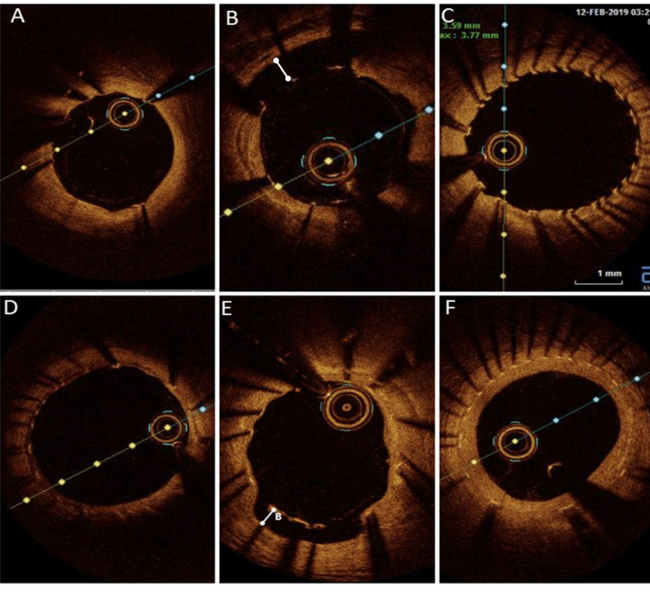
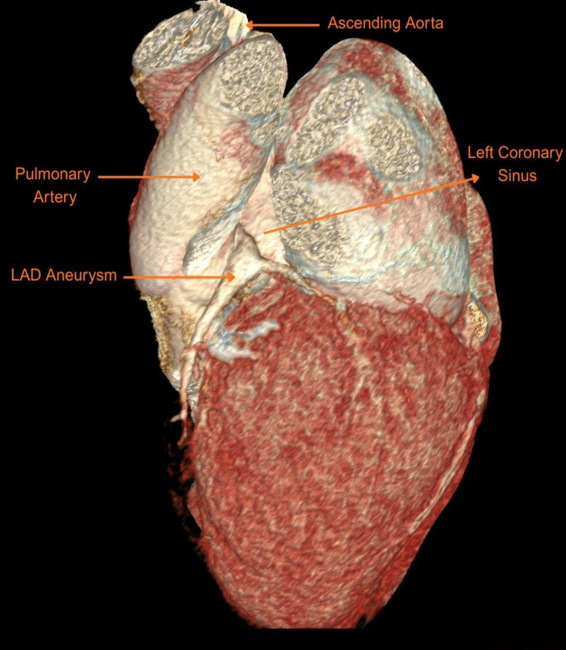
_______________________________________________ J INVASIVE CARDIOL 2008;20:E174-E175 Coronary aneurysm formation after drug-eluting stent (DES) implantation is a rare complication. It has been documented with sirolimus-eluting stents (SES)...
...
08/01/2008
Journal of Invasive Cardiology
Case Report
08/01/2008
Marcin Demkow, PhD, MD; Lukasz Kalinczuk, MD, PhD; Witold Ruzyllo, MD, PhD
_______________________________________________ J INVASIVE CARDIOL 2008;20:E139-E145 After both its acute and long-term usage proved to be highly effective, drug-eluting stent (DES) implantation, although off-label, became a preferred...
...
08/01/2008
Journal of Invasive Cardiology
Case Report
08/01/2008
Rafid Fayadh Al-Aqeedi, MD, MACC; Abdulrahman D. Al-Nabti, MD, FACC, FRCPC
_______________________________________________ J INVASIVE CARDIOL 2008;20:E146-E149 Acute myocardial infarction (AMI) is reported to occur in 3–10 cases per 100,000 deliveries.1,2 It is a rare but devastating event with a fatality rate as...
...
08/01/2008
Journal of Invasive Cardiology
Case Report
08/01/2008
Marie-Claude Morice, MD, FESC, FACC; Helen Routledge, MBChB, FRCP, MD; Thierry Lefèvre, MD; Federico De Marco, MD, PhD; Yves Louvard, MD; Jordi Balcells, MD
_______________________________________________ J INVASIVE CARDIOL 2008;20:E150-E153 Vessel perforation is a rare but dire complication of percutaneous coronary interventions (PCI) and is associated with a high risk of pericardial...
...
08/01/2008
Journal of Invasive Cardiology
Case Report
08/01/2008
Farrukh Hussain, MD, FRCPC
_______________________________________________ J INVASIVE CARDIOL 2008;20:E154-E157 We describe 2 patients — one with a left anterior descending (LAD)/diagonal bifurcation and the other with a protected distal left main bifurcation — in...
...
08/01/2008
Journal of Invasive Cardiology
Case Report
08/01/2008
Reji Pappy, MD; Mazen S. Abu-Fadel, MD; Thomas A. Hennebry, MB, BCh, BAO, MD
_______________________________________________ J INVASIVE CARDIOL 2008;20:E158-E160 Ureteroarterial fistulae (UAFs) are rare but potentially fatal entities that require prompt diagnosis and intervention. Moschowitz and colleagues were the...
...
08/01/2008
Journal of Invasive Cardiology
Case Report
08/01/2008
Inder M. Singh, MD, MS; Roopa A. Subbarao, MD; Saihari Sadanandan, MD
_______________________________________________ J INVASIVE CARDIOL 2008;20:E161-E166 Myocardial bridge (MB) is a condition that occurs when the myocardium overlies the epicardial segment of a coronary artery.1,2 The overlying myocardium is...
...
08/01/2008
Journal of Invasive Cardiology
Case Report
08/01/2008
Tywaun Tillman, MD; Reynaldo Mulingtapang, MD; John Thompson Sullebarger, MD
_______________________________________________ J INVASIVE CARDIOL 2008;20:E167-E170 Percutaneous closure of secundum atrial septal defect (ASD) and patent foramen ovale (PFO) has become a safe and effective alternative to surgery in...
...
08/01/2008
Journal of Invasive Cardiology
Case Report
08/01/2008
Gregory Piazza, MD, MS; Joanna J. Wykrzykowska, MD, PhD; Roger J. Laham, MD
_______________________________________________ J INVASIVE CARDIOL 2008;20;E171-E173 Hypertrophic obstructive cardiomyopathy (HOCM) and aortic stenosis (AS) both result in congestive heart failure symptoms, syncope and chest pain.1–3 In...
...
08/01/2008
Journal of Invasive Cardiology
Review
08/01/2008
Charles Pollack, Jr., MD
Acute ST-segment elevation myocardial infarction (STEMI) usually results from atherothrombosis, a disease process involving the rupture of an atherosclerotic plaque with subsequent thrombosis and coronary arterial occlusion at the site of the...
Acute ST-segment elevation...
08/01/2008
Journal of Invasive Cardiology
Case Report
08/01/2008
David Quintero, MD; Mazda Biria, MD; David G. Meyers, MD, MPH
Hemophilia A is an inherited X-linked recessive disorder of the intrinsic coagulation pathway which affects 1 in 10,000 males and is characterized by deficiency of factor VIII with resultant bleeding diathesis. Platelet function is normal....
Hemophilia A is an inherited...
08/01/2008
Journal of Invasive Cardiology
Case Report
08/01/2008
Marieke L. Fokkema; Pieter J. Vlaar, MSc; Tone Svilaas, MD
The primary goal of treatment in patients presenting with ST-elevation myocardial infarction (STEMI) is reperfusion of the infarcted myocardium. Percutaneous coronary intervention (PCI) has emerged as preferred reperfusion therapy for STEMI.1...
The primary goal of treatment in...
08/01/2008
Journal of Invasive Cardiology
Review
08/01/2008
Samin K. Sharma, MD, FACC, FSCAI
At the time they were introduced in 1988, the nonionic contrast agents were significantly more expensive than the previously available agents due to substantial development expenses and higher manufacturing costs. However, the improved safety...
At the time they were introduced...
08/01/2008
Journal of Invasive Cardiology
Rapid Communication
08/01/2008
Gregory M. Ayers, MD, PhD; Todd J. Cohen, MD, FACC, FHRS
It is well known that technology for electrophysiology (EP) has advanced substantially over the past two decades to include the ability to map and treat arrhythmias that originate in any of the heart chambers, including the left atrium and...
It is well known that technology...
08/01/2008
Journal of Invasive Cardiology
Rapid Communication
08/01/2008
Laurence M. Schneider, MBBCh, FRACP, MD; James R. Wilentz, MD; Gary S. Roubin, MD, PhD; Jiri J. Vitek, MD, PhD
Case Report. The patient was a symptomatic 78-year-old male with a prior history of hypertension, noninsulin-dependent type 2 diabetes, coronary artery bypass graft surgery and coronary and peripheral percutaneous intervention. The patient...
Case Report. The patient was a...
08/01/2008
Journal of Invasive Cardiology
Clinical Images
08/01/2008
Lloyd W. Klein, MD; Jaime R. Chavez, MD; Alvaro Montoya, MD
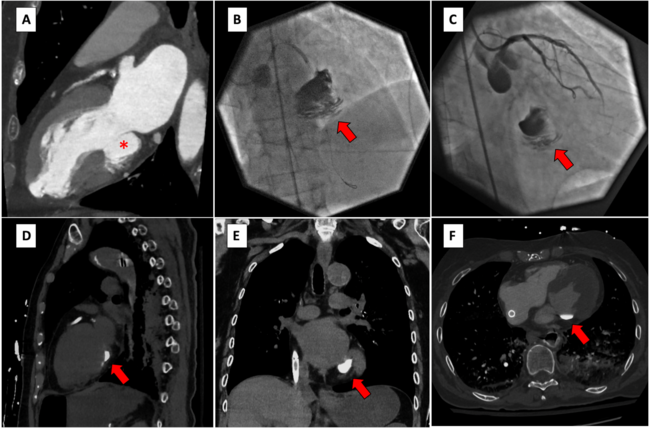
Case Presentation. A 58-year-old Asian woman presented with substernal chest pressure made worse by swallowing. This discomfort had been present for 2 years and had recently become more severe and frequent. Panel A. Computed tomographic scan...
Case Presentation. A 58-year-old...
08/01/2008
Journal of Invasive Cardiology
Letters to the Editor
08/01/2008
Ruby Satpathy, MD; Tom Lanspa, MD; Syed Mohiuddin, MD
Dear Editor, Re-do coronary artery bypass graft (CABG) surgeries are associated with increased peri- and postoperative mortality. The increasing use of these reoperations has led to the use of a variety of different kinds of grafts, e.g.,...
Dear Editor, Re-do coronary...
08/01/2008
Journal of Invasive Cardiology
Editorial Message
08/01/2008
Richard E. Shaw, PhD, FACC
This issue of the Journal of Invasive Cardiology introduces a new format which includes a special focus section to explore in more detail an important topic in cardiovascular medicine. Each focus section will be organized by an invited guest...
This issue of the Journal of...
08/01/2008
Journal of Invasive Cardiology
Original Contribution
08/01/2008
Jörgen Waigand, MD; Angelika Kusch, MD; Torsten Thieme, MD; Gerhard Janssen, MD; Ruth H. Strasser, MD; Christoph Axthelm, MD; Sibylle Schmidt, MSc; Rainer G. Ruf, MD; Jochen Kramer, MD; C. Michael Gross, MD; Rainer Dietz, MD
Stent implantation revolutionized interventional cardiology. Stent development required improved antiplatelet therapy and new materials.1–3 Nonetheless, intimal hyperplasia resulting in in-stent restenosis (ISR) occurs in a significant number...
Stent implantation...
08/01/2008
Journal of Invasive Cardiology
Original Contribution
08/01/2008
Euloge Kouadio Kramoh, MD; Nagib Dahdah, MD; Anne Fournier, MD; Shubhayan Sanatani, MD; Martin Hosking, MD; Joaquim Mir, MD
Nearly two decades have elapsed since the early percutaneous closure of ventricular septal defects (VSD),1,2 and controversies surrounding such techniques persist.3 The early types of devices developed for VSD closure were associated with low...
Nearly two decades have elapsed...
08/01/2008
Journal of Invasive Cardiology
Commentary
08/01/2008
P. Syamasundar Rao, MD, FACC
Rashkind1 performed catheter closure of ventricular septal defects (VSDs) in animal models in the early 1970s; he initially used hooked, single-disc and double-disc Rashkind devices. Subsequently, other investigators2–6 attempted...
Rashkind1 performed catheter...
08/01/2008
Journal of Invasive Cardiology
Original Contribution
08/01/2008
Mohammed Andron, MSc, MBChB, MRCP, MD, MBBS; Khaled Albouaini, MSc, MBChB, MRCP, MD, MBBS; Raphael A. Perry, MD, FRCP, BMBS, BSc; Mohaned Egred, MBChB, MD, BSc(Hons), FRCP, BSc, MRCP; Albert E. Alahmar, MD, BSc, MBChB, MRCP
The transradial approach to percutaneous coronary intervention (PCI) is established as a safe procedure with improved patient comfort and early ambulation.1–3 This has translated into early discharge with reduced procedural costs leading to...
The transradial approach to...
08/01/2008
Journal of Invasive Cardiology
Commentary
08/01/2008
Paul C. Ho, MD, MSc
Rotational coronary atherectomy can be utilized for maximal plaque debulking or for a less aggressive strategy of lesion modification. The early recommended burr-to-artery ratio of 0.75–8, which was deemed to achieve a delicate balance of...
Rotational coronary atherectomy...
08/01/2008
Journal of Invasive Cardiology
Original Contribution
08/01/2008
Michael A. Kutcher, MD, FACC, FSCAI; Stacy H. Graham, MD; Matthew T. Sacrinty, MPH; Robert J. Applegate, MD; William C. Little, MD; Renato M. Santos, MD; Sanjay K. Gandhi, MD, PhD
Achieving rapid reperfusion in patients with ST-elevation myocardial infarction (STEM) has been established as an effective and life-saving treatment for these patients. The mortality benefit of primary percutaneous coronary intervention...
Achieving rapid reperfusion in...
08/01/2008
Journal of Invasive Cardiology
Original Contribution
08/01/2008
Christopher T. Bajzer, MD; Surabhi Madhwal, MD; Samir R. Kapadia, MD; Patrick L. Whitlow, MD; Deepak L. Bhatt, MD, MPH, FACC, FAHA, FESC, MSCAI; Vivek Rajagopal, MD
Stroke is the third major cause of death in the United States with carotid artery occlusive disease as the underlying etiology in about 20–30% of cases.1,2 Carotid artery stenting (CAS) is a widely used procedure for carotid artery occlusive...
Stroke is the third major cause...
08/01/2008
Journal of Invasive Cardiology
Commentary
08/01/2008
Adnan K. Chhatriwalla, MD; Deepak L. Bhatt, MD, MPH, FACC, FAHA, FESC, MSCAI
The superiority of primary percutaneous coronary intervention (PCI) over fibrinolytic therapy for the treatment of ST-elevation myocardial infarction (STEMI) has been demonstrated in several large studies.1-3 Nevertheless, the preponderance...
The superiority of primary...
08/01/2008
Journal of Invasive Cardiology