Volume 20 - Issue 4 - April, 2008

Case Report
08/01/2008
Yoon Haeng Cho, MD, PhD; Nae-Hee Lee, MD, PhD; Hye Sun Seo, MD
_______________________________________________ J INVASIVE CARDIOL 2008;20:E129-E132 Percutaneous treatment of coronary chronic total occlusions (CTO) remains one of the major challenges in interventional cardiology. Although CTO in the...
...
08/01/2008
Journal of Invasive Cardiology
Case Report
08/01/2008
John Thompson Sullebarger, MD; Nancy Wymer, RN; Denise Holloway, ARNP
_______________________________________________ J INVASIVE CARDIOL 2008;20:E133-E135 The management of coronary disease in patients with spinal or intracranial disease may be challenging. In some cases, coronary lesions may require...
...
08/01/2008
Journal of Invasive Cardiology
Case Report
08/01/2008
Mohammed Murtaza, MD; Shahriar Yazdanfar, MD; Anil Kumar, MD
_______________________________________________ J INVASIVE CARDIOL 2008;20:E136-E137 Coronary collateral vessels are able to supply blood to a myocardial territory vascularized by severely stenosed or occluded epicardial arteries. They may...
...
08/01/2008
Journal of Invasive Cardiology
IAGS (International Andreas Gruentzig Society) Proceedings
08/01/2008
Carlos E. Ruiz, MD, PhD; Paul T.L. Chiam, MBBS, MRCP
_______________________________________________ J INVASIVE CARDIOL 2008;20:E109-E113 Stroke is the third leading cause of mortality in the developed world.1 The incidence of first-ever strokes was > 731,000 in 1996 in the United States...
...
08/01/2008
Journal of Invasive Cardiology
IAGS (International Andreas Gruentzig Society) Proceedings
08/01/2008
Bernard Lung, MD; Dominique Himbert, MD; Alec Vahanian, MD; Eric Brochet, MD
_______________________________________________ J INVASIVE CARDIOL 2008;20:E114-E119 Mitral stenosis (MS) is still frequent in many countries where rheumatic fever remains endemic.1–2 In Western countries, since the disappearance of...
...
08/01/2008
Journal of Invasive Cardiology
IAGS (International Andreas Gruentzig Society) Proceedings
08/01/2008
Alex R. Hobson, BSc, MRCP; Vijayalakshmi Kunadian, MBBS, MD, MRCP; Blan Purcell, BSc, MD, MRCP; Azfar G. Zaman, BSc, MD, FRCP, MBChB; Daniel B. McKenzie, MRCP, BMedSci; Keith D. Dawkins, MD, FRCP, FACC; Nick Curzen, PhD, FRCP, FESC
_______________________________________________ J INVASIVE CARDIOL 2008;20:E120-E123 Stent thrombosis (ST) is an important, life-threatening complication of percutaneous coronary intervention (PCI) and coronary stent placement that has...
...
08/01/2008
Journal of Invasive Cardiology
Clinical Images
08/01/2008
Konstantinos Spargias, MD, PhD; Sofia Thomopoulou, MD; Petros Sfirakis, MD
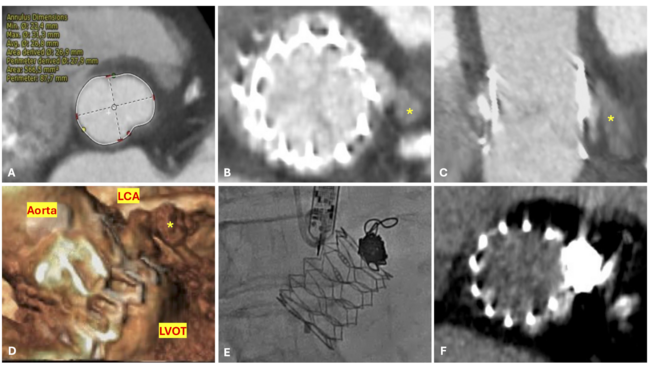
_______________________________________________ J INVASIVE CARDIOL 2008;20:E124-E125 An infrequent, but potentially lethal, complication after aortic valve replacement (AVR) is the occurrence of iatrogenic coronary ostial stenosis. This...
...
08/01/2008
Journal of Invasive Cardiology
Case Report
08/01/2008
Tariq Ashraf, FCPS, MBBS; Asad Pathan, MD; Asadullah Kundi, FCPS
_______________________________________________ J INVASIVE CARDIOL 2008;20:E126-E128 Technique. Percutaneous transmitral commissurotomy (PTMC) was first described by Inoue et al in 1984 as an alternative to surgical closed mitral...
...
08/01/2008
Journal of Invasive Cardiology
Original Contribution
08/01/2008
Huda Elshershari, MD; Qi-Ling Cao, MD; Ziyad M. Hijazi, MD, MPH
Percutaneous closure of atrial septal defects (ASDs) is a safe procedure and has been routinely performed in many centers around the world as an alternative to surgical closure.1–5 However, in elderly patients with ASD, prolonged...
Percutaneous closure of atrial...
08/01/2008
Journal of Invasive Cardiology
Commentary
08/01/2008
Srihari S. Naidu, MD
Atrial septal defects (ASD), which comprise roughly 10% of all congenital cardiac disease, are frequently first encountered in the adult population.1 Significant shunting results in the insidious development of symptoms, culminating in overt...
Atrial septal defects (ASD),...
08/01/2008
Journal of Invasive Cardiology
Original Contribution
08/01/2008
Micha T. Maeder, MD; Matthias E. Pfisterer, MD; Peter T. Buser, MD; Hans W. Roser, MD; Jakob Roth, MD; Daniel Weilenmann, MD; Fabian P. Nietlispach, MD; Michael J. Zellweger, MD; Beat Amsler, MD; Christoph A. Kaiser, MD
Intracoronary brachytherapy using β- or γ-irradiation is effective in reducing angiographic restenosis as well as target vessel revascularization (TVR) in patients with in-stent restenosis (ISR) after bare-metal stent (BMS) implantation.1–5...
Intracoronary brachytherapy...
08/01/2008
Journal of Invasive Cardiology
IAGS (International Andreas Gruentzig Society) Proceedings
08/01/2008
Jacques Théron, MD
My mentor, René Djindjian, one of the fathers of interventional neuroradiology, used to say that it was very difficult to write the history of a technique because one can never satisfy everyone. I agree, thus I will only present here the...
My mentor, René Djindjian, one...
08/01/2008
Journal of Invasive Cardiology
Original Contribution
08/01/2008
Takashi Matsukage, MD, PhD; Shigeru Saito, MD; Yuji Ikari, MD, PhD, FACC, FESC; Yasuhiro Mori, MD, PhD; Ken Okumura, MD, PhD; Fuminobu Yoshimachi, MD, PhD; Motomaru Masutani, MD, PhD
Use of a distal protection device is essential in current percutaneous coronary intervention (PCI) procedures because distal embolization can be avoided with some specific lesions such as vein grafts,1,2 carotid stenoses3,4 and thrombus-rich...
Use of a distal protection...
08/01/2008
Journal of Invasive Cardiology
IAGS (International Andreas Gruentzig Society) Proceedings
08/01/2008
Bernhard Meier, MD, FACC, FESC
_______________________________________________ J INVASIVE CARDIOL 2008;20:E97-E101 Coronary angioplasty was not the first interventional procedure in cardiology (Table 1), but it clearly launched the discipline called interventional...
...
08/01/2008
Journal of Invasive Cardiology
Original Contribution
08/01/2008
Deepak L. Bhatt, MD, MPH, FACC, FAHA, FESC, MSCAI; Anthony A. Bravry, MD, MPH; Russell E. Raymond, DO; Charles E. Chambers, MD; Andrew J. DeNardo, MD; James B. Hermiller, MD, FACC, MSCAI; Paul R. Myers, MD; Douglas E. Pitts, MD; John A. Scott, MD; Scott J. Savader, MD; Steven R. Steinhubl, MD
Multiple devices are currently available for closure of the femoral artery access site after cardiac catheterization.1 Currently, the most widely used closure devices are the Angio-Seal™ device (St. Jude Medical, St. Paul, Minnesota)2–4 and...
Multiple devices are currently...
08/01/2008
Journal of Invasive Cardiology
Commentary
08/01/2008
Dominique Joyal, MD; Robert S. Dieter, MD, RVT
The introduction of vascular closure devices (VCDs) in the mid-1990s has truly made a difference for the interventional cardiologist. Despite a multitude of studies showing either decreased, increased or similar rates of vascular...
The introduction of vascular...
08/01/2008
Journal of Invasive Cardiology
Original Contribution
08/01/2008
Yuji Oikawa, MD; Junji Yajima, MD; Dominick J. Angiolillo, MD, PhD; Masafumi Akabane, MD; Ryuichi Funada, MD; Shunsuke Matsuno, MD; Toshiro Inaba, MD; Yuya Nakagawa, MD; Michinari Nakamura, MD; Hitoshi Sawada, MD; Tadanori Aizawa, MD
Coronary artery aneurysms (CAAs) represent a relatively uncommon finding in patients who undergo percutaneous coronary intervention (PCI). However, the prevalence of CAAs has been shown to be higher in patients undergoing PCI utilizing...
Coronary artery aneurysms...
08/01/2008
Journal of Invasive Cardiology
Original Contribution
08/01/2008
Filippo Crea, MD; Maria De Vita, MD; Giovanni Paolo Talarico, MD; Giovanni Schiavoni, MD; Antonio Giuseppe Rebuzzi, MD; Giuseppe G.L. Biondi-Zoccai, MD, PhD; Rocco Mongiardo, MD; Giampaolo Niccoli, MD, PhD; Carlo Trani, MD; Mario Attilio Mazzari, MD; Italo Porto, MD, PhD; Enrico Romagnoli, MD, PhD; Antonio Maria Leone, MD, PhD; Francesco Burzotta, MD, PhD
Stent thrombosis (ST) is a recognized complication limiting the clinical efficacy of percutaneous coronary interventions (PCI), the incidence reported being between 0.5% and 2.2%.1–5 Due to the increasing number of stent-based PCI procedures,...
Stent thrombosis (ST) is a...
08/01/2008
Journal of Invasive Cardiology
Commentary
08/01/2008
Madan Sharma, MD; Yerem Yeghiazarians, MD
Stent thrombosis (ST), while infrequent, is a serious complication of percutaneous coronary intervention (PCI) resulting in myocardial infarction (MI) or death.1–4 While drug- eluting stents (DES) have reduced the rate of restenosis and...
Stent thrombosis (ST), while...
08/01/2008
Journal of Invasive Cardiology
Original Contribution
08/01/2008
Alan M. Kleinfeld, PhD; David Fitchett, MD; Sanjit S. Jolly, MD, MSc, FRCP; Warren J. Cantor, MD; Hahn Hoe Kim, MD; Gordon Moe, MD; Jason M. Burstein, MD; Aurora Mendelsohn
B-type natriuretic peptide (BNP) and serum unbound free fatty acid (FFAu) are novel cardiac markers. BNP is a polypeptide secreted by the cardiac ventricles in response to volume and pressure overload. Measurement of BNP levels has...
B-type natriuretic peptide (BNP)...
08/01/2008
Journal of Invasive Cardiology
Review
08/01/2008
Bryan P. Yan, MBBS, FRACP, MD; Ronen Gurvitch, MBBS, FRACP; Andrew E. Ajani, MBBS, MD, FRACP, FJFICM, FCSANZ; Ron Waksman, MD
Primary percutaneous coronary intervention (PCI) is established as optimal therapy for patients with ST-elevation myocardial infarction (STEMI).1 The goal of primary PCI is to achieve a thrombolysis in myocardial infarction (TIMI) 3 flow and...
Primary percutaneous coronary...
08/01/2008
Journal of Invasive Cardiology
Editorial Message
08/01/2008
Richard E. Shaw, PhD, FACC
This issue of the Journal of Invasive Cardiology includes original research, a Rapid Communication article, a Review, several case reports, two Clinical Images selections, and articles from the proceedings of the 30th Anniversary of...
This issue of the Journal of...
08/01/2008
Journal of Invasive Cardiology