Volume 19 - Issue 7 - July, 2007

Case Report
08/01/2008
Damras Tresukosol, MD; Nattawut Wongpraparut, MD; Tippayawan Lirdvilai
Stenosis of the internal carotid artery is responsible for 10–20% of all strokes or transient ischemic attacks. Percutaneous transluminal carotid artery stenting (CAS) is a promising new treatment option for carotid artery stenosis. These...
Stenosis of the internal carotid...
08/01/2008
Journal of Invasive Cardiology
Case Report
08/01/2008
Marc Klapholz, MD; Alberto Hendler, MD
The ostium of the right coronary artery (RCA) is not a tubular structure . Hence, sizing, positioning and flaring the stent in the ostium of the RCA demands considerable skill, and occasionally will not yield optimal results. At least mild...
The ostium of the right coronary...
08/01/2008
Journal of Invasive Cardiology
Case Report
08/01/2008
Atsunori Okamura, MD; Hiroshi Ito, MD; Kenshi Fujii, MD
Embolization of thrombi and plaque components liberated by balloon inflation has been speculated1 to cause angiographic no-reflow during percutaneous coronary intervention (PCI) in patients with acute myocardial infarction (AMI). Embolic...
Embolization of thrombi and...
08/01/2008
Journal of Invasive Cardiology
Letters to the Editor
08/01/2008
Rajesh Vijayvergiya, MD, DM
I read the article regarding a single coronary artery by Namboodiri et al,1 published in the April 2007 issue of the Journal of Invasive Cardiology, with great interest. However, the authors missed referencing a few important publications...
I read the article regarding a...
08/01/2008
Journal of Invasive Cardiology
Letters to the Editor
08/01/2008
Adrian C. Iancu, MD, PhD; Alexandra Lazar, MD
We were pleased to have our Clinical Decision Making article “Carotid Artery In-Stent Restenosis in a Patient with Contralateral Total Occlusion, Resolved with Drug-Eluting Stenting” published in the June 2007 issue of the Journal of Invasive...
We were pleased to have our...
08/01/2008
Journal of Invasive Cardiology
Letters to the Editor
08/01/2008
Jack P. Chen, MD, FACC, FSCAI, FCCP
Today’s interventional cardiologist is armed with a vast array of devices for treatment of increasingly difficult lesions. Inhospitable anatomies previously considered suitable only for surgical therapy are now frequently accessible with...
Today’s interventional...
08/01/2008
Journal of Invasive Cardiology
Case Report
08/01/2008
Matthew W. Martinez, MD, FACC; Martina Mookadam, MD; Farouk Mookadam, MB, BCh, MBBCh, MD, FRCPC, FACC
Hemolytic anemia related to intracardiac prosthetic materials is well recognized. It was first reported by Sayed et al, when a Teflon ASD patch produced intravascular hemolysis.1 Since then, intravascular hemolysis has been described after...
Hemolytic anemia related to...
08/01/2008
Journal of Invasive Cardiology
Case Report
08/01/2008
Oliver J. Ormerod, FRCP, DM; Ryan G. Schrale, MBBS; Keith M. Channon, MD, PhD, FRCP
Case Report. A 42-year-old asymptomatic female with longstanding Type-1 diabetes and secondary chronic renal failure underwent evaluation for potential kidney-pancreas transplantation. A screening treadmill myocardial perfusion scintigraphy...
Case Report. A 42-year-old...
08/01/2008
Journal of Invasive Cardiology
Case Report
08/01/2008
Babak Kazemi, MD; Naser Aslanabadi, MD; Bahram Sohrabi, MD
Acute aortic dissection during coronary arteriography or percutaneous coronary intervention is quite rare,1,2 but is a feared complication. Patients in this clinical setting may have a potential risk for acute myocardial infarction (MI)...
Acute aortic dissection during...
08/01/2008
Journal of Invasive Cardiology
Case Report
08/01/2008
Rosario Fiorilli, MD; Roberto Violini, MD; Antonio Parma, MD
Congenital coronary anomalies are relatively uncommon, with a prevalence varying from 0.3% of autopsy series1 to 1.2% of angiographic studies.2 Such anomalies may occur in several anatomical arrangements, with different clinical significance,...
Congenital coronary anomalies...
08/01/2008
Journal of Invasive Cardiology
Case Report
08/01/2008
Henry E. Kim, MD, MPH
Rupture of atherosclerotic plaque leading to exposure of highly thrombogenic material to the blood pool with subsequent thrombus formation is the principal mechanism associated with acute coronary syndromes.1,2 Percutaneous coronary...
Rupture of atherosclerotic...
08/01/2008
Journal of Invasive Cardiology
Case Report
08/01/2008
Massoud A. Leesar, MD, FACC; Ziad Elghoul, MD
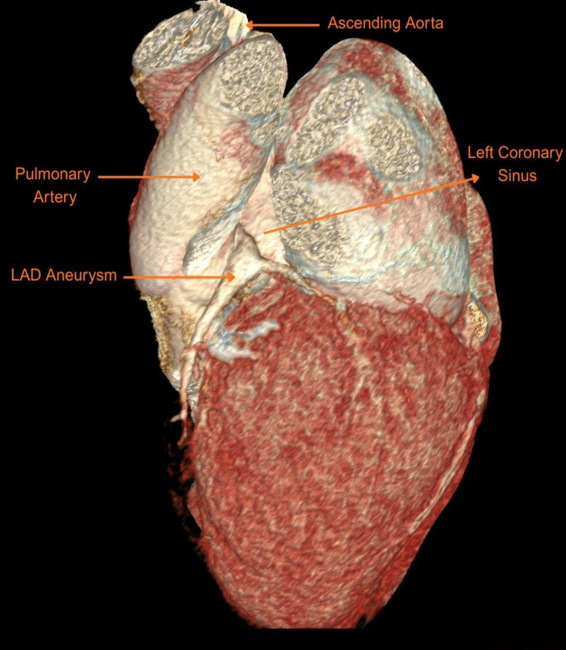
Coronary artery fistulae are uncommon vascular anomalies. The incidence of these anomalies is low, ranging from 0.2 to 0.25%.1 The fistulae frequently drain into one of the ventricles, the pulmonary arteries, the coronary sinus and the...
Coronary artery fistulae are...
08/01/2008
Journal of Invasive Cardiology
Commentary
08/01/2008
P. Syamasundar Rao, MD, FACC
Patent ductus arteriosus (PDA) may be an isolated lesion or may be present in association with other defects. Isolated PDA constitutes 6–11% of all congenital heart defects. The configuration of PDA varies considerably, but most often it has...
Patent ductus arteriosus (PDA)...
08/01/2008
Journal of Invasive Cardiology
Original Contribution
08/01/2008
Amanda G.R.M. Sousa, MD, PhD; Jose de Ribamar Costa, Jr., MD, PhD; Fausto Feres, MD, PhD; Andrea S. Abizaid, MD, PhD; Rodolfo Staico, MD, PhD; Alexandre Antonio Cunha Abizaid, MD, PhD; Leandro I. Lasave, MD; Pedro Beraldo, MD; Luiz Fernando Tanajura, MD, PhD; Eduardo M. R. Sousa, MD, PhD
Although stenting has improved clinical outcomes of patients undergoing percutaneous coronary intervention (PCI), bare-metal stents are associated with a considerable risk of restenosis.1,2 The main cause of in-stent restenosis is excessive...
Although stenting has improved...
08/01/2008
Journal of Invasive Cardiology
Original Contribution
08/01/2008
Gail A. Shammas, BSN, BS , RN, BSc; Michael Jerin, PhD; Peter Sharis, MD; Ghassan Harb, MD; Stephanie Egts, MD; Eric J. Dippel, MD; Penny Stoakes, RN; Jeannette Byrd, RN; Nicolas W. Shammas, MD, MS, FACC, FSCAI, FACP, FSVM
Interatrial septal defects (IASD) have been associated with an increased incidence of cryptogenic strokes.1–7 Percutaneous closure of these defects is now widely performed and the safety of this procedure has been established. It is unclear,...
Interatrial septal defects...
08/01/2008
Journal of Invasive Cardiology
Clinical Images
08/01/2008
Rajesh Jindal, MD; Rupesh George, MD; Balbir Singh, MD
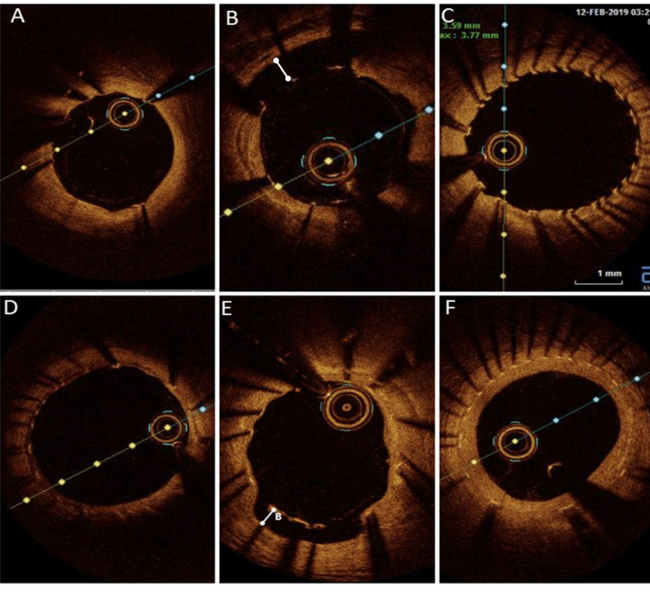
Introduction of drug-eluting stent (DES) has led to a marked reduction in the problem of in-stent restenosis across all patient subsets and lesions complexities.7 Recently, several case reports of aneurysm formation after DES implantation...
Introduction of drug-eluting...
08/01/2008
Journal of Invasive Cardiology
Case Report
08/01/2008
Vineeta Ahooja, MD; Deepak Thatai, MD
Variant angina is a distinct clinical entity first described by Prinzmetal and associates in 1959.1 The classic presentation is characterized by chest pain occurring at rest, and is more frequent in young women. Unlike true angina, the chest...
Variant angina is a distinct...
08/01/2008
Journal of Invasive Cardiology
Original Contribution
08/01/2008
Sorin J. Brener, MD; Steven R. Steinhubl, MD; Eric J. Topol, MD; Danielle M. Brennan, MS; Peter B. Berger, MD
When clopidogrel is added to background aspirin therapy, it reduces the composite of cardiovascular death, myocardial infarction (MI) or stroke in patients with acute coronary syndromes (ACS)1 or percutaneous revascularization.2 The most...
When clopidogrel is added to...
08/01/2008
Journal of Invasive Cardiology
Original Contribution
08/01/2008
Jeffrey H. Freihage, MD; Michael Tempelhof, MD; Bruce E. Lewis, MD; Dinesh Arab, MD; Lowell H. Steen, MD; Ferdinand Leya, MD; Kevin P. Cohoon, MD; Dominique Joyal, MD; Robert S. Dieter, MD, RVT
Conflicting opinions exist regarding the optimal dose of acetyl salicylic acid (ASA) to be given after percutaneous coronary intervention (PCI) with drug-eluting stents (DES). The Seventh ACCP Conference on Antithrombotic and Thrombolytic...
Conflicting opinions exist...
08/01/2008
Journal of Invasive Cardiology
Original Contribution
08/01/2008
Mehnaz Atiq, MD; Nadeem Aslam, MD; Khawar Abbass Kazmi, MD, FCPS
Patent ductus arteriosus (PDA) can cause congestive cardiac failure, repeated pneumonia, pulmonary hypertension and an increased risk for endocarditis. Transcatheter closure of PDA is currently the preferred therapeutic alternative to...
Patent ductus arteriosus (PDA)...
08/01/2008
Journal of Invasive Cardiology