Volume 16 - Issue 3 - March, 2004
08/01/2008
Carl E. Eybel, MD; Francis Q. Almeda, MD; Demetrius K. Lopes, MD
Case Report. We present the case of a 52-year-old male with a history of hypertension who presented to the Emergency Room (ER) of a community hospital with a 2-month history of progressively worsening exertional chest pressure. While in the...
Case Report. We present the case of a 52-year-old male with a history of hypertension who presented to the Emergency Room (ER) of a community hospital with a 2-month history of progressively worsening exertional chest pressure. While in the...
Case Report. We present the case...
08/01/2008
Journal of Invasive Cardiology
Case Report
08/01/2008
Joseph Aragon, MD; Frank Litvak, MD
Intravascular radiation is currently the only Food and Drug Administration-approved modality to treat in-stent restenosis (ISR).1,2 Multiple clinical trials have shown efficacy of beta-radiation in reducing intimal growth associated with...
Intravascular radiation is currently the only Food and Drug Administration-approved modality to treat in-stent restenosis (ISR).1,2 Multiple clinical trials have shown efficacy of beta-radiation in reducing intimal growth associated with...
Intravascular radiation is...
08/01/2008
Journal of Invasive Cardiology
Case Report
08/01/2008
Carlos Barrera-Ramírez, MD; José Garcia, MD; Raúl Moreno-Gómez, MD, PhD; Carlos Macaya, MD, PhD
ABSTRACT: In 1.5–2.0% of patients with acute myocardial infarction referred for primary percutaneous coronary intervention, the left main trunk is identified as the culprit vessel. Among the congenital coronary anomalies, an anomalous origin...
ABSTRACT: In 1.5–2.0% of patients with acute myocardial infarction referred for primary percutaneous coronary intervention, the left main trunk is identified as the culprit vessel. Among the congenital coronary anomalies, an anomalous origin...
ABSTRACT: In 1.5–2.0% of...
08/01/2008
Journal of Invasive Cardiology
Clinical Images
08/01/2008
Arthur Kemer, MD; Ganeshkumar Anne, MD; Luis Gruberg, MD; Alexander Goldberg, MD
The use of stents during percutaneous coronary intervention is now increasingly common. Stent embolization into the systemic or coronary circulation before deployment is a rare but recognized complication of coronary stenting, with hazardous...
The use of stents during percutaneous coronary intervention is now increasingly common. Stent embolization into the systemic or coronary circulation before deployment is a rare but recognized complication of coronary stenting, with hazardous...
The use of stents during...
08/01/2008
Journal of Invasive Cardiology
Editorial Message
08/01/2008
Richard E. Shaw, PhD, FACC
Dear Readers,
This issue of the Journal of Invasive Cardiology coincides with the annual scientific sessions of the American College of Cardiology and includes original research articles, commentaries, review articles, case reports and...
Dear Readers,
This issue of the Journal of Invasive Cardiology coincides with the annual scientific sessions of the American College of Cardiology and includes original research articles, commentaries, review articles, case reports and...
Dear Readers,
This issue of the...
08/01/2008
Journal of Invasive Cardiology
08/01/2008
James J. Ferguson, III, MD
ABSTRACT: Traditional antithrombotic regimens for the management of acute coronary syndromes are far from optimal. There is considerable opportunity for improvement of standard treatment with unfractionated heparin and aspirin. The...
ABSTRACT: Traditional antithrombotic regimens for the management of acute coronary syndromes are far from optimal. There is considerable opportunity for improvement of standard treatment with unfractionated heparin and aspirin. The...
ABSTRACT: Traditional...
08/01/2008
Journal of Invasive Cardiology
08/01/2008
James J. Ferguson, III, MD
Continued from previous page
Several other recent studies have also examined the efficacy and safety of the combination of LMWHs and GP IIb/IIIa antagonists in the catheterization laboratory (Table 1). Kereiakes et al. reported the results...
Continued from previous page
Several other recent studies have also examined the efficacy and safety of the combination of LMWHs and GP IIb/IIIa antagonists in the catheterization laboratory (Table 1). Kereiakes et al. reported the results...
Continued from previous...
08/01/2008
Journal of Invasive Cardiology
Case Report
08/01/2008
Truong Duong, MD; Rahul N. Khurana, MD; Richard A. Francoz, MD
ABSTRACT: We report two cases of severe intravascular hemolysis (IVH) following mitral valve repair using a Cosgrove-Edwards ring. In both cases, the degree of mitral regurgitation (MR) seen postoperatively worsened significantly compared to...
ABSTRACT: We report two cases of severe intravascular hemolysis (IVH) following mitral valve repair using a Cosgrove-Edwards ring. In both cases, the degree of mitral regurgitation (MR) seen postoperatively worsened significantly compared to...
ABSTRACT: We report two cases of...
08/01/2008
Journal of Invasive Cardiology
Case Report
08/01/2008
Benjamin M. Wu, MD, PhD; Mehrdad Rezaee, MD, PhD; Mamoo Nakamura, MD
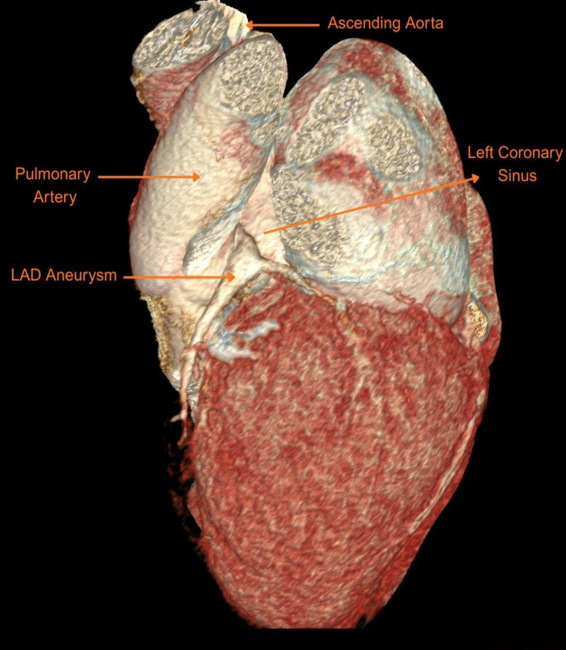
ABSTRACT: The incidence of coronary artery aneurysms is about 1–2%, with clinical course dependent on the size of the aneurysm. A case of moderate-size aneurysm in the proximal left anterior descending coronary artery with stenosis at both...
ABSTRACT: The incidence of coronary artery aneurysms is about 1–2%, with clinical course dependent on the size of the aneurysm. A case of moderate-size aneurysm in the proximal left anterior descending coronary artery with stenosis at both...
ABSTRACT: The incidence of...
08/01/2008
Journal of Invasive Cardiology
Case Report
08/01/2008
Deepak L. Bhatt, MD, MPH, FACC, FAHA, FESC, MSCAI; Jose Emilio Exaire, MD; Cameron Haery, MD; Jay S. Yadav, MD; Irving Franco, MD; Stephen G. Ellis, MD
One of the most challenging scenarios encountered during the percutaneous treatment of acute coronary syndromes (ACS) is the presence of thrombus, and the subsequent distal embolization due to mechanical disruption of the culprit lesion.1...
One of the most challenging scenarios encountered during the percutaneous treatment of acute coronary syndromes (ACS) is the presence of thrombus, and the subsequent distal embolization due to mechanical disruption of the culprit lesion.1...
One of the most challenging...
08/01/2008
Journal of Invasive Cardiology
08/01/2008
Sergei Yeroslavtsev, MD; Akram Abuful, MD; Shmuel Fuchs, MD; Reuben Ilia, MD; Jean Marc Weinstein, MRCP; Carlos Cafri, MD; G. Rosenstein, MD
ABSTRACT: Heart catheterization is frequently applied in patients with coronary artery disease for diagnostic and therapeutic implications. Using the femoral approach, post-procedure bed rest of 4–6 hours is recommended to prevent groin...
ABSTRACT: Heart catheterization is frequently applied in patients with coronary artery disease for diagnostic and therapeutic implications. Using the femoral approach, post-procedure bed rest of 4–6 hours is recommended to prevent groin...
ABSTRACT: Heart catheterization...
08/01/2008
Journal of Invasive Cardiology
08/01/2008
Anthony Della Siega, MD; Richard Mildenberger, MD; Peter Klinke, MD; A. Ziakis, MD; M.B. Williams, MD; R.D. Kinloch, MD; J.D. Hilton, MD; Eric Fretz, MD
ABSTRACT: Transradial percutaneous coronary intervention (PCI) is a safe and effective method of percutaneous revascularization. However, there are no data on the efficacy of the transradial approach in left main (LM) PCI. We studied 80...
ABSTRACT: Transradial percutaneous coronary intervention (PCI) is a safe and effective method of percutaneous revascularization. However, there are no data on the efficacy of the transradial approach in left main (LM) PCI. We studied 80...
ABSTRACT: Transradial...
08/01/2008
Journal of Invasive Cardiology
Vascular Disease
08/01/2008
Deepak L. Bhatt, MD, MPH, FACC, FAHA, FESC, MSCAI; Alex Abou-Chebl, MD; Christopher T. Bajzer, MD; Michael R. Tamberella, MD, FACC; Jay S. Yadav, MD
ABSTRACT: We describe a case of carotid artery restenosis following carotid artery stenting for treatment of post-endarterectomy stenosis. The goal is to highlight the risk of recurrent restenosis following endarterectomy. In this case...
ABSTRACT: We describe a case of carotid artery restenosis following carotid artery stenting for treatment of post-endarterectomy stenosis. The goal is to highlight the risk of recurrent restenosis following endarterectomy. In this case...
ABSTRACT: We describe a case of...
08/01/2008
Journal of Invasive Cardiology
08/01/2008
Luis Gruberg, MD; Ariel Roguin, MD, PhD; Rafael Beyar, MD, DSc, MPH; Ehud Grenadier, MD; Chandrashekhar V. Patil, MD; Michael Kapeliovich, MD; Sirouch Petcherski, MD; Monther Boulos, MD; Shlomo Amikam, MD; Shai Linn, MD; Walter Markiewicz, MD; Eugenia Nikolsky, MD, PhD
ABSTRACT: Background. The long-term prognosis of diabetic patients with multivessel coronary artery disease (CAD) treated by surgical or percutaneous coronary revascularization is significantly worse as compared to non-diabetics. Lower rates...
ABSTRACT: Background. The long-term prognosis of diabetic patients with multivessel coronary artery disease (CAD) treated by surgical or percutaneous coronary revascularization is significantly worse as compared to non-diabetics. Lower rates...
ABSTRACT: Background. The...
08/01/2008
Journal of Invasive Cardiology
Commentary
08/01/2008
Rajendra H. Mehta, MD, MS; Michael H. Sketch, Jr., MD
Percutaneous coronary interventions (PCI) have been increasingly adopted for the treatment of coronary artery disease in patients with diabetes mellitus. This form of coronary revascularization is attractive because of its ability to avoid...
Percutaneous coronary interventions (PCI) have been increasingly adopted for the treatment of coronary artery disease in patients with diabetes mellitus. This form of coronary revascularization is attractive because of its ability to avoid...
Percutaneous coronary...
08/01/2008
Journal of Invasive Cardiology
08/01/2008
Ralf-Peter Franke, PhD, MD; Friedrich Jung, MD, PhD; Peter Reuter, PhD; Wolfgang Röhlke, PhD; Klaus Matschke, MD; Steffi Keller, MD; Bernd Klosterhalfen, MD; Christian Mittermayer, MD; Christoph Mrowietz, PhD
ABSTRACT: This study evaluated specially designed perfluorocarbon (PFC) emulsions as blood substitutes in case of induced ischemia of the left heart ventricle in healthy farm pigs. Two hundred milliliters of perfluorocarbon emulsion were...
ABSTRACT: This study evaluated specially designed perfluorocarbon (PFC) emulsions as blood substitutes in case of induced ischemia of the left heart ventricle in healthy farm pigs. Two hundred milliliters of perfluorocarbon emulsion were...
ABSTRACT: This study evaluated...
08/01/2008
Journal of Invasive Cardiology
08/01/2008
Marcelo Sanmartin, MD; Raymundo Ocaranza, MD; Diogenes Cuevas, MD; Javier Goicolea, MD; Raul Castellanos, MD; Marisol Bravo, MD; Ramon Mantilla, MD; Rafael J. Ruiz-Salmeron, PhD
ABSTRACT: Although numerous studies have established the utility of 4 French (Fr) catheters for routine coronary angiography, its adequacy for automatic quantitative coronary analysis has not been previously assessed. Methods. In 32...
ABSTRACT: Although numerous studies have established the utility of 4 French (Fr) catheters for routine coronary angiography, its adequacy for automatic quantitative coronary analysis has not been previously assessed. Methods. In 32...
ABSTRACT: Although numerous...
08/01/2008
Journal of Invasive Cardiology
08/01/2008
Cesar A. Esteves, MD, PhD; Renata Cassar, MD; Carlos A.C. Pedra, MD; Sergio C. Pontes, Jr., MD; Sergio Navarro Braga, MD, PhD; Valmir F. Fontes, MD; Simone R.F. Pedra, MD
ABSTRACT: The aim of this study was to evaluate the feasibility, safety and efficacy of transcatheter closure of secundum atrial septal defects (ASD) in patients with complex anatomy. From September 1997 to July 2003, a total of 40 patients...
ABSTRACT: The aim of this study was to evaluate the feasibility, safety and efficacy of transcatheter closure of secundum atrial septal defects (ASD) in patients with complex anatomy. From September 1997 to July 2003, a total of 40 patients...
ABSTRACT: The aim of this study...
08/01/2008
Journal of Invasive Cardiology
08/01/2008
Carlos A.C. Pedra, MD; Valmir F. Fontes, MD; Simone R.F. Pedra, MD; Cesar A. Esteves, MD, PhD; Renata Cassar, MD; Sergio Navarro Braga, MD, PhD; Sergio C. Pontes, Jr., MD
Continued from previous page
Transcatheter closure was successful in the remaining 35 patients (87.5%). The calculated Qp/Qs was 2.5 ± 0.8. All patients had normal to mildly elevated pulmonary artery pressures. The fluoroscopic and total...
Continued from previous page
Transcatheter closure was successful in the remaining 35 patients (87.5%). The calculated Qp/Qs was 2.5 ± 0.8. All patients had normal to mildly elevated pulmonary artery pressures. The fluoroscopic and total...
Continued from previous...
08/01/2008
Journal of Invasive Cardiology
Commentary
08/01/2008
P. Syamasundar Rao, MD, FACC; Ashraf M. Nagm, MD
Since the pioneering investigations by King, Rashkind and their colleagues1–6 in mid 1970s of percutaneous device occlusion of secundum atrial septal defects (ASDs), a number of other investigators have designed and tested other devices as...
Since the pioneering investigations by King, Rashkind and their colleagues1–6 in mid 1970s of percutaneous device occlusion of secundum atrial septal defects (ASDs), a number of other investigators have designed and tested other devices as...
Since the pioneering...
08/01/2008
Journal of Invasive Cardiology