Antimicrobial Stewardship Highlights From SAWC
© 2025 HMP Global. All Rights Reserved.
Any views and opinions expressed are those of the author(s) and/or participants and do not necessarily reflect the views, policy, or position of Podiatry Today or HMP Global, their employees, and affiliates.
Antimicrobial Stewardship in Chronic Wound Management: Clinical Practice Summary for Podiatrists
- Antimicrobial Resistance Awareness: Overprescription and inappropriate antibiotic use remain major contributors to resistance, particularly among podiatrists managing diabetic foot ulcers (DFUs) and venous leg ulcers (VLUs).
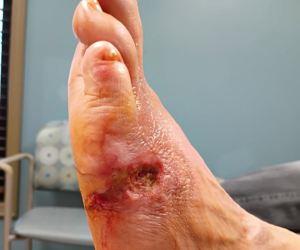
- Judicious Prescribing: Not all chronic wounds require systemic antibiotics; reserve therapy for wounds showing clear clinical signs of infection—both overt (erythema, warmth, purulence) and covert (increased pain, delayed healing, odor).
- Targeted Therapy:
◦ Perform wound cultures—preferably tissue biopsies—to identify true pathogens.
◦ Avoid treating commensal flora or colonizing bacteria that do not drive infection.
- Empiric Treatment Considerations:
◦ Initiate empiric antibiotics based on local epidemiology and pathogen prevalence.
◦ Reference your local antibiogram—a geographic or institutional snapshot of microbial susceptibility—to guide initial empiric selection.
- Antibiotic Selection Principles:
◦ Match antibiotic bioavailability and tissue penetration to the patient’s vascular status.
◦ Recognize that Augmentin (amoxicillin/clavulanate), though commonly prescribed, has low bioavailability and may be suboptimal for patients with micro- or macrovascular disease affecting perfusion to the lower extremity.
- Clinical Action Points:
◦ Review and integrate hospital antibiograms into your prescribing workflow.
◦ Reassess antibiotic choice once culture results are available; de-escalate therapy when appropriate.
◦ Educate clinical teams on antibiotic stewardship principles to reduce misuse and preserve efficacy.
- Practice Impact:
◦ Improves infection outcomes, reduces antimicrobial resistance, and enhances wound healing efficacy through evidence-based prescribing.
Transcript
Hi, I'm Dr. Windy Cole. I am the Director of Wound Care Research at Kent State University, College of Podiatric Medicine.
And here at SAWC Fall, 2025, we had a wonderful session on antimicrobial stewardship and antimicrobial resistance that mirrored a new consensus document that was published in Wounds. I think there are a lot of pertinent facts and pearls that podiatric medicine clinicians can take away from this document.
I think, unfortunately, the epidemic of misuse of antibiotics is really due to poor processes in prescribing among health care physicians, podiatrists among them. We see the bulk of diabetic foot ulcers and venous leg ulcers, and not every wound needs to be prescribed antibiotics. So really being judicious in when we prescribe systemic antibiotics is key.
We know that these wounds have been open for many weeks, many months, many years. They're contaminated with bacteria, but they don't necessarily need prescribed antibiotic therapy. It's only when we see signs and symptoms of infection, both those covert and overt signs that we should then be prescribing antibiotics, we should also tailor antibiotics against the appropriate pathogen, and that means taking a wound culture or even better a tissue sample so that we could isolate the bad actors. Not every single bacteria that shows up on the culture needs treated because you will culture commensals and normal skin flora; you really just want to tease out what the pathogens are. And then empiric antibiotic therapy, we typically start before we get those culture results back. And so we could use an antibiotic that is going to really focus on the typical pathogens that we have in our geographic location.
It's really important to know what your anti-biogram is. And if you don't know what an anti-biogram is, it's really a snapshot of a specific population. And again, what pathogens are likely causing the infection in that population. So it's either a hospital or a geographic location. Most hospitals will have those anti-biograms available. So if you're not familiar with it, I think as a podiatric surgeon, you should be familiar with your hospital's antibiotics.
Then when you prescribe antibiotic, again tailored to that pathogen, you really want to understand the bioavailability of that antibiotic. Most of us, myself included, use Augmentin a lot for diabetic foot ulcers, but I've changed my practices because, believe it or not, Augmentin has low bioavailability. If we're using it to treat diabetic foot ulcers, our diabetics often have micro- and macrovascular disease, so they have limited perfusion to the foot, and then you have limited bioavailability of Augmentin. So it will change your practice when you get to know what the bioavailability is of many oral antibiotics.
And those are some pearls that you can really put to good use at your next day in clinic.