Year 1 Outcomes: Advancing a Standardized Predictable Cost of Care Model in US Oncology
Key Clinical Summary
- The Predictable Cost of Care (PCC) Working Group established a transparent framework to calculate predictable total costs of cancer therapy.
- The model integrates treatment, administration, and complication-related costs while excluding nonregimen-specific diagnostics.
- Initial validation using metastatic non–small cell lung cancer (mNSCLC) demonstrates the model’s potential to enhance value-based treatment decisions.
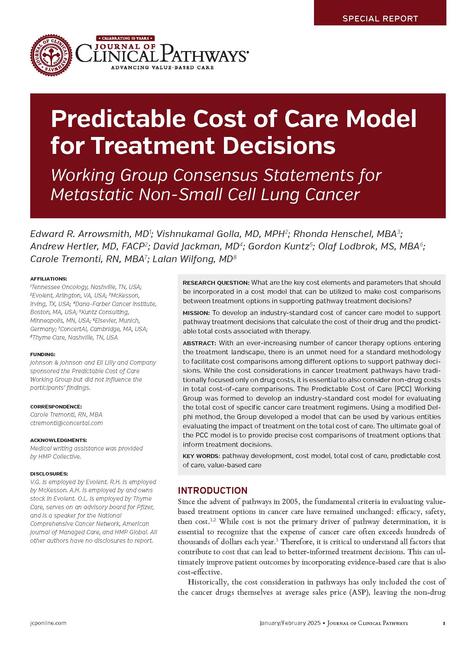
As cancer therapies multiply, clinicians and pathway developers face growing complexity in comparing treatment costs. To create a uniform and transparent approach, the Predictable Cost of Care Working Group (PCC) developed a standardized model for evaluating total therapy costs in oncology. The initiative’s first-year results lay the groundwork for a consistent, data-driven framework that can inform pathway selection and value-based care decisions across US oncology settings.
Main Findings
The inaugural year of the PCC focused on building consensus around key cost components and model parameters. Representatives from seven leading oncology pathway organizations—including academic medical centers, community oncology networks, and payers—collaborated over five virtual meetings using a modified Delphi method to establish the framework.
The group identified 4 primary cost categories:
- Treatment costs (chemotherapy, targeted therapy, immunotherapy).
- Treatment administration costs (infusion, facility, and provider fees).
- Costs related to treatment complications (hospitalizations, emergency department visits, supportive care).
- Diagnostic costs, which were evaluated but excluded since they are standardized and not regimen-specific.
Additionally, 3 framework parameters were defined: data sources and framework, timeframe, and statistical parameters. The model uses publicly available data from Centers for Medicare & Medicaid Services (CMS), including the Average Sales Price (ASP) and Medicare Physician Fee Schedule, to ensure transparency and reproducibility.
Cost projections were standardized to 6-month and 1-year intervals, allowing pathway developers to compare regimens across consistent timeframes. The model also integrates mean and median values, ranges, and confidence intervals to account for data variability. By focusing on predictable and regimen-specific elements, the PCC model provides a clearer picture of total care costs beyond drug acquisition alone.
This initial model was tested using metastatic non–small cell lung cancer (mNSCLC) as a pilot disease state, chosen for its complex treatment landscape and high variability in therapy costs. Results demonstrated that including administration and adverse event management significantly alters total cost rankings compared to drug-only evaluations.
Clinical Implications
The PCC model represents a pivotal advancement in oncology cost modeling. By moving beyond drug price alone, it captures the real-world economic impact of therapy delivery and complication management. For clinicians and pathway developers, this approach offers a standardized, reproducible tool for comparing regimens on a total cost-of-care basis—supporting evidence-based, value-oriented treatment selection.
In the broader US health care landscape, the model’s transparency aligns with payer and provider goals for accountable, value-based oncology care. It also lays a foundation for collaboration between pharmaceutical manufacturers, pathway developers, and policy stakeholders seeking to balance innovation with affordability.
Conclusion
The Year 1 outcomes of the Predictable Cost of Care model establish a transparent, reproducible framework for evaluating oncology treatment costs. As the initiative enters its next phase—testing with real-world datasets—it promises to refine cost assessment in cancer pathways, advancing equitable and sustainable value-based care across the United States.
Reference
Arrowsmith E, Golla V, Henschel R, et al. Predictable cost of care model for treatment decisions: working group consensus statements for metastatic non-small cell lung cancer. J Clin Pathways. 2025;11(4):27-32.