The Cost of Progress: How Policy and Market Forces Are Redefining Health Care
In 2025, health care costs continued to rise, contributing to uncertainty in the health insurance market. For 2026, private insurers must prepare for the expiration of the Affordable Care Act (ACA) enhanced premium tax credits and set their premium rates based on projected cost increases. Analysts have projected the potential for significant premium increases as a result, presenting a barrier for patients to remain insured. To the providers of oncology care, this situation places even greater pressure to provide cost-efficient quality care, while still maintaining a patient-centric care model.
In our Transformative Business Trends column (page 38), Vogenberg examines how employer plans have been impacted not only by cost, but by multiple market factors—including lingering effects of the COVID-19 pandemic, integration of artificial intelligence (AI) in health care, and the popularity of GLP-1s—over the past few years. Vogenberg highlights key employer trends emerging for 2026 such as more market segment splitting, reducing or limiting access to care via commercial insurance, and minimizing plan risk (cost) to balance anticipated double-digit premium increases.
Moving our focus to patients and the quality of care they receive, Raff et al describe the implementation of a structured, scalable framework for implementing an outpatient step-up dosing (SUD) of teclistamab in a community oncology setting in our Original Research article (page 16). The goal of the SUD model was to mitigate adverse events (AEs) associated with teclistamab therapy. A comprehensive playbook to support physician education on teclistamab administration and AE management was developed, allowing providers to gain familiarity with shifting from a hybrid SUD model (administering outpatient SUD and then admitting for observation) to a full outpatient SUD. Their success with the full outpatient conversion is significant for improving patient access, as well as controlling the cost of administration.
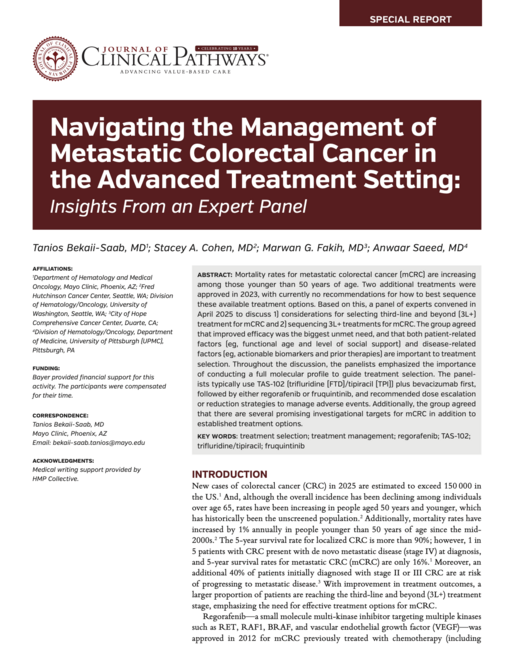
Our second Original Research article (page 26) evaluates the role of immune checkpoint inhibitors (ICIs) near the end of life (EOL) and whether they exacerbate mortality outcomes. ICIs have advanced oncology care, extending both progression-free and overall survival in 18 different cancers. However, previous studies have found a negative association between ICI use at EOL and poorer performance status and increased financial toxicity while providing minimal clinical benefit. The study by Kaur et al reveals significant variability in the interval between the last immunotherapy treatment and death, with an association linked to the cancer type and the presence of risk factors. Their results highlight the importance of adopting a cautious and mindful approach to ensure ICI treatment decisions align with patient-centered care and optimized outcomes during EOL.
Finally, this will be my last Editor’s Page for the Journal of Clinical Pathways (JCP). After 10 rewarding years as Editor-in-Chief, I have decided to step down to allow the journal to move into its next generation. In 2015, JCP was a little more than an ambitious concept. It has been a privilege to help build JCP into the respected publication it is today. This journey has been made possible by an extraordinary community of authors, reviewers, and colleagues who have shared their expertise, creativity, and commitment to advancing our field. I am profoundly grateful for your trust, support, and collaboration throughout this decade. Thank you all for allowing me to be part of this remarkable story.