The View From the Stage: How AI, Data, and Pharmacist Leadership Drove Discussion at CPC+CBEx 2025
In this recap of the 9th annual Clinical Pathways Congress + Cancer Care Business Exchange (CPC+CBEx), Gordon Kuntz—a member of the Journal of Clinical Pathways editorial board and CPC+CBEx moderator since 2019—highlights important themes and notable sessions from this year’s conference.
Themes
Artificial Intelligence
Artificial Intelligence (AI) has been a prominent topic at CPC+CBEx for several years. Until last year, AI was described as “coming soon,” with numerous predictions and not many concrete examples. This year, the conference featured specific examples of AI-enabled operations and clinical support.
In their session titled “Beyond the Hype Part 2: Real-World Impact of AI-Powered Operational Support,” Barry Russo, MBA, CEO of the Center for Cancer and Blood Disorders, and San Banergee, MBA, chief technology officer at Navista, shared practical applications of the technologies in use at their institutions. They provided examples of documentation support tools, medical record management platforms, pre-authorization assistance, and other AI-assisted tools.
In his keynote session, Tom Koulopoulos, chairman and founder of the Delphi Group, spoke on how AI is expected to influence health care in the very near future. His presentation was impactful, with live demonstrations of innovative technology including an AI version of himself that can communicate and a robot dog on stage.
In general, the sessions covered the overarching theme that AI continues to evolve in oncology practices, with certain administrative and clinical solutions being deployed.
Real-World Data and Evidence
Another important theme of the conference was the role of real-world data and evidence in oncology. In their session “Real-World Evidence Doesn’t Move the Needle. Or Does It?” Aimee Ginsberg Chesnick, PharmD, BCPS, director of clinical content strategy at The US Oncology Network/McKesson, and Lalan Wilfong Lalan Wilfong, MD, senior vice president of value-based care at Thyme Care, discussed the need for rigor in real-world data study design. They highlighted the need to ensure that studies have sufficient sample size, ample diversity of sources, presence of a control group, and accurate statistical analysis. Studies that lack these attributes are not perceived as credible and will likely not influence pathways and clinical decision-making.
Role of Pharmacists
Oncology pharmacists played a major role in this year’s Congress, from representing pathway developers to presenting sessions. Two of the pharmacist-focused sessions included “The Evolution of Pharmacist Leadership Across the Oncology Care Spectrum” and “Innovative Collaborations in Oncology: Bridging Pathways, Industry, and Patient Care,” both discussing the importance of collaboration between pharmacists, pharmaceutical companies, pathway developers, and health care providers to enhance patient outcomes and optimize care delivery. Overall, the conference showed how pharmacists from many organizations have become prominent champions of pathways.
Session Highlights
Linda Bosserman, MD, PhD, medical director, Value Based Care & Center for International Medicine at City of Hope, and David Jackman, MD, medical director of clinical pathways at the Dana-Farber Cancer Institute, presented the results from a survey of nine clinical oncology pathway users and developers. They are expecting to add four more respondents and will be publishing an article with the final results in an upcoming issue of the Journal of Clinical Pathways.
Amanda Berra, EVP, chief education officer, Union Healthcare Insight, PhD, and Deirdre Saulet, PhD, chief innovation officer, Jasper Health, presented a legislative update. Some of the key takeaways included a discussion on the impact of higher than expected medical loss ratios for Medicare Advantage and commercial plans, and the expected health cost increase of up to 9% for 2026. These updates could spell trouble for Medicare Advantage plans, commercial plans, and individuals.
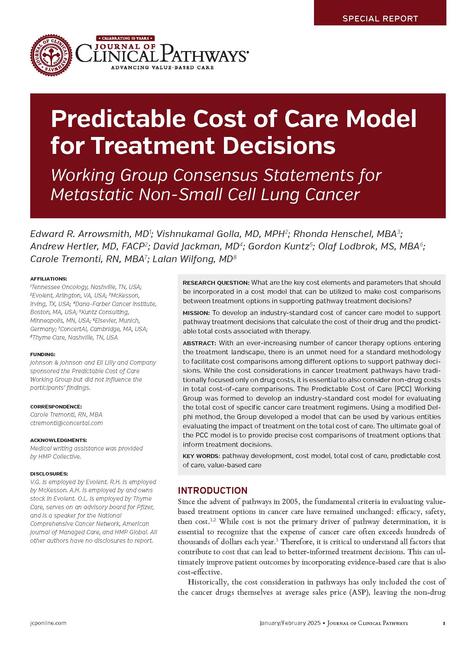
Carole Tremonti, RN, MBA, senior director, Provider Partnerships, ConcertAI, and Gordon Kuntz, president, Kuntz Consulting, provided an update on the Predictable Cost of Care Working Group, a multistakeholder, industry-wide initiative to develop new industry standards for economic models. For Phase 2, the group is developing a model and is looking for partners to provide utilization and cost data related to adverse events. The model is expected to be completed by the end of the year, and the group will be asking pharmaceutical companies to run it for their therapies for testing and validation prior to its formal launch late in 2025.
Clinical Pathway Categories: Infrastructure & Innovation and Business
This column highlights how advancements in artificial intelligence (AI), real-world evidence, and pharmacist leadership directly support the infrastructure & innovation objectives of clinical pathways by introducing operational efficiencies, data-driven decision-making, and collaborative care models that align with evidence-based standards. Simultaneously, the column supports the business category by addressing cost predictability, legislative impacts, and value-based care strategies, ultimately enhancing oncology care delivery through sustainable, standardized, and patient-centered pathways.