Poster Insights from SAWC Fall
© 2026 HMP Global. All Rights Reserved.
Any views and opinions expressed are those of the author(s) and/or participants and do not necessarily reflect the views, policy, or position of Podiatry Today or HMP Global, their employees, and affiliates.
Transcript
Please note: This content is a direct transcript, capturing the authentic conversation without edits. Some language may reflect the flow of live discussion rather than polished text.
Patrick McEneaney, DPM:
Hi, I'm Dr. Patrick McEneaney. I'm owner and CEO of Northern Illinois Foot and Ankle Specialists. I'm double board certified by the American Board of Foot and Ankle Surgery. And I'm co-director of the Northwest Illinois Foot and Ankle Foundation Fellowship. With me, I have Dr. Rimi Statkus, one of my partners here. Would you like to introduce yourself?
Rimi Statkus, DPM:
Yes. Dr. Rimi Statkis, same group that we work with. I'm the research director for the fellowship program and then work across clinic and surgical management for foot and ankle problems.
Patrick McEneaney, DPM:
Great. Well, we're here today talking about our posters. So why don't you jump in and talk about your first poster?
Rimi Statkus, DPM:
First one was a case series of patients, hard to heal wounds. And I use micronized fish skin grafts and across multiple anatomical areas that were very hard to heal and able to work in really good areas with different types of surgeries, with external fixators being used, reconstructive procedures, healing abscesses quicker than other wound sites. So it was very effective.
Patrick McEneaney, DPM:
So why did you use the micronized fish skin graft versus other types of products?
Rimi Statkus, DPM:
So fish skin graft is almost like human tissue when you look on an electron microscope. So it's almost taking a graft instead of having donor site morbidity, you're using, it's like for like. So you're putting structure into a void to fill the space and to heal it up. It's more normal tissue that grows back, less scarring and better outcomes.
Patrick McEneaney, DPM:
And what were some of the things that you found that you weren't expecting when you were doing this case series with the use of the fish skin graft?
Rimi Statkus, DPM:
Specifically one of the patients that I used it on, I had multiple wounds and I used it in a previous abscess area. So I cleared the infection and then I filled the hole with the micronized fish skin. And that healed quicker than the other wounds that were more superficial actually, surprisingly.
Patrick McEneaney, DPM:
And how long did you wait before you put the fish skin graft in versus draining the abscess?
Rimi Statkus, DPM:
It was several days. And then clinically seeing the signs of infection go down, trending lab values, obviously infection management with infectious disease and just seeing that improvement over several days before we did that.
Patrick McEneaney, DPM:
So seeing the results of that poster, is this going to change the way you practice going forward?
Rimi Statkus, DPM:
Yes, because using this, you can use it in any anatomical space. You can use it for a variety of not just wound healing, but as well normal healing for other surgical procedures. And you can see these patients are now a year out after the fact you can see that the tissue that grows back and the healing that we have is better than just secondary intention as well.
Patrick McEneaney, DPM:
So where do you see yourself using a particularized version of the fish skin graft versus more of a sheet? How are you going to put that delineation in?
Rimi Statkus, DPM:
Foot tendon repairs, that type of thing. I like to wrap it so the sheet version of a graft works better. The micronize really to fill in spaces and it's amputation sites that works really well. These previous abscess sites where there's an area to fill. So can you get any space?
Patrick McEneaney, DPM:
And I found that in some of these, when you have an amputation site, even putting some sort of skin substitute graft underneath the incision has been really helpful because we know that these patients are very prone to non-compliance. They're very prone to dehiscence for a myriad of reasons. But I've found that when it dehisces, you wind up with a graft right underneath the area and that would be your next round of treatment. And so it's kind of like you have it already there working for you in case that happens.
Rimi Statkus, DPM:
It's another way of protection. Yeah, definitely.
Patrick McEneaney, DPM:
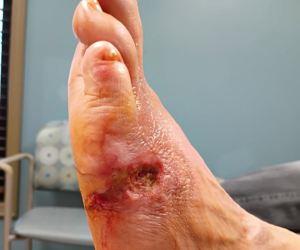
Great. Well, my poster that I had that you were involved with also was looking at using a fish skin graft in a dehisced dead space after a mass was excised. And what happened is the patient had a very routine ganglion excision and what wound up happening is that afterwards, the whole area dehisced and wound up with a wound that was over four centimeters long.
And so what happened is we had this big dead space in an otherwise healthy patient, but a lot of just wide open wound. And so those can be difficult to manage. These patients can get infected. You go in for a very routine type of procedure and now they're looking at infection, possible amputation. And so what we did in this type of situation is we used a fish skin graft to cover these areas as a nice wound covering. And after two applications, we're able to get it healed in about eight weeks. And so we found that that was more helpful than just kind of doing just standard wound care. So tell me about your third poster.
Rimi Statkus, DPM:
The other one I've got is actually looking at polymicrobial contamination of wounds and using chlorhexidine gluconate solution. To irrigate the wound, to clear out the infection and then using a fish skin graft to heal it as well. And so there was a multiple case series. One that really stood out was a patient who lived on a farm. And so-
Patrick McEneaney, DPM:
We both know him.
Rimi Statkus, DPM:
Yes. And so you go through the spectrum of the bacteria that grew. It literally grew four or five different bacteria, multiple resistance, everything. So we were able to clear out and he had an amputation performed and this was secondarily infected after the fact because compliance was a challenge with him because he's always got to be out in the farm and literally in the mud.
Patrick McEneaney, DPM:
And he was overweight, venous insufficiency.
Rimi Statkus, DPM:
Correct.
Patrick McEneaney, DPM:
He took care of a bunch of animals by himself and literally would come into clinic with feces on them. And so we'd have this challenge that we just couldn't get him closed no matter what we put on him.
Rimi Statkus, DPM:
Right.
Patrick McEneaney, DPM:
And so what do you think turned the tide on this?
Rimi Statkus, DPM:
Well, obviously infection management was the big thing because that was the big challenge. You could be looking at different types of antibiotics, but to cover the whole spectrum that he grew was always a challenge. And he didn't want to go in the hospital. So trying to do intravenous antibiotics was also a challenge. So going in surgically to physically clear it out. And then also in the clinic, we were using the same irrigation as well.
Patrick McEneaney, DPM:
And that was chlorhexidine.
Rimi Statkus, DPM:
Correct. And so we were able to clear the infection and then with the skin substitute, we're able to heal it up.
Patrick McEneaney, DPM:
And it was pretty amazing just seeing just how long that wound stood open, throwing so many different modalities at it and it really, I think getting just the bacterial contamination and getting that biofilm just removed from that, really just tipped the tide in that patient.
Rimi Statkus, DPM:
Absolutely. And one of the other patients was a similar story. He first was very hesitant to get medical management in general. And we tried with infectious disease to get his polymicrobial contamination under control and infection. And that was a challenge in itself and able to clear something that was present for months. And he could see a proof in the pudding. And with the irrigation and then with the application of the skin substitute, it was just, it healed up. It changed his life.
Patrick McEneaney, DPM:
And for me, I've found that using a chlorhexidine solution has kind of changed how I manage these infections now. And just even the contamination that I find that it's a great way to disinfect the wound. And I just find that it's probably like something else that we're missing from just using normal saline.
Rimi Statkus, DPM:
Absolutely. And being happy to use it in the clinic now, it's not just in the operating room because obviously it's great. You have a sterile environment and clean it all out, but you can't do it every single time versus patients coming to the office, you can do it every time.
Patrick McEneaney, DPM:
Yeah. And I think that it's something that definitely has a lot of research behind it, but there's also kind of more and more research that's going on just saying how impactful this could be. So what do you think looking forward, like what are your next posters you think you're going to look at? And we've had a lot of interesting patients coming through our clinic.
Rimi Statkus, DPM:
We've had, just looking, not trying to reinvent the wheel, but we have a lot of different patients, a lot of different wound challenges because we get the patients, the complicated ones sent to us. And so using these modalities in different anatomical areas. So that's always a big challenge for us. For us, offloading is a big issue as well. So looking at different modalities in that context, we use these products all the time in the operating room as well as in the clinic.
Patrick McEneaney, DPM:
Yeah. So I think there's a lot of room for continued growth and continued research in both the fish skin, which we had posters on and using the chlorhexidine irrigation. And so I think going forward, I'd like to see us kind of look at this more and say, how much more can we be productive with for these wounds and progressing them forward?