Highlights From Top Posters at the ACPM Conference
© 2025 HMP Global. All Rights Reserved.
Any views and opinions expressed are those of the author(s) and/or participants and do not necessarily reflect the views, policy, or position of Podiatry Today or HMP Global, their employees, and affiliates.
At the recent American College of Podiatric Medicine (ACPM) Conference, researchers presented poster abstracts on interesting cases, evolving research, and emerging thought leadership in podiatry. The ACPM Education Committee reviewed all poster abstract submissions and selected the top 5 for oral presentation. These abstracts particularly shined in the areas of evaluation including: originality and novelty; scientific rigor; significance and impact; data and results; clarity and structure; and relevance to the conference. Podiatry Today had a chance to touch down with several of the honored oral presenters to learn more about their work and its impact on podiatry.
Understanding the Impact of Diabetes Complications in an Underserved Area
Hooman Mir, DPM, MSci, FAPWCA shared some insights from his abstract, “Silent Inequities: Ethnic Disparities in Diabetes-Related Amputation Rates in Medically Underserved US Regions,” co-authored with Student Doctor Yasim Zafar. He notes his project focused on the Rio Grande Valley of Texas, where he states the Hispanic population struggles with statistically high rates of diabetes. He reviewed a decade of data from the Centers for Medicare and Medicaid Services (CMS) to compare diabetes-related hospitalizations, emergency visits, and costs in this region with national averages. He also explored large population studies, like the GOT2D and the Genes T2D program to see how much genetic risk played a role.
“And finally, I incorporated all of the findings from the medical literature on racial disparities in amputation risk,” said Dr. Mir. We concluded that, ultimately, diabetes, obesity, and related hospitalizations are dramatically higher in the Rio Grande Valley than the national average. But what was very, very shocking for me to find out was the cost of the wound care and diabetic limb salvage, in fact, was 1.3 more times higher in this region compared to our national average. And although genetic variants for type 2 diabetes do exist. They do not explain the severity of the disparities that we see in terms of the diabetic foot amputations in the Rio Grande Valley.”
When reflecting on possible reasons why this is the case, Dr. Mir had a few thoughts.
“I feel that my conclusion was very, very clear, that the systematic barriers, like limited access to preventive care and lack of access to Spanish-speaking physicians, are probably the driving forces that would lead to higher amputation rates in the Rio Grande Valley,” he explained. So, my recommendation has been a shift towards earlier podiatric interventions, targeted education, and really major policy changes that would give more attention to a screening and treatment in the high-risk community within the Rio Grande Valley. I believe that, if we act now, we can really reverse these trends and drastically reduce amputation rates in the region.”
When asked what he hoped podiatrists would take home from his research, Dr. Mir conveyed that preventative medicine programs for these patients are vital and that their value cannot be underplayed. He cited his past positive experience with such educational and interventional programs across the nation, and advances in technology that patients in underserved areas have yet to fully benefit from.
Medical Food and DFUs: What is the Impact?
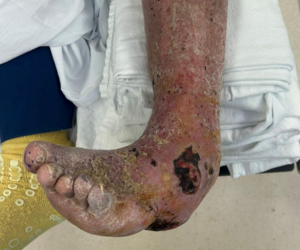
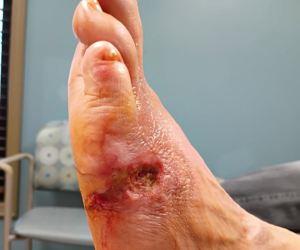
Eric Trathen, DPM also shared high points from his case series, “Medical Food Doubles the Healing Rate for Diabetic Foot Ulcer: A Case Series.” He shared he performed a chart review on patients with a diabetic foot ulcer (DFU) who underwent standard of care wound care, but were also on a supplement, specifically a medical food consisting of bioavailable vitamins B6, B9, and B12. A series of 5 patients fit this criteria, and also underwent debridement, offloading, and management of any biofilm or colonization. The supplement in question is indicated for diabetic peripheral neuropathy, which was the reason these patients had it included in their regimens. However, Dr. Trathen was curious if there was a relationship between this supplement’s use and healing times, due to potential improvement of neuronal function and/or improved microcirculation.
Dr. Trathen did indeed find that his case series experienced comparatively faster healing times than his patients not using such supplementation.
He commented on the overall rationale for this type of supplementation, in his experience.
“I think anytime we find a nutritional benefit to treating our patients, as opposed to using other products, we're improving overall health and we're avoiding other products which may also have a side effect that we would have to deal with,” he said. “Standard of care is still appropriate but also adding appropriate supplementation to facilitate overall health could also be a factor in healing.”
When Pressure Redistribution is Not Enough
Lt. Camellia Russell, MBA, a DPM Candidate at Temple University School of Podiatric Medicine shared her poster findings, “Why Pressure Redistribution Isn’t Enough for Chronic Diabetic Ulcer Management.” She began by stressing the known importance of offloading in patients with diabetic foot ulcers, and specifically the typically discussed gold standard of total contact casting (TCC).
“When we look at the reality, when we talk about something being gold standard, we really expect something to be used very consistently,” she said. “But when I was in clinic, we had only one patient that was put in TTC in a month. Then, in an externship, in a large, hospital-affiliated wound care center we had perhaps 2 patients out of 30 patients a day put in TTC. And if you look at the data, it comes to less than 6% of all wound care centers are using TCC.”
Lt. Russell shared that the goal of the abstract was to then shift those goalposts to a more real-world perspective, including the use of devices such as surgical shoes, CAM boots, or wedge shoes. In her research, she found that patient-related factors contributed to difficulties with certain types of offloading. She noted social determinants of health, insurance status, safe transportation access, housing circumstances and income level all played roles.
“Sometimes (the patients’) work demands mean that they have to stand a lot,” she said. Which also contributes to perceived and actual barriers to offloading.
“(We think that) the burden of TCC should be shifted to the other devices, because it's more practical in the real world, and it's (more) commonly used. If something is not commonly used, we believe that it shouldn't be considered the gold standard anymore,” she shared.
Lt. Russell conveyed her hope that DPMs will consider what it means to truly be a “gold standard,” and understand that such a definition can find limits in economic and practical factors.
“(By) knowing the fact that patients might face the challenges, and addressing those challenges, we hope these (other) offloading devices become a gold standard, too.”
How Could a Time Out Prevent Amputations?
Syeda Roshan DPM, FACPM, CWSP presented at the ACPM conference on the concept of a “time out” before amputation (TOBA). She shared that in her team’s research, about 150,000 non-traumatic lower extremity amputations occur annually and up to 51% occur without prior vascular assessment. Her presentation and work focused in on potentially preventing some of these amputations and shining a light on potential gaps in care.
“We've noticed that there is a disproportionate impact on vulnerable groups such as African-American communities, our patients with diabetes, and especially those in underserved communities,” she said.
Inspired by the presurgical time out protocol, this pre-amputation time out is a mandatory pause before any planned amputation to verify vascular status and confirm that all diagnostic and radiological data has been reviewed and understood.
“The goal is to prevent any amputations when a revascularization or another salvage option is possible,” she said. “Our evidence showed that between 49% to 68% of amputations are preceded by arterial testing, (but) foot amputations show the lowest rate of vascular testing. When vascular surgeons are involved in tertiary settings, nearly 100% receive pre-amputation evaluation.”
Dr. Roshan went on to share an example of a pilot program in North Caroline where introducing TOBA resulted in a reduction in amputation severity and showed feasibility for prevention. This paradigm advocates for screening, appropriate referrals and intervention, and ultimately a goal of limb preservation versus amputation. She added that mortality, safety, and quality of life factors could also potentially benefit. She noted that the Save a Leg, Save a Life (SALSA-L) organization is closely aligned with this effort, with grassroots, community-based outreach across the country.
Published in partnership with the American College of Podiatric Medicine.