Transforming Wound Care: Does Nitric Oxide Foam Show Promise in Real-World Healing Outcomes?
Hard-to-heal wounds continue to place a significant clinical and economic burden on healthcare systems, particularly among aging and medically complex populations. Emerging real-world evidence suggests that nitric oxide–delivering foam offers a biologically active approach that goes beyond passive wound care by enhancing perfusion, reducing bioburden, and accelerating healing. This article explores the science, clinical rationale, and observational data supporting nitric oxide foam as a promising frontline therapy in modern wound management.
Key Takeaways
- Biologically active wound therapy matters: Nitric oxide directly addresses core barriers to healing—including impaired perfusion, infection, and dysregulated inflammation—rather than simply providing passive wound coverage.
- Real-world data show meaningful impact: In skilled nursing facility settings, nitric oxide–delivering foam demonstrated significantly higher healing probabilities across multiple pressure injury stages compared with standard of care.
- Scalable and workflow-friendly innovation: With minimal training requirements and seamless EMR integration, nitric oxide foam has the potential to improve outcomes while supporting efficiency
Hard-to-heal wounds which occur as a result of diabetic foot ulcers (DFUs), venous leg ulcers (VLUs), pressure ulcers (PUs) and postoperative wounds (POWs) represent a tremendous economic and clinical burden. These injuries are often refractory to standard treatments resulting in long times to healing, high susceptibility to infection, and lowered quality-of-life.1,2
Hard-to-heal wounds are a growing global burden, impacting millions of individuals and straining healthcare systems worldwide. Diabetic foot ulcers (DFUs) are a common condition among individuals with diabetes mellitus with 4-10% of these patients developing a DFU, and up to 25% experiencing at least one ulcer during their lifetime.3 The development and severity of a DFU correlates with multiple factors such as neuropathy, peripheral arterial disease, and inadequate glycemic control.4 VLUs, caused by venous disease, are seen in as many as 4-5% of the geriatric population with about 85% of all leg ulcers related to venous disease.5 Additionally, VLUs carry high rates of recurrence, with a 57% incidence reported within 12 months of healing, reaching 78% within 3 years.6 The presence of PUs, frequently found in immobilized patients, constitute a significant global healthcare challenge, impacting thousands of individuals annually.7 In the United States alone, an estimated up to 3 million adults are affected each year.7 According to one published report, the global incidence of surgical wounds is estimated at 102.8 million.8 Moreover, postsurgical wounds have been documented as one of the most expensive to treat.9
Traditional approaches, centered on moisture balance, infection control, and mechanical offloading, often fall short in addressing the complex biological deficits that impair healing, particularly in aging and comorbid populations.2 There is an urgent need for biologically active therapies that go beyond passive support but also actively modulate the wound microenvironment. Innovations that harness mechanisms such as enhanced perfusion, broad antimicrobial action, and cellular regeneration—like nitric oxide delivery systems—represent a promising frontier. These therapies may have the potential to accelerate healing, reduce complications, and improve patient outcomes, especially in resource-constrained settings where advanced care options are limited.
Nitric Oxide: A Multifaceted Agent in Wound Healing
Wound healing is a complex biological process involving inflammation, tissue regeneration, and remodeling. Chronic wounds, such as pressure ulcers, often fail to progress through these stages due to impaired vascularization, persistent infection, and dysregulated inflammation. Emerging evidence supports the therapeutic potential of nitric oxide (NO), a gaseous signaling molecule naturally produced in the body, as a biologically active agent capable of addressing these barriers to healing.
Mechanisms of Action
Nitric oxide plays a central role in several physiological processes critical to wound repair:10-12
- Vasodilation: NO induces relaxation of vascular smooth muscle, increasing blood flow to the wound bed. This enhanced perfusion improves oxygen and nutrient delivery, which are essential for tissue regeneration.
- Broad Antimicrobial Action: NO exhibits broad-spectrum antimicrobial properties through multiple mechanisms. It disrupts bacterial membranes, inactivates essential enzymes, damages DNA, and induces oxidative stress collectively reducing bioburden and lowering the risk of infection from bacteria, fungi, and viruses.
- Cellular Proliferation and Angiogenesis: NO stimulates fibroblast proliferation, collagen synthesis, keratinocyte migration, and the formation of new blood vessels (angiogenesis), while also modulating extracellular matrix remodeling. These collectively support granulation tissue development, re-epithelialization, and wound closure.
- Inflammation Modulation: NO regulates the expression of cytokines and chemokines, modulating the activity of macrophages and neutrophils. This balanced inflammatory response can prevent chronic inflammation and promote progression to the proliferative phase of healing.
- Vascular Homeostasis: Through its effects on endothelial cells and platelet aggregation, NO contributes to maintaining a stable vascular environment conducive to healing.
Therapeutic Delivery of Nitric Oxide
NO therapy can be administered in several ways:13-16
- Direct Application: Gaseous NO can be applied directly to the wound bed, offering immediate exposure to its therapeutic effects.
- Chemical Generation: Acidified nitrite or NO donors can be topically applied to generate NO at the wound site, providing controlled and sustained release.
- Endogenous Production: Various cells naturally synthesize NO through the enzymatic conversion of L-arginine to L-citrulline via nitric oxide synthase (NOS). Enhancing this pathway through L-arginine supplementation, either topically or through diet, has shown promise in improving wound healing outcomes.
Clinical Implications
The multifaceted therapeutic potential of nitric oxide (NO) positions it as a compelling innovation in chronic wound management. Its ability to simultaneously enhance perfusion, reduce microbial burden, and modulate inflammation addresses three of the most persistent barriers to healing in complex wounds. Unlike passive dressings, NO-based therapies actively engage the wound microenvironment, offering a biologically driven approach that aligns with the evolving standards of modern wound care. Additionally, because of its diverse mechanisms of action, NO can reduce microbial burden without the same risk of resistance observed with conventional antimicrobial therapies.
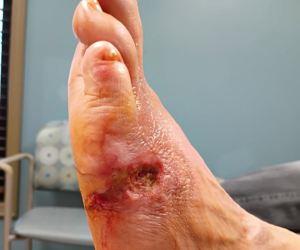
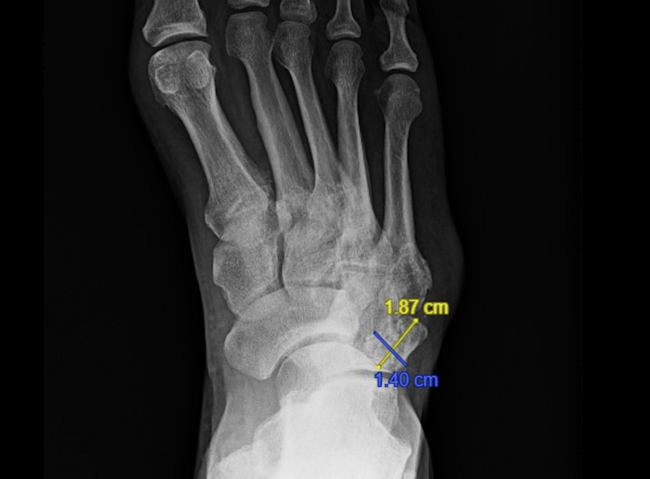
As the global burden of chronic wounds escalates—particularly among aging populations and individuals with comorbid conditions—there is a growing imperative to adopt therapies that are both mechanistically sound and clinically effective. Emerging real-world evidence supports the use of nitric oxide-delivering foam as a potentially disruptive solution in this space. With its ease of use and promising outcomes, I feel that NO foam may redefine frontline wound care strategies and set a new benchmark for biologically active interventions (Figure 1).
New Real-World Evidence from Skilled Nursing Facilities
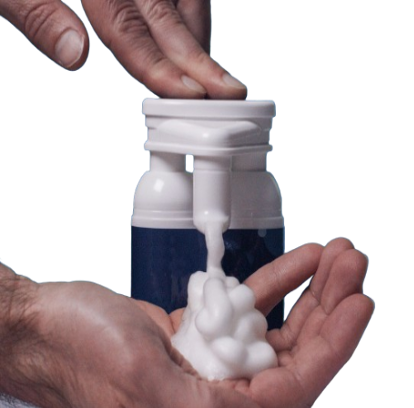
New, not-yet published data from a retrospective observational study looked at the healing outcomes of pressure injuries treated with a nitric oxide-delivering foam (NODF) in skilled nursing facilities (SNFs), comparing them to historical standard-of-care (SOC) controls.
Design and Methods
- Population: Adult SNF patients (200 patients per group, intervention and control) with stage I–IV, unstageable, or deep tissue pressure injuries.
- Intervention: NODF applied at least twice over 7 days.
- Control: SOC included saline, debridement, standard dressings, and antimicrobials.
- Matching: 1:1 propensity score matching on baseline covariates, including wound area, stage, comorbidities, patient sex, and treatment timing.
- Analysis: Bayesian hierarchical models were used to assess the probability of complete closure within 12 weeks, with posterior means, medians, and 95% credible intervals (CrIs) reported.
Key Findings
- Healing Probability: By 12 weeks, NODF-treated wounds showed a significantly higher probability of complete closure compared with SOC across most wound stages (overall 64% [95% CrI 51–76%] vs 35% [22–49%]).
- Stage-Specific Outcomes: Significant benefits were observed in Stage 1 (94% vs 79%), Stage 2 (79% vs 46%), Stage 3 (64% vs 28%), Stage 4 (38% vs 13%), unstageable wounds (39% vs 12%), and deep-tissue pressure injuries (67% vs 32%), there was more uncertainty in Stage 1 and Stage 4 but overall superiority suggested.
These results highlight the potential of NO-based therapies to improve wound outcomes in real-world SNF settings, where resources and staffing may be limited.
Workflow Integration
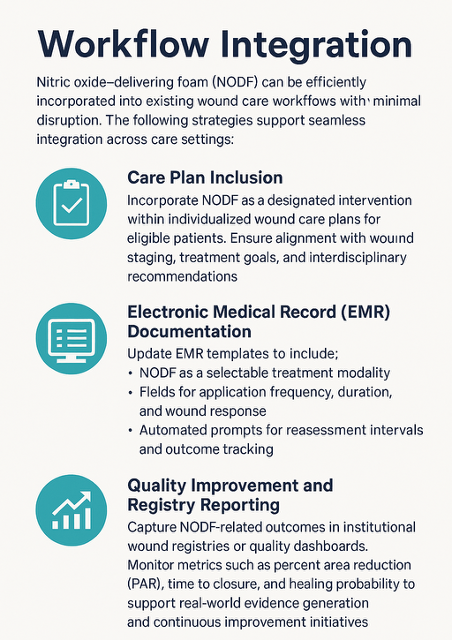
Nitric oxide-delivering foam (NODF) can be efficiently incorporated into existing wound care workflows with minimal disruption (Figure 2). The following strategies can support seamless integration across care settings:
- Care Plan Inclusion: Incorporate NODF as a designated intervention within individualized wound care plans for eligible patients. Ensure alignment with wound staging, treatment goals, and interdisciplinary recommendations.
- Electronic Medical Record (EMR) Documentation: Update EMR templates to include:
◦ NODF as a selectable treatment modality
◦ Fields for application frequency, duration, and wound response
◦ Automated prompts for reassessment intervals and outcome tracking
- Quality Improvement and Registry Reporting: Capture NODF-related outcomes in institutional wound registries or quality dashboards. Monitor metrics such as percent area reduction (PAR), time to closure, and healing probability to support real-world evidence generation and continuous improvement initiatives.
By embedding NODF into routine workflows, facilities can enhance consistency, improve healing outcomes, and support data-driven decision-making in chronic wound management.
Discussion
The integration of NODF into wound care protocols could offer a cost-effective, over-the-counter solution with minimal training requirements. Its dual action—enhancing perfusion and reducing microbial load—addresses 2 critical barriers to healing in chronic wounds.
Given the projected rise in hard-to-heal wounds due to global aging and healthcare disparities, scalable interventions like NODF may play a pivotal role in reducing long term negative sequala and improving quality of life for vulnerable populations.
Conclusion
In my observation and experience, nitric oxide foam represents a promising advancement in hard to heal wound management. With strong mechanistic rationale and supportive real-world data, it offers a novel therapeutic pathway that aligns with global efforts to reduce the burden of hard to heal wounds. Future prospective studies and broader implementation strategies will be essential to validate and expand its impact across diverse care settings.
Dr. Cole is the Director of Wound Care Research at Kent State University School of Podiatric Medicine. She is a Member of the Board of Directors of the American College of Clinical Wound Specialists, the Chair of the Gaps Work Group for the Wound Care Collaborative Community, and a Trustee of the American Board of Wound Management.
Dr. Cole discloses that she works with NOxy Health in a research capacity. This affiliation did not influence the design, execution, or interpretation of the work presented in this article.
References
1. Marques R, Lopes M, Ramos P, Neves-Amado J, Alves P. Prognostic factors for delayed healing of complex wounds in adults: A scoping review. Int Wound J. 2023;20(7):2869-2886. doi:10.1111/iwj.14128
2. Atkin L, Bućko Z, Conde Montero E, Cutting K, Moffatt C, Probst A, Romanelli M, Schultz G, Tettelbach W. Implementing TIMERS: the race against hard-to-heal wounds. J Wound Care. 2019;28(Sup3a):1-12. Available from: https://doi.org/10.12968/jowc.2019.28.Sup3a.S1
3. Abdissa D, Adugna T, Gerema U, Dereje D. Prevalence of diabetic foot ulcer and associated factors among adult diabetic patients on follow-up clinic at Jimma Medical Center, Southwest Ethiopia, 2019: An institutional-based cross-sectional study. J Diabetes Res. 2020 Mar 15;2020:4106383. doi: 10.1155/2020/4106383. PMID: 32258165; PMCID: PMC7102459.
4. Bahati R, Kitua D, Selestine L, Mwanga A, Urio M, Mchele G, Antanamsu D. Factors influencing the severity of diabetic foot ulcers: a cross-sectional study. BMC Endocr Disord. 2025 Mar 20;25(1):76. doi: 10.1186/s12902-024-01785-0. PMID: 40108563; PMCID: PMC11924770.
5. Mayrovitz HN, Wong S, Mancuso C. Venous, arterial, and neuropathic leg ulcers with emphasis on the geriatric population. Cureus. 2023 Apr 25;15(4):e38123. doi: 10.7759/cureus.38123. PMID: 37252574; PMCID: PMC10212749.
6. Finlayson K, Wu M-L, Edwards HE. Identifying risk factors and protective factors for venous leg ulcer recurrence using a theoretical approach: a longitudinal study. Int J Nurs Stud. 2015;52(6):1042-1051. doi:https://doi.org/10.1016/j.ijnurstu.2015.02.016.
7. Mervis JS, Phillips TJ. Pressure ulcers: Pathophysiology, epidemiology, risk factors, and presentation. J Am Acad Dermatol. 2019 Oct;81(4):881-890.
8. Chakraborty C, Gupta B, Ghosh S. Mobile metadata assisted community database of chronic wound images. Wound Medicine. 2014; 6:34-42.
9. Carter MJ, DaVanzo J, Haught R, Nusgart M, Cartwright D, Fife CE. Chronic wound prevalence and the associated cost of treatment in Medicare beneficiaries: changes between 2014 and 2019. J Med Econ. 2023;26(1):894-901. doi:10.1080/13696998.2023.2232256
10. Witte MB, Barbul A. Role of nitric oxide in wound repair. Am J Surg. 2002 Apr;183(4):406-12. doi: 10.1016/s0002-9610(02)00815-2. PMID: 11975928.
11. Bahadoran Z, Mirmiran P, Hosseinpanah F, Kashfi K, Ghasemi A. Nitric oxide-based treatments improve wound healing associated with diabetes mellitus. Med Gas Res. 2025 Mar 1;15(1):23-35. doi: 10.4103/mgr.MEDGASRES-D-24-00020. Epub 2024 Jul 25. PMID: 39436167; PMCID: PMC11515056.
12. Malone-Povolny MJ, Maloney SE, Schoenfisch MH. Nitric oxide therapy for diabetic wound healing. Adv Healthc Mater. 2019 Jun;8(12):e1801210. doi: 10.1002/adhm.201801210. Epub 2019 Jan 15.
13. Ahmed R, Augustine R, Chaudhry M, et al. Nitric oxide-releasing biomaterials for promoting wound healing in impaired diabetic wounds: State of the art and recent trends. Biomed Pharmacother. 2022;149:112707. doi:10.1016/j.biopha.2022.112707
14. Kandhwal M, Behl T, Kumar A, Arora S. Understanding the potential role and delivery approaches of nitric oxide in chronic wound healing management. Curr Pharm Des. 2021;27(17):1999-2014. doi: 10.2174/1381612826666201026152209. PMID: 33106138.
15. Yu H, Cui LX, Huang N, Yang ZL. Recent developments in nitric oxide-releasing biomaterials for biomedical applications. Med Gas Res. 2019 Oct-Dec;9(4):184-191. doi: 10.4103/2045-9912.273956. PMID: 31898603; PMCID: PMC7802421.
16. Oliver S, Pham TTP, Li Y, Xu FJ, Boyer C. More than skin deep: using polymers to facilitate topical delivery of nitric oxide. Biomater Sci. 2021 Jan 26;9(2):391-405. doi: 10.1039/d0bm01197e. PMID: 32856653.
© 2026 HMP Global. All Rights Reserved.
Any views and opinions expressed are those of the author(s) and/or participants and do not necessarily reflect the views, policy, or position of Podiatry Today or HMP Global, their employees, and affiliates.