Volume 30 - Issue 9 - September, 2018

Original Contribution
08/28/2018
Takashi Matsumoto, MD; Kazunori Horie, MD; Norio Tada, MD; Tsuyoshi Isawa, MD; Masataka Taguri, PhD; Shigeaki Kato, PhD; Taku Honda, MD; Tatsushi Ootomo, MD; Naoto Inoue, MD
We investigated whether a newly designed strategy of immediate transradial intervention using one sheathless hydrophilic-coated guiding catheter after diagnostic coronary angiography with one 4.0 Fr sheath via a single access site (the...
We investigated whether a newly...
08/28/2018
Journal of Invasive Cardiology
Original Contribution
08/28/2018
Kintur Sanghvi, MD, FACC, FSCAI; Joseph Kusick, DO; Courtney Krathen, DO
We studied the safety and efficacy of tibio-pedal access as the sole primary access for revascularization of peripheral artery disease by reviewing a prospectively maintained database of patients where it was used as a primary access for...
We studied the safety and...
08/28/2018
Journal of Invasive Cardiology
08/28/2018
Selected abstracts presented at the 14th Annual C3 Meeting.
Selected abstracts presented at...
08/28/2018
Journal of Invasive Cardiology
08/28/2018
Jeffrey S. Berger, MD, MS; Nathaniel R. Smilowitz, MD, MS; Francisco Ujueta, MD, MS
We examined coronary artery anatomy in patients referred for coronary angiography for the evaluation of perioperative MI after non-cardiac surgery.
We examined coronary artery...
08/28/2018
Journal of Invasive Cardiology
Clinical Images
08/28/2018
Yat-Yin Lam, MD; Alex Pui-wai Lee, MBChB; Chak-Yu So, MBChB; Kun-Chong Tam, MD
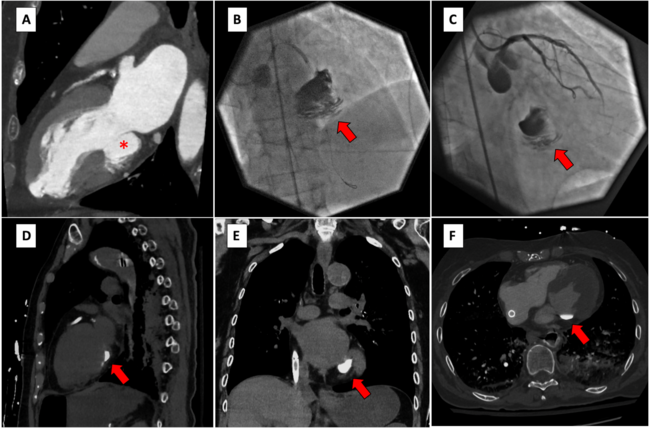
A 72-year-old woman with severe mitral and tricuspid regurgitation secondary to chronic atrial fibrillation presented with refractory heart failure despite optimal medical treatment. She was considered inoperable, and thus underwent...
A 72-year-old woman with severe...
08/28/2018
Journal of Invasive Cardiology
Clinical Images
08/28/2018
Brody D. Slostad, MD; Chance M. Witt, MD; Thomas A. Foley, MD
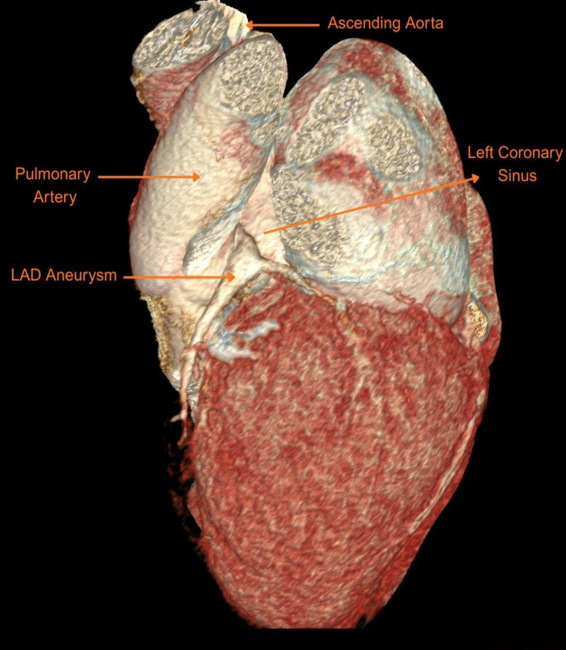
Coronary artery anomalies are relatively rare (~1% on CTA). We present two exceedingly rare cases, as well as the first reported case of anomalous retro-aortic coronary arteries diagnosed with cardiac CTA and angiography.
Coronary artery anomalies are...
08/28/2018
Journal of Invasive Cardiology
Clinical Images
08/28/2018
Suhail Q. Allaqaband, MD; Tanvir Bajwa, MD; Khawaja Afzal Ammar, MBBS, MS; Anthony DeFranco, MD
This case of a 56-year-old woman with normal coronaries displays the side-to-side motion of the unengaged catheter followed by the rhythmic up-and-down, piston-like movements of the catheter tip after engagement.
This case of a 56-year-old woman...
08/28/2018
Journal of Invasive Cardiology
Clinical Images
08/28/2018
Giovanni Lorenzoni, MD; Pierluigi Merella, MD; Gavino Casu, MD; Graziana Viola, MD; Nicola Marziliano, PhD
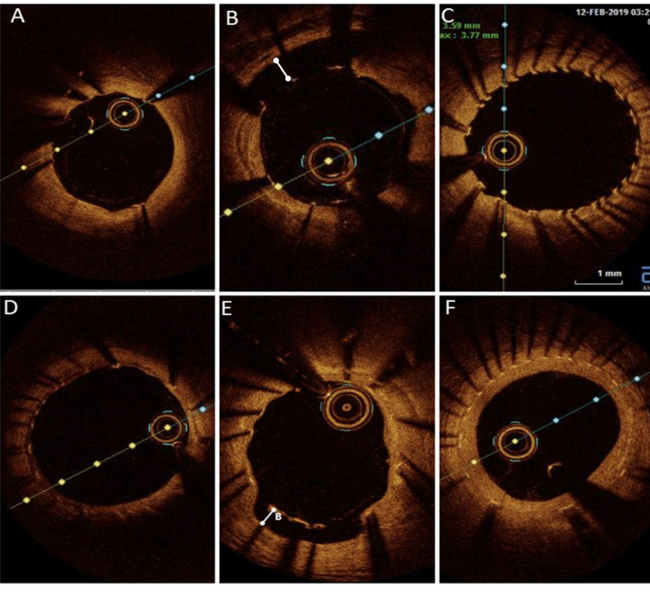
This image shows an impressive “honeycomb” pattern of neoatherosclerosis in the context of very late in-stent restenosis. In this case, OCT excluded the most common mechanisms of late in-stent restenosis, underlying the complexity of this...
This image shows an impressive...
08/28/2018
Journal of Invasive Cardiology
Original Contribution
07/15/2018
Alfredo G. Cerillo, MD; Olivier Muller, MD, PhD; Clinton Lloyd, MD; Patric Biaggi, MD; Michael Hilker, MD; Roberto Corti, MD; Yaron Almagor, MD; Miriam Brinkert, MD; Andreas Rück, MD; Florim Cuculi, MD; Stefan Toggweiler, MD; Won-Keun Kim, MD; Richard Kobza, MD
We report an international experience of TAVR using the self-expanding Acurate neo valve (Boston Scientific) in aortic regurgitation.
We report an international...
07/15/2018
Journal of Invasive Cardiology
Original Contribution
07/15/2018
Pierre Robert, MD; Patrick Messner-Pellenc, MD, PhD; Florence Leclercq, MD, PhD; Guillaume Cayla, MD, PhD; Benoit Lattuca, MD; David Belardi, MD; Christophe Demattei, MD; Laurent Schmutz, MD; Luc Cornillet, MD; Bertrand Ledermann, MD; Jean-Christophe Macia, MD; A. Lemmi, MD; Richard Gervasoni, MD; Francois Roubille, MD, PhD; Thien Tri Cung, MD
Recent studies have challenged systematic pretreatment with a P2Y12 inhibitor before PCI in elective and NSTEMI patients. This study assesses outcomes after performing PCI immediately after coronary angiography with an exclusive...
Recent studies have challenged...
07/15/2018
Journal of Invasive Cardiology
Original Contribution
07/15/2018
Liam McCormick, MD, MRCP; Toru Naganuma, MD; Nick E.J. West, MD, PhD, FRCP; Sandeep Basavarajaiah, MD, MRCP, MBBS; Adam Brown, PhD, MRCP; Parag Gajendragadkar, MD, MRCP
We aimed to define the frequency of anatomic variants and success rates during transradial access for PCI. These data provide reassurance for would-be radial converts that the learning curve may not be as steep as envisaged. 
We aimed to define the frequency...
07/15/2018
Journal of Invasive Cardiology
Original Contribution
06/15/2018
Ashleigh Long, MD, PhD; Paul Mahoney, MD
Transcatheter mitral valve-in-valve (TMVIV) or valve-in-ring (TMVIR) replacement has shown early promise in poor surgical candidates. This retrospective study reviewed the procedural outcomes of all TMVIV and TMVIR procedures between...
Transcatheter mitral...
06/15/2018
Journal of Invasive Cardiology