Coring Aspiration Thrombectomy or “CAT Pounce” Technique for Large Coronary Thrombi Resistant to Aspiration Alone
© 2025 HMP Global. All Rights Reserved.
Any views and opinions expressed are those of the author(s) and/or participants and do not necessarily reflect the views, policy, or position of the Journal of Invasive Cardiology or HMP Global, their employees, and affiliates.
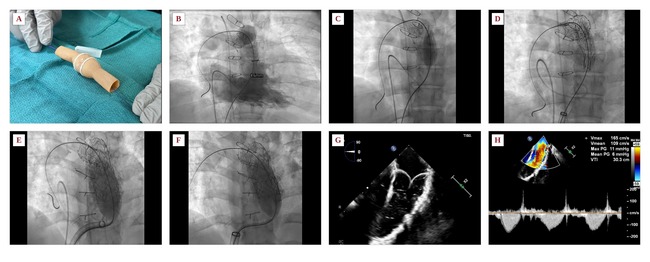
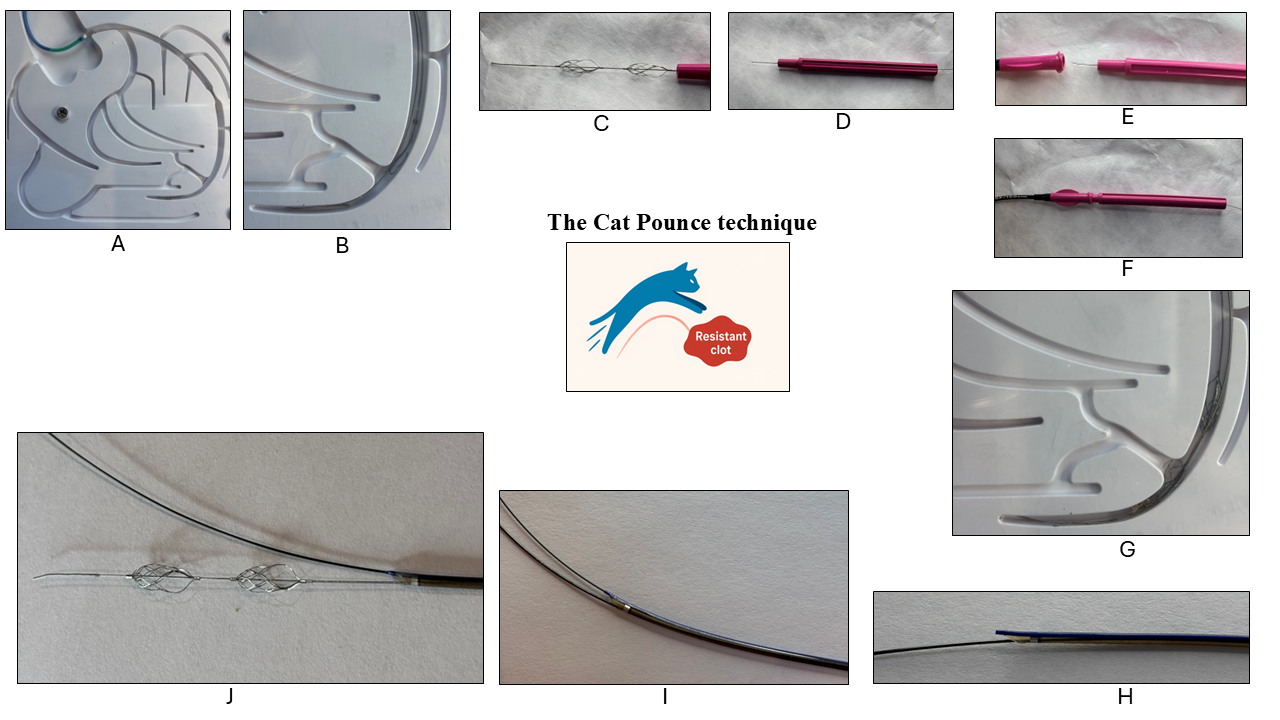
Massive thrombi (Thrombolysis in Myocardial Infarction [TIMI] grade 4-5) remain a difficult subset of percutaneous coronary interventions in acute coronary syndrome and are often resistant to aspiration thrombectomy despite antithrombotic therapy and intracoronary thrombolytics. We describe a novel approach combining aspiration with off-label coring thrombectomy to remove thrombi unresponsive to suction (Figure). The “CAT Pounce” technique uses the CAT RX catheter (Penumbra) and the Pounce LP basket (Surmodics) to extract organized coronary thrombi safely and effectively (Video).
After failed TIMI-3 flow restoration using the CAT RX through a 6F guide, the steps are:
- Place a 300-cm buddy wire alongside a short working wire (Figure A).
- Advance a Pounce LP microcatheter (MC) over the long wire beside the working wire (Figure B).
- Remove the long wire.
- Deliver the Pounce LP basket via MC (Figure C-F).
- Withdraw the MC while pinning the working wire (Figure G).
- Attach a hemostatic device to the CAT RX hub.
- Thread the basket wire into the CAT RX over-the-wire lumen until its tip aligns with the working wire (Figure H).
- Thread the working wire into the CAT RX port (Figure I).
- Advance the CAT RX over both wires to the proximal thrombus (Figure J).
- Tighten the valves.
- Connect the aspiration tubing.
- Remove the working wire.
- Initiate aspiration.
- Pull and rotate the basket into the CAT RX tip.
- Withdraw the CAT RX and basket together.
- Bleed back and retighten guide valve.
- Stop console aspiration.
- Aspirate 10 mL manually via the guide.
- Rewire the vessel.
- Re-aspirate with the CAT RX for 30 to 60 seconds.
Affiliations and Disclosures
Hady Lichaa, MD
From the Department of Cardiology at Ascension Saint Thomas Rutherford Hospital, University of Tennessee Health Science Center Nashville, Tennessee.
Acknowledgments: Many thanks for the hard work and outstanding standards set by the cath lab staff at Ascension Saint Thomas Rutherford Hospital in Murfreesboro TN.
Disclosures: Dr Lichaa is a consultant for Surmodics, Medtronic, and Abbott Vascular.
Address for correspondence: Hady Lichaa, MD, 1840 Medical Center Pkwy Suite 201, Murfreesboro, TN 37129, USA. Email: Hady.lichaa@gmail.com; X: @HadyLichaaMD
References
- Jeon HS, Kim YI, Lee JH, et al. Failed thrombus aspiration and reduced myocardial perfusion in patients with STEMI and large thrombus burden. JACC Cardiovasc Interv. 2024;17(19):2216-2225. doi:10.1016/j.jcin.2024.07.016