Anomalous Origin of the Right Coronary Artery From the Left Anterior Descending Artery: A Rare Trifurcation Lesion
© 2026 HMP Global. All Rights Reserved.
Any views and opinions expressed are those of the author(s) and/or participants and do not necessarily reflect the views, policy, or position of the Journal of Invasive Cardiology or HMP Global, their employees, and affiliates.
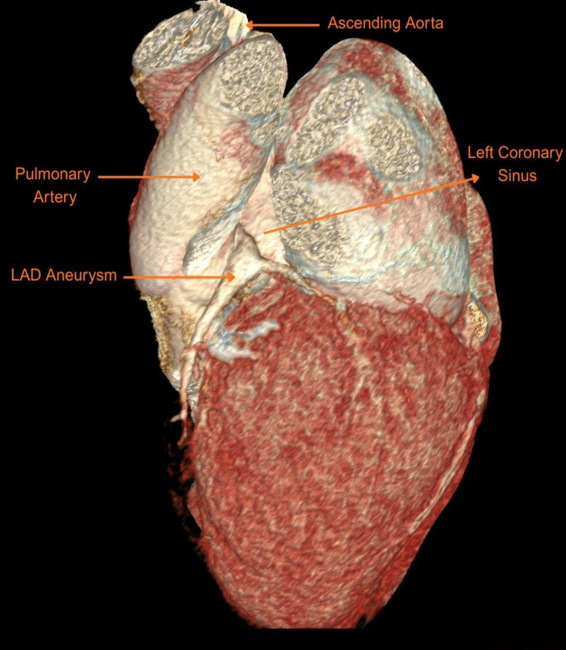
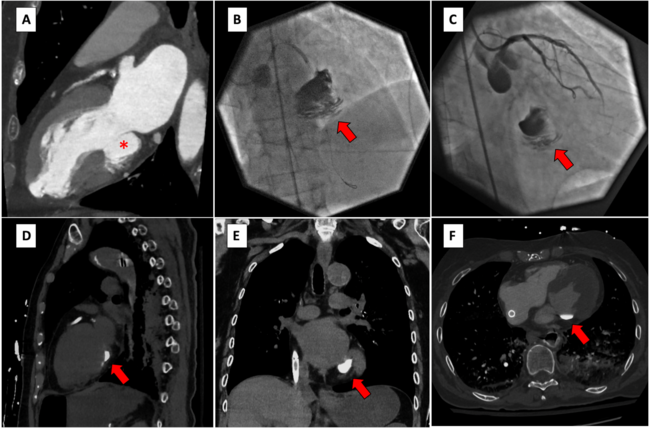
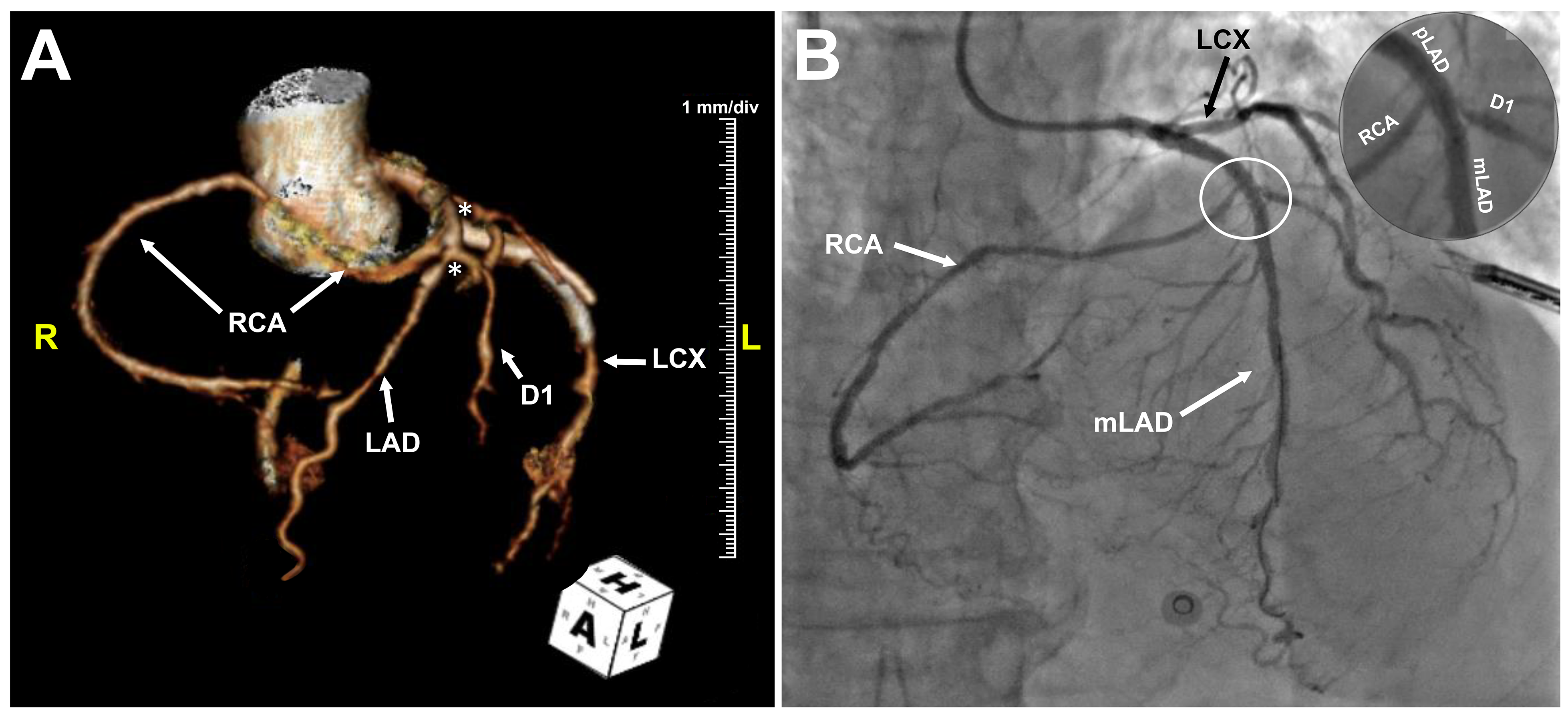
A 77-year-old woman underwent cardiac computed tomography angiography (CCTA) for stable chest discomfort. CCTA revealed a dominant right coronary artery (RCA) originating from the proximal left anterior descending artery (LAD) and coursing between the aorta and right ventricular outflow tract before assuming its normal path in the right atrioventricular groove. Coronary angiography demonstrated a complex trifurcation lesion involving the LAD, first diagonal branch (D1), and anomalous RCA (Figure A). The LAD had severe (70%) stenosis distal to the RCA origin (instantaneous wave-free ratio 0.72) and the D1 had severe (80%) stenosis, while the RCA was free of significant disease.
A provisional stenting technique was adopted, with both the RCA and D1 protected using 0.014-inch guidewires.1 After predilation of the D1, the LAD lesion was stented, resulting in excellent Thrombolysis in Myocardial Infarction 3 flow across all branches (Figure B).
Single coronary artery anomalies are exceedingly rare, with fewer than 40 cases of an RCA originating from the LAD reported in the literature.2-5 The presence of right-dominant circulation adds further rarity and procedural complexity. Recognition of such variants is crucial, as intervention demands meticulous wiring strategy, stent positioning, and prevention of ischemia in territories supplied by the anomalous vessel.
This case highlights successful percutaneous management of an anomalous RCA arising from the LAD, a rare trifurcation anatomy encountered in coronary interventions.
Affiliations and Disclosures
Prabhjot Hundal, MD; M. Fuad Jan, MBBS (Hons), MD; Suhail Q. Allaqaband, MD
From Aurora Cardiovascular and Thoracic Services, Aurora Sinai/Aurora St. Luke’s Medical Centers, Aurora Health Care, Milwaukee, Wisconsin.
Acknowledgments: Dr Hundal’s time is supported by the Colton Scholarship.
Disclosures: The authors report no financial relationships or conflicts of interest regarding the content herein.
Consent statement: The authors confirm that informed consent was obtained from the patient for the intervention(s) described in the manuscript and for the publication of their thereof, including any and all images.
Address for correspondence: Suhail Q. Allaqaband, MD, Aurora Cardiovascular and Thoracic Services, Aurora St. Luke’s Medical Center, 2801 W. Kinnickinnic River Parkway, Ste. 530, Milwaukee, WI 53215, USA. Email: wi.publishing3@aah.org
References
1. Kovacevic M, Burzotta F, Elharty S, et al. Left main trifurcation and its percutaneous treatment: what is known so far? Circ Cardiovasc Interv. 2021;14(3):e009872. doi:10.1161/CIRCINTERVENTIONS.120.009872
2. Lau WR, Lee PT, Koh CH. Coronary artery anomalies - state of the art review. Curr Probl Cardiol. 2023;48(11):101935. doi:10.1016/j.cpcardiol.2023.101935
3. Yurtdaş M, Gülen O. Anomalous origin of the right coronary artery from the left anterior descending artery: review of the literature. Cardiol J. 2012;19(2):122-129.
4. Fuenzalida JJV, Becerra-Rodriguez ES, Quivira Muñoz AS, et al. Anatomical variants of the origin of the coronary arteries: a systematic review and meta-analysis of prevalence. Diagnostics (Basel). 2024;14(13):1458. doi:10.3390/diagnostics14131458
5. Wilson J, Reda H, Gurley JC. Anomalous right coronary artery originating from the left anterior descending artery: case report and review of the literature. Int J Cardiol. 2009;137(3):195-198. doi:10.1016/j.ijcard.2009.03.140