Intravascular Ultrasound-Guided True Lumen Re-entry for Successful Recanalization of Chronic Total Occlusions
Case description. A 72-year-old male with severe chronic angina and congestive heart failure was referred for percutaneous treatment of a mid-right coronary artery (RCA) CTO. Diagnostic angiography demonstrated a non-obstructive lesion in the mid-left anterior descending artery (LAD) and widely patent left main and left circumflex coronary arteries. The distal RCA was supplied by collateral vessels from the LAD.
The RCA was engaged with an AL 1.0 7 Fr guide and contralateral injection for distal RCA  visualization was performed using a diagnostic JL4 6 Fr catheter positioned at the left main coronary ostium (Figure 1A). Anticoagulation was achieved with unfractionated heparin. A CrossBoss catheter (BridgePoint Medical) was advanced over a Fielder FC (Abbott Vascular, Santa Clara, California) guidewire to the proximal CTO cap. Bidirectional rotation of the torque device along with the fast-spin technique was used to advance the 3.0 Fr atraumatic rounded tip of the CrossBoss CTO catheter through the CTO. Figure 2 provides a schematic description of
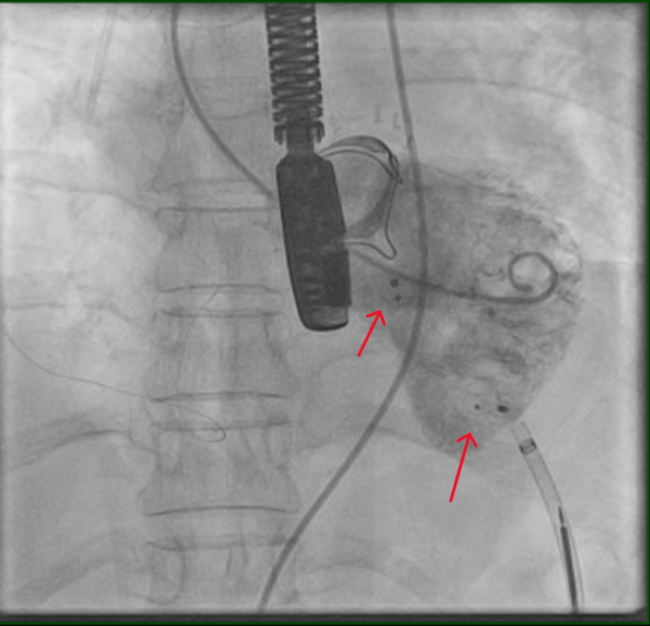
  the CrossBoss device and fast-spin technique. The CrossBoss catheter successfully crossed the lesion but entered the subintimal space past the point of the distal RCA retrograde filling (Figure 1B). After unsuccessful re-entry attempts with a Pilot 200 guidewire (Abbott Vascular), a Stingray balloon catheter was advanced into the distal RCA (Figure 1C). Despite angiographic proximity to the small-caliber distal RCA true lumen, visualized from the left coronary injection in orthogonal projections, (Figure 1C) entry into the true lumen could not be achieved. After dilatation of the subintimal space with a 2.0 mm balloon, a 25 MHz IVUS catheter (Eagle, Volcano Corp., San Diego, California) was used to guide re-entry. IVUS images of the distal RCA true lumen acquired from the subintimal space demonstrated significant plaque burden (Figures 3A, 3B). Proximal pull-back of the IVUS catheter revealed a more favorable site for re-entry with significantly less true lumen plaque burden (Figures 3C, 3D). A repeat attempt at this site for gaining access to the true lumen was successful
  using the Stingray balloon and wire combination (Figure 1D), positioned at the site identified by IVUS, approximately 10–12 mm proximal to the original site of the angiography-guided re-entry attempts (Figure 3D). Confirmation of the distal RCA true lumen was also accomplished via IVUS visualization of the distal RCA bifurcation and presence of side branches. This strategy is preferred over contrast injection through an end-hole microcatheter or an over-the-wire balloon lumen. Final successful recanalization of the RCA and brisk distal flow were secured by placement of 3 overlapping 3.0 mm x 23 mm drug-eluting stents and non-compliant balloon post-dilatation (Figure 1F).
Discussion
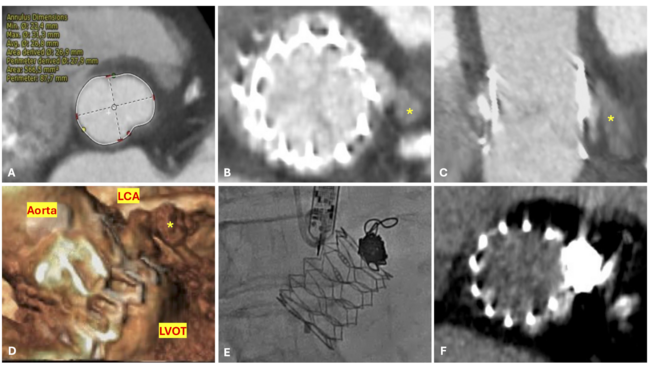
One of the main challenges of coronary CTO procedures is re-entry into the distal true lumen after subintimal tracking of guidewires and/or crossing catheters. Despite the use of different re-entry techniques, selection of the re-entry site remains crucial to a successful procedure. Our case demonstrates the potential use of IVUS for selection of an optimal re-entry location in the presence of an angiographically suboptimal distal vessel target with significant plaque burden. The Stingray system is a dedicated re-entry device which consists of a flat balloon that orients itself along the vessel wall after low-pressure inflation (2–4 atmospheres), and a stiff wire with a 0.003 inch tip that is advanced through one of the two offset exit ports of the balloon, traditionally under angiographic guidance, directed towards the distal vessel true lumen (Figure 4).7–9 Relying solely on angiographic views for guiding re-entry may not identify significant plaque burden, especially if it is eccentric and could hinder guidewire re-entry. IVUS could assist in the selection of an optimal re-entry site with less plaque burden and calcification.5,10 This technique, in our experience, is most useful when the distal target vessel is of small caliber. A solid-state IVUS catheter is better-suited for guiding re-entry, as images are obtained closer to its tip.
Using IVUS for true lumen re-entry has limitations. It may be challenging to differentiate between the true lumen and subintimal space. Color-Doppler IVUS to detect intracoronary flow may aid in the identification of the true lumen. Contrast injections through an end-hole microcatheter or through an over- the-wire balloon lumen for confirmation of the distal true lumen access should be avoided. There is potential for enlargement and extension of the subintimal dissection plane with resultant compression of the true lumen and “staining” of the subintimal space, making further angiographic imaging difficult. Advancing an IVUS catheter into the subintimal space can be challenging, often requiring predilatation of the subintimal space. Balloon dilation and enlargement of the subintimal space may make distal re-entry even more challenging, given the increment in the distance from the true lumen. Though the risk of coronary vessel perforation with an IVUS catheter is low, it may however be advanced inadvertently through an unidentified perforation, resulting in cardiac tamponade.10 We suggest careful examination of the angiogram and contralateral injection before advancing the IVUS catheter within the subintimal space.
In summary, the technique of IVUS-guided distal vessel true lumen re-entry during coronary revascularization of a CTO may be a useful addition to the existing re-entry approaches and strategies.
Acknowledgement. We gratefully acknowledge the tremendous support of the cardiac catheterization laboratory team at the Dallas VA Medical Center for enabling the development of novel catheterization techniques and the performance of clinical research.
guidewire re-entry. IVUS could assist in the selection of an optimal re-entry site with less plaque burden and calcification.5,10 This technique, in our experience, is most useful when the distal target vessel is of small caliber. A solid-state IVUS catheter is better-suited for guiding re-entry, as images are obtained closer to its tip.
Using IVUS for true lumen re-entry has limitations. It may be challenging to differentiate between the true lumen and subintimal space. Color-Doppler IVUS to detect intracoronary flow may aid in the identification of the true lumen. Contrast injections through an end-hole microcatheter or through an over- the-wire balloon lumen for confirmation of the distal true lumen access should be avoided. There is potential for enlargement and extension of the subintimal dissection plane with resultant compression of the true lumen and “staining” of the subintimal space, making further angiographic imaging difficult. Advancing an IVUS catheter into the subintimal space can be challenging, often requiring predilatation of the subintimal space. Balloon dilation and enlargement of the subintimal space may make distal re-entry even more challenging, given the increment in the distance from the true lumen. Though the risk of coronary vessel perforation with an IVUS catheter is low, it may however be advanced inadvertently through an unidentified perforation, resulting in cardiac tamponade.10 We suggest careful examination of the angiogram and contralateral injection before advancing the IVUS catheter within the subintimal space.
In summary, the technique of IVUS-guided distal vessel true lumen re-entry during coronary revascularization of a CTO may be a useful addition to the existing re-entry approaches and strategies.
Acknowledgement. We gratefully acknowledge the tremendous support of the cardiac catheterization laboratory team at the Dallas VA Medical Center for enabling the development of novel catheterization techniques and the performance of clinical research.
References
1. Badhey N, Lombardi WL, Thompson CA, et al. Use of the Venture® Wire Control Catheter for subintimal coronary dissection and reentry in chronic total occlusions. J Invasive Cardiol 2010;22:445–448. 2. Colombo A, Mikhail GW, Michev I, et al. Treating chronic total occlusions using subintimal tracking and reentry: the STAR technique. Catheter Cardiovasc Interv 2005;64:407–411; discussion 412. 3. Surmely JF, Tsuchikane E, Katoh O, et al. New concept for CTO recanalization using controlled antegrade and retrograde subintimal tracking: The CART technique. J Invasive Cardiol 2006;18:334–338. 4. Rathore S, Katoh O, Matsuo H, et al. Retrograde percutaneous recanalization of chronic total occlusion of the coronary arteries: Procedural outcomes and predictors of success in contemporary practice. Circ Cardiovasc Interv 2009;2:124–132. 5. Tsujita K, Maehara A, Mintz GS, et al. Intravascular ultrasound comparison of the retrograde versus antegrade approach to percutaneous intervention for chronic total coronary occlusions. JACC Cardiovasc Interv 2009;2:846–854. 6. Iturbe JM, Abdel-Karim AR, Raja VN, et al. Use of the venture wire control catheter for the treatment of coronary artery chronic total occlusions. Catheter Cardiovasc Interv 2010 Mar 26. [Epub ahead of print] 7. Brilakis ES, Lombardi WL, Banerjee S. Use of the Stingray® Guidewire and the Venture® Catheter for crossing flush coronary chronic total occlusions due to In-Stent Restenosis. Catheter Cardiovasc Interv 2010: in press. 8. Weisz G, Moses JW. Contemporary principles of coronary chronic total occlusion recanalization. Catheter Cardiovasc Interv 2010;75(Suppl 1):S21–S27. 9. Casserly IP, Rogers RK. Use of Stingray re-entry system in treatment of complex tibial artery occlusive disease. Catheter Cardiovasc Interv 2010;76:584–588. 10. Ito S, Suzuki T, Ito T, et al. Novel technique using intravascular ultrasound-guided guidewire cross in coronary intervention for uncrossable chronic total occlusions. Circ J 2004;68:1088–1092.