The Left Radial is Now Open for Access: How to Keep Radial First
Editor's note: A pdf of this article is available for download at right (look for red pdf icon).
Case Presentation
The lower mortality with radial approach for those with myocardial infarction has driven a surge in radial approach for vascular access.1 A 2018 American Heart Association Scientific Statement noted that for every 1000 patients with acute coronary syndrome undergoing transradial percutaneous coronary intervention (PCI), there were 10 fewer deaths (95% confidence interval [CI], 5-16), and the corresponding number needed to treat with transradial access to prevent 1 death was 100 (95% CI, 67-235).1
Radial procedures in the United States have increased dramatically from a rate of 1% in 2008 to now well over 40%.2 Radial access rates will most likely further escalate with the near-tripling of obesity across the globe3, as studies confirm the resulting lower bleeding complications, greater patient satisfaction, rapid ambulation, and lower costs, as well as the lesser-known advantages of opening up an additional femoral access site for hemodynamic support or chronic total occlusion PCI and availability for mesenteric, pelvic, peripheral vascular, and neurovascular intervention.1,2,4-6
Given most physicians’ preference to stand on the right side of the patient in order to take advantage of the operator’s own hand dominance and comfort, as well as the patient’s right wrist proximity, room configuration, right radial access as the default preference is logical. Specialty universal catheters provide a multitude of shapes required to access the coronary vessels from the right wrist, increasing success rates, although with some added expense. However, a significant percentage of cases still default to the common femoral artery approach, either as the primary access choice, or the default access of choice with a failed right radial artery attempt, completely eliminating the advantage of radial access and reducing outcome metrics, such as bleeding or vascular complications.1,7
Seeking to “stay radial” starts by proactively identifying those cases likely to result in right radial access failures. Anatomically challenging right radial cases usually occur in a well-defined subgroup of patients displaying common, overlapping anatomic characteristics, including increased vessel tortuosity, ectasia, and angulation, combined with a shorter length between the ascending aorta to coronary vessel takeoff (Table 1).
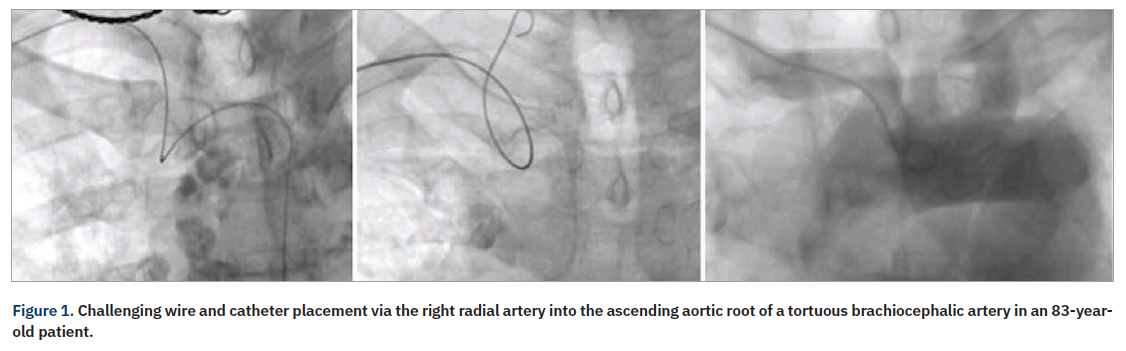
As people age, arterial elasticity is reduced. The aorta is no different, losing elasticity8 and leading to progressive tortuosity of the brachiocephalic-aortic junction (Figure 1).
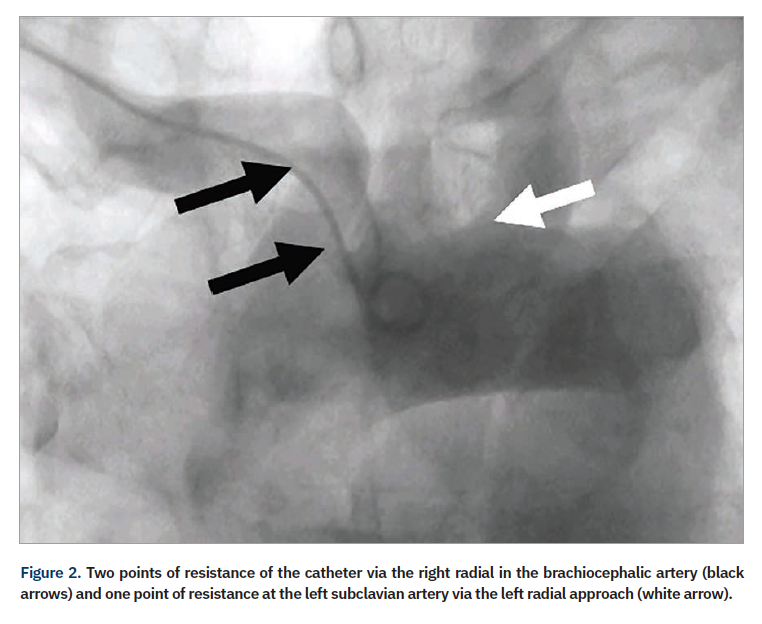
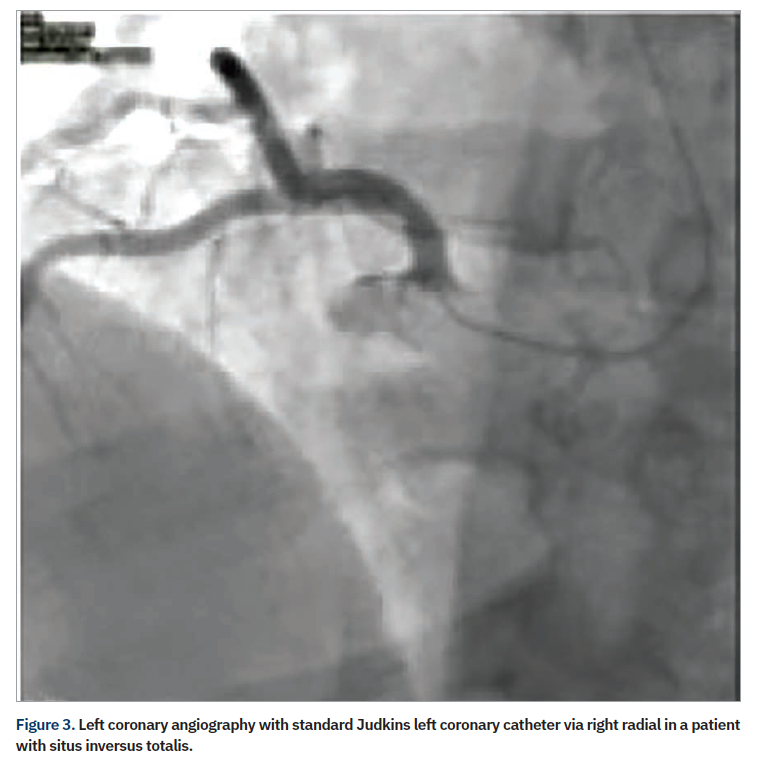
A review of 2100 failed transradial approaches for PCI found age >75 years (P<.001); prior coronary bypass surgery (CABG) (P<.001), and height <5 feet, 5 inches (165 cm) (P=.02) as independent predictors.9 Another study examined 1609 patients and found previous CABG, cardiogenic shock, and female sex as multivariable predictors for transradial failure of PCI (with right radial the default for transradial procedures, except in the case of prior CABG).10 Although a more experienced radial operator will often overcome the challenges of a right radial approach, there are still some patients where the majority of operators favor femoral access, such as patients with history of CABG. In a subgroup of patients (Table 1), access via the left radial artery may allow programs to “stay radial”. The catheter passing via the left arm follows a similar path as the femoral approach, with only one area of resistance in its path, at the left subclavian-aorta junction; conversely, the catheter passing via the right arm has two areas of resistance in its path, at the subclavian-brachiocephalic and the brachiocephalic–aortic junctions (Figure 2).11 An example of the analogy is the ease of right radial in those with situs inversus totalis (Figure 3), where with only one spot of resistance, the typical femoral catheters can be used easily via the right wrist.12
With a path similar to the femoral approach, left wrist access offers the advantage of using the same catheters for angiography and guide support for PCI. The manufacturing of longer diagnostic and guide catheters, and longer balloon and stent shaft lengths, will make a left wrist approach easier in those taller than 6 feet. Medtronic, for example, now offers 118 cm Launcher guiding catheters to overcome distance challenges without impeding delivery of balloons or stents. Terumo Interventional Systems offers longer length R2P (radial to pedal) interventional sheaths, balloons, and stents.6
Why then, is left radial still considered a secondary access? Until recently, one culprit was the lack of consistent product options for arm positioning, combined with the ergonomic limitations to the physician working on the right side of the patient to use the patient’s left wrist. Pillows supporting the left arm are neither consistent nor stable, and do not prevent arm drift. Arm support systems such as the Left Arm Support System (LASS) (LP Medical) and the STARSystem (Adept Medical) offer support for left radial or ulnar access, and support of the arm across the abdomen. The Cobra Board (TZ Medical) and Cardio-TRAP (Trans-Radial Solutions) offer left arm positioning across the abdomen (Figure 4).
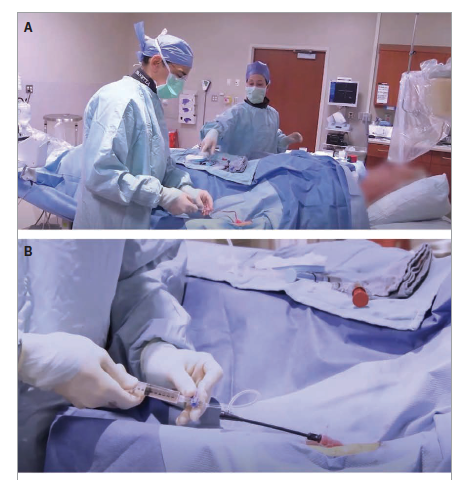
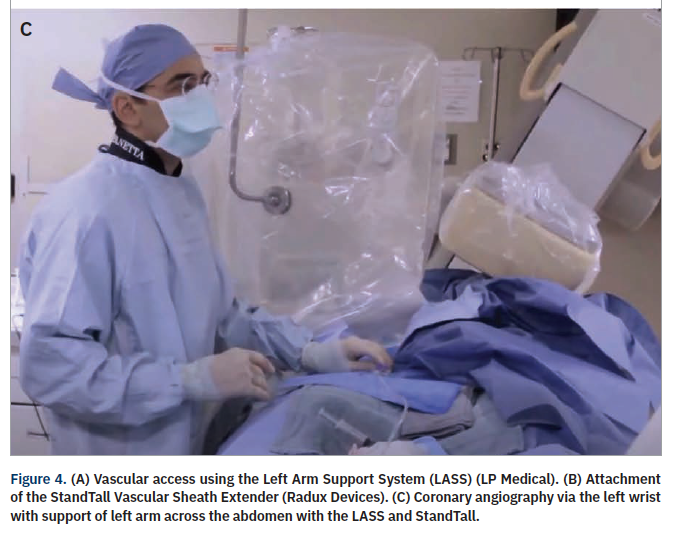
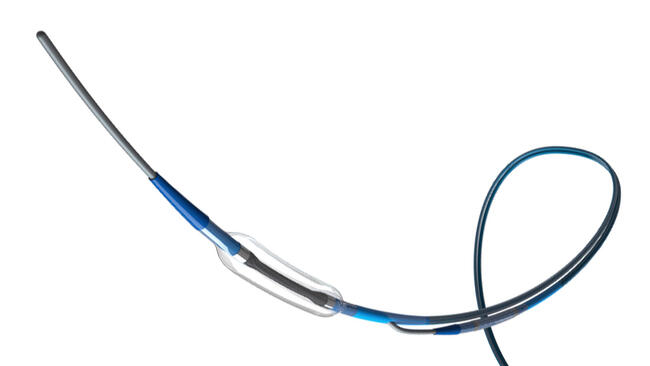
New to the catheterization laboratory is the StandTall Vascular Sheath Extender (Radux Devices) that increases the left radial artery vessel length externally for the physician (Figure 4). The added length of the StandTall can extend the access site up to 25 cm if needed, and that length reduces or eliminates the bending that typically causes significant repeated operator stress and injury. The StandTall Sheath Extender, along with one of the dedicated boards supporting the left arm for arterial access across the low abdomen, will comfortably and with reproduceable consistency, open up the left wrist for access and intervention.
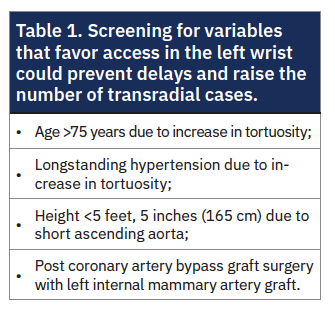
Screening for variables that favor access in the left wrist could prevent delays and raise the number of transradial cases. Consider the left wrist in those with prior CABG, short stature <5 feet 5 inches (165 cm), age >75 years, and/or long-standing hypertension (Table 1). Avoiding intravenous (IV) peripheral line placement in the hands or near the wrists will also save time. If integrated, the “stay radial” approach should lead to fewer femoral artery defaults, lower costs, and higher overall radial artery access utilization.
References
1. Mason PJ, Shah B, Tamis-Holland JE, et al; American Heart Association Interventional Cardiovascular Care Committee of the Council on Clinical Cardiology; Council on Cardiovascular and Stroke Nursing; Council on Peripheral Vascular Disease; and Council on Genomic and Precision Medicine. An update on radial artery access and best practices for transradial coronary angiography and tntervention in acute coronary syndrome: a scientific statement from the American Heart Association. Circ Cardiovasc Interv. 2018 Sep; 11(9): e000035.
2. Rao SV, Dharma S. 25 Years of transradial intervention: looking back and anticipating what is ahead. JACC Cardiovasc Interv. 2017; 10(22): 2266-2268.
3. World Health Organization. Obesity and overweight. Accessed June 24, 2021. Available online at https://www.who.int/news-room/fact-sheets/detail/obesity- and-overweight
4. Mitchell MD, Hong JA, Lee BY, et al. Systemic review and cost-benefit analysis of radial artery access for coronary angiography and intervention. Cardiovas Qual Outcomes. 2012; 5: 454-462.
5. Takeshi O, Raveendran G, Panetta CJ. Long radial sheath for angiography of femoral artery large sheath access site with vascular closure devices. Cardiology and Angiology: An International Journal. 2021 Mar; 10(1): 41-45.
6. Posham R, Young LB, Lookstein RA, et al. Radial access for lower extremity peripheral arterial interventions: do we have the tools? Semin Intervent Radiol. 2018 Dec; 35(5): 427-434.
7. Gragnano F, Brana M, Frigoli E, et al; MATRIX Trial Investigators. Access-site cossover in patients with acute coronary syndrome undergoing invasive management. JACC Cardiovasc Interv. 2021 Feb 22; 14(4): 361-373.
8. Boufi M, Guivier-Curien C, Loundou AD, et al. Morphological analysis of healthy aortic arch. Eur J Vasc Endovasc Surg. 2017 May; 53(5): 663-670.
9. Dehghani P, Mohammad A, Bajaj R, et al. Mechanism and predictors of failed transradial approach for percutaneous coronary interventions. JACC Cardiovasc Interv. 2009 Nov; 2(11): 1057-1064.
10. Abdelaal E, Brousseau-Provencher C, Montminy S, et al; Interventional Cardiologists at Quebec Heart-Lung Institute. Risk score, causes, and clinical impact of failure of transradial approach for percutaneous coronary interventions. JACC Cardiovasc Interv. 2013 Nov; 6(11): 1129-1137.
11. Patel T, Shah S, Rihal CS, et al. Cannulation of the coronary ostia. In: Patel’s Atlas of Transradial Intervention: The Basics and Beyond. 2nd ed. Malvern, PA: HMP Communications, 2012.
12. Panetta, CJ and Rao, S. Transradial access on the side the heart resides on: Case report on right transradial access angiography in two patients with situs inversus totalis. Journal of Clinical and Invasive Cardiology. 2018; 4(1).
13. Campeau L. Percutaneous radial artery approach for coronary angiography. Cathet Cardiovasc Diagn. 1989 Jan; 16(1): 3-7. doi: 10.1002/ccd.1810160103