Innovation That Overcomes Radial Access Challenges
© 2025 HMP Global. All Rights Reserved.
Any views and opinions expressed are those of the author(s) and/or participants and do not necessarily reflect the views, policy, or position of Cath Lab Digest or HMP Global, their employees, and affiliates.
Manit Sabharwal with Morton Kern, MD, MSCAI, and Arnold Seto, MD, MPA, FSCAI, FACC, FAHA
Transradial access (TRA) is widely used for percutaneous coronary intervention (PCI) procedures because of its association with lower bleeding and vascular complications compared to transfemoral artery access. In August, interventional cardiologists and long-term radialists Morton Kern, MD, MSCAI, and Arnold Seto, MD, MPA, FSCAI, FACC, FAHA, both practicing in Long Beach, California*, discussed a novel radial access tool with Merit Medical®’s Manit Sabharwal. Discussion ranged from TRA clinical tips to the challenges of bringing a new product into the cath lab system. They concluded that innovative products are worth the effort and that patients will benefit from a fresh approach to a familiar procedure.
Innovation Starts With a Critical Look at Challenges
Both physicians have performed hundreds of radial access procedures using many different products. Just as every physician has their go-to tools, Dr. Kern and Dr. Seto both trained on and use the Terumo Glidesheath Slender® in their radial access procedures. “Terumo helped build the radial market in the U.S.,” said Dr. Seto. “When someone learns one technique or device, it’s hard to change.” And yet when something truly different and innovative comes along, that can create a different kind of energy.
Until recently, there had not been many options for TRA. The Glidesheath Slender is an excellent product, but like any product, it has idiosyncrasies; for instance, occasional kinking and difficulty with sheath insertion. For safety reasons, Dr. Seto no longer nicks the skin for radial sheath insertion. But as a result, the Glidesheath Slender would typically need to be pushed in with “both hands, holding most of it in order to push it through without kinking,” according to Dr. Seto. The final challenge was securement in the face of the sheath’s slippery hydrophilic coating. More than once, a patient has retracted their arm against the locked Protego® radiation protection system shield, resulting in the sheath pulling out.
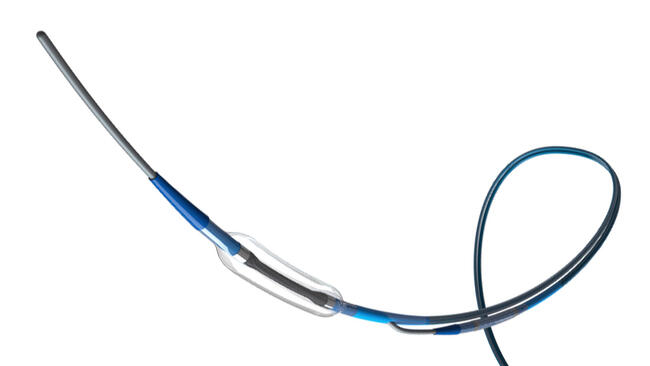
The new sheath from Merit® generated interest as a possible improvement over the current tools. The Prelude Wave™ “went right in and it slipped through the tissue with great ease,” said Dr. Kern. He considered that a “big plus” for the product. The other concern was that securing a sheath in place can be difficult. Many interventional cardiologists use Tegaderm™, but the Prelude Wave comes with a unique fixation system, the SnapFix™ technology, which Dr. Kern said is very easy to use. Dr. Kern was “sold on the first case.”
Clinical Tips for TRA
Sliding in the Sheath
One early accommodation for the Glidesheath Slender was to “nick the skin to get the sheath in,” said Dr. Seto. Today, most Glidesheath Slenders are able to penetrate the skin, though some patients still have tough skin and are a “little resistant [to easy advancement] and the sheath tends to kink” in those situations, said Dr. Seto. In contrast, the Prelude Wave came with a stiff dilator that facilitated sheath movement and was a significant advantage over competitive tools.
Securing the Sheath
Catheter exchanges are constant opportunities for lubricious sheaths to slip out of their placement. This can be a problem for radialists, because they depend on the steady presence of the sheath.
“When we first started these radial access procedures, after sheath insertion, we sutured the sheath to the skin to keep it from moving around,” said Dr. Seto. That practice gave way to securing the sheath using 3M™ Tegaderm. But the presence of any leaked blood at the sheath insertion area would render the Tegaderm useless. A thin blood layer under the film prevents the adhesive from gripping properly, resulting in a weak anchoring of the sheath and a poor film seal.
Two Radial Prep Setups for TRA
On the arm without the drape, the SnapFix adhered to the skin without difficulty, and blood did not interfere with its adhesion. The interaction between the SnapFix and radial drapes was discussed as well. Drs. Kern and Seto typically choose between two prep setups for radial access procedures:
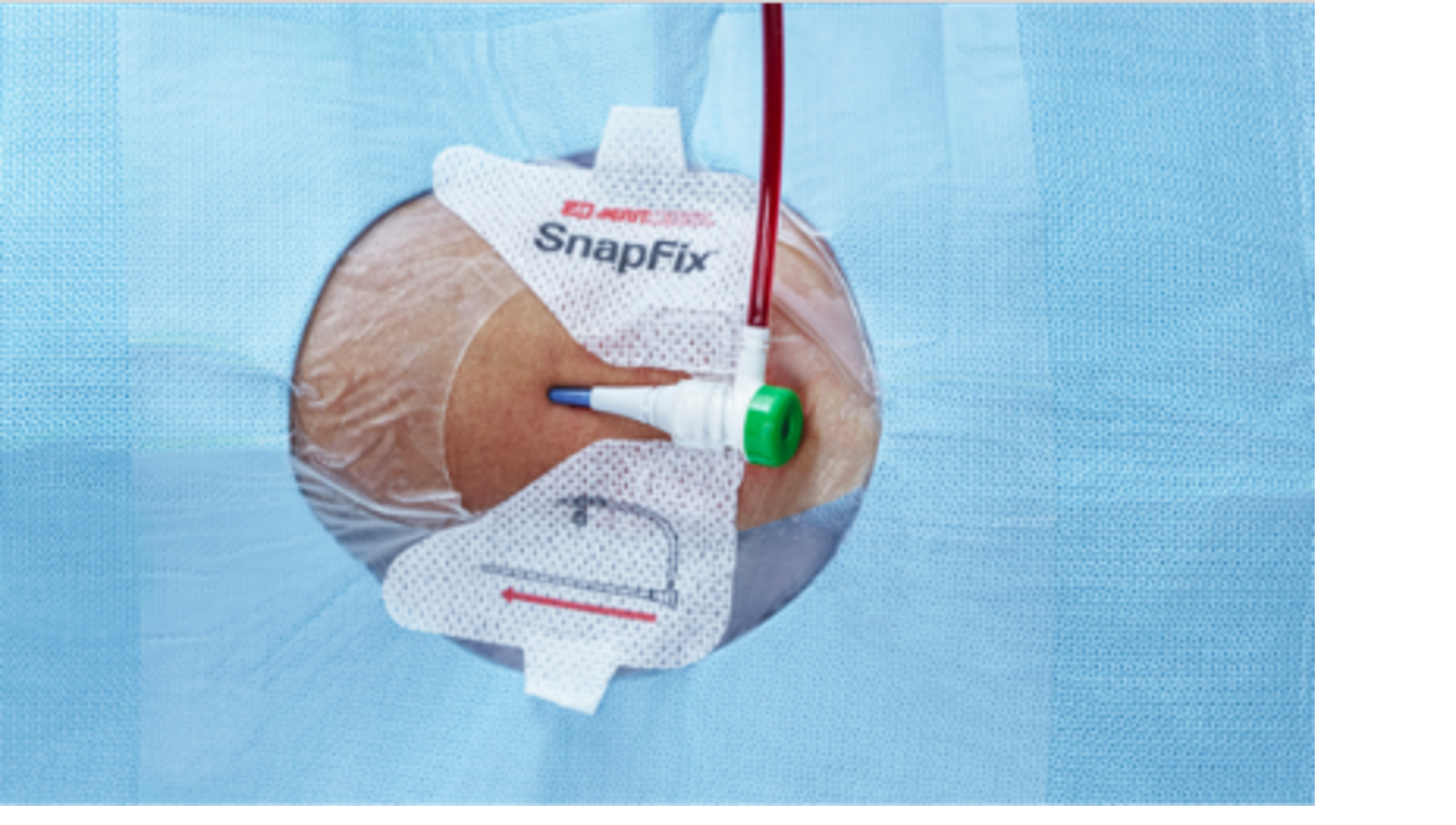
Figure 1. Circular draping setup. Photo courtesy Merit Medical. Over the drape: Use a radial drape with a circular port access to the insertion site (Figure 1).
-
Add the SnapFix device on top of the radial drape with the wings partially over the skin and partially over the drape
-
-
A gloved hand cover and a drape applied beginning at the mid forearm.
-
This allows a large section of the forearm to be exposed in case of ulnar artery or brachial vein access (Figure 1).
-
The SnapFix is applied to the sheath, with the wings easily attaching to the exposed skin adjacent to the sheath near the wrist.
-
Prelude Wave With SnapFix: Two-Fold Solution
The Prelude Wave’s SnapFix technology is a straightforward solution for securing the lubricious sheath, according to Drs. Kern and Seto. Dr. Kern explains: “When the sheath is in the artery, the SnapFix adhesive wings cover the skin next to the sheath [Figure 2]. You pull out the tabs underneath, and it sticks to the arm.”
Because the Prelude Wave’s hydrophilic coating has the best-in-class ease of insertion, it is both easy to insert and easy to withdraw. That’s why the SnapFix technology is the perfect securement complement to the Prelude Wave. Once in place, the Prelude Wave stays in place.
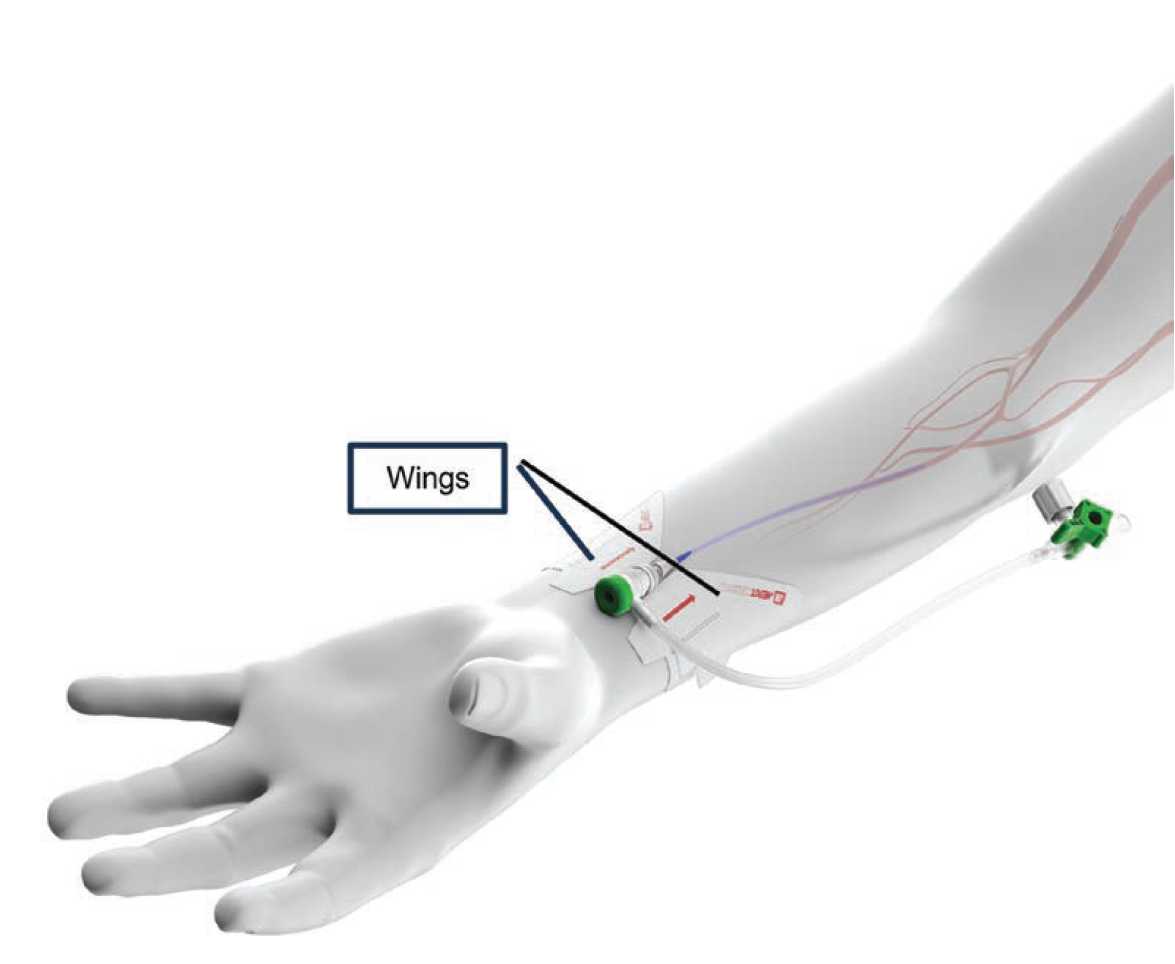
Photo courtesy Merit Medical.
Advice for Terumo Users Wanting to Try Something Else
Changing from a product or technology you trained on can be challenging, and it is understandable that clinicians are not eager to do that. Getting the operator and their team on board is helped by keeping the message about the product “pretty simple” and straightforward, said Dr. Kern. “Talking with staff about the new product also facilitates using the new product in the lab.” Look for ways to enhance training for the team, which is part of the solution to team acceptance.
But the combination of the Prelude Wave and the SnapFix technology is a winning combination for a team to try.
This article is sponsored by Merit Medical.
*Consultants of Merit Medical®
Reference
- Sridevi P, Sharma R, Boudoulas K. Newer emerging strategies to reduce radial artery occlusion: post-transradial catheterization. Quality Improvement Tools: Society for Cardiovascular Angiography and Interventions (SCAI). Published June 19, 2025. Accessed September 2, 2025. https://scai.org/quality-improvement-tools/qi-tips/newer-emerging-strategies-reduce-radial-artery-occlusion-post.
The above suggestions and other information, which may include both Merit and third-party products, are for the practitioner’s convenience and for general information purposes only. This information does not constitute medical or legal advice, nor is it meant to endorse or guarantee the suitability of any of the referenced products or methods for any specific patient or procedure. Before using any product, refer to the Instructions for Use (IFU) for indications, contraindications, warnings, precautions, and directions for use.
407562001_001
Find More:
Renal Denervation Topic Center
Cardiovascular Ambulatory Surgery Centers (ASCs) Topic Center
Grand Rounds With Morton Kern, MD
Peripheral Artery Disease Topic Center
Go to Cath Lab Digest's Current Issue
Go to the Journal of Invasive Cardiology Issue