HOW TO USEThe Cutting Balloon: Tips and Techniques
March 2002
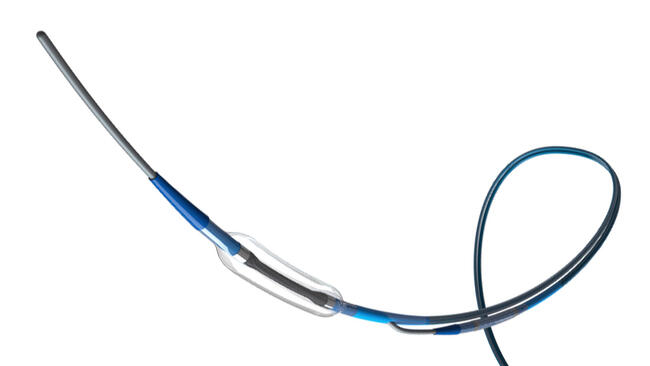
When the Cutting Balloon is inflated, the tiny atherotomes score the arterial disease, interrupting the elastic and fibrotic continuity and allowing for plaque displacement, thereby decreasing the amount of trauma to the artery wall.
The Cutting Balloon was originally positioned for resistant lesions, but now has been found to be useful in many other situations. Our experience shows excellent results when it is used in:
In-stent restenosis;
Aorta-ostial lesions (especially saphenous vein graft anastomosis);
Focal saphenous vein graft body lesions; and
Bifurcations, in addition to small vessels and de novo ostial lesions.
Prior to brachytherapy, the Cutting Balloon gives a stable and predictable lumen for prolonged placement of the radiation delivery catheter.
Mild to moderately calcified lesions can also be treated with a Cutting Balloon.
In order to achieve excellent results when using this device, it’s important to use the correct equipment and to size the balloon appropriately. The procedure is facilitated by the understanding of delivery, inflation and deflation, and dilatation and post-dilatation options.
Equipment
The initial use of the Cutting Balloon was facilitated with the back-up support provided by 8F guiding catheters. However, along with appropriate wire support, 6 and 7F systems are presently being utilized. A 6F guiding catheter can be used for Cutting Balloon sizes 3.25 mm or less. A 3.5 mm balloon with 4 atherotomes is best used with a 7F system. This allows adequate contrast visualization of the interventional site. In addition, using too small of a guiding catheter may not allow the Cutting Balloon to be retrieved without pushing the atherotome against the balloon material. This may cause micro-punctures and limit the continued use of the device.
Guide catheter shapes of choice usually work, except in acute bend guide shapes, such as internal mammary curves, where guide resistance may be felt with the 15 mm length device.
In an acute circumflex takeoff, Amplatz, Voda, or Q-curve shapes, or extra support guiding catheters, will facilitate the delivery of the Cutting Balloon. Additionally, the Amplatz curve can protect the ostium of the circumflex at the time of device withdrawal.
Cutting Balloons can be delivered with almost any guidewire, depending on the physicians’ preference. When deliverability is difficult because of vessel tortuousity, use of a floppy guidewire may help advancement past the curved areas by limiting wire bias. In an over-the-wire device, a more supportive guidewire may be used when the balloon is distal to the tortuosity. Some physicians have used the ACS Wiggle Wire (Guidant Corporation, Santa Clara, Calif.) to traverse areas of tortuosity or in situations where the atherotome may be caught on calcium or a stent strut. The Wiggle Wire has a series of pre-bent areas forming an artificial guidewire bias away from any obstruction. Buddy wire technique can also be helpful.
Sizing
Sizing the Cutting Balloon is the most critical step in achieving a successful procedure. When intravascular ultrasound is used, the balloon-to-artery ratio should be 1:1, measuring from media to media. In in-stent restenosis when the stent size is known, the Cutting Balloon can also be sized 1:1 or upsized to a 0.25“0.50 mm larger balloon size if the device is kept within the stent. When sizing by angiography, it is been our practice to upsize the Cutting Balloon by a quarter size. Exceptions include:
Ostial lesions;
Lesions on an extreme bend;
Small vessels, because of the risk of perforation.
Therefore, sizing should be more conservative, similar to use of the Rotablator® (Boston Scientific). If the initial device is undersized, a hazy angiographic appearance may be present. This is due to contrast flowing through the unflattened incisions. Although a conventional balloon may be used in post-dilatation, the lack of atherotomes to facilitate the displacement of plaque may cause deep wall trauma to the vessel.
Delivering the Cutting Balloon
As a result of the atherotomes, the Cutting Balloon becomes a stiffer device that delivers like the older generation stents. Appropriate use of equipment as noted earlier will facilitate the delivery of the device in most situations. Here are some of the maneuvers that are used in more difficult situations:
1. If the device fails to traverse a de novo lesion, use a 1.5“2.0mm Maverick® Catheter (Boston Scientific) to pre-dilate the lesion. This will not compromise the end result.
2. Use of the buddy wire technique will also help entry into tortuous segments or into a stent.
3. If this fails, inflating the device when it is partially in the lesion and then advancing as it deflates may be helpful.
Inflation/Deflation Techniques
Inflating or deflating the Cutting Balloon incorrectly can cause damage to the balloon.
When inflating the Cutting Balloon, do it slowly and gradually, at one atmosphere per five seconds. This slow inflation technique will allow the balloon material to unfold around the atherotomes, exposing the atherotomes to the vessel wall without scoring the balloon surface. When the Cutting Balloon is fully inflated to nominal pressure (six atmospheres), an inflation time of 60 to 90 seconds is preferred. This inflation time allows the Cutting Balloon to not only score the lesion, but also allows the Cutting Balloon to flatten out the incisions. Performing multiple slow inflations may improve angiographic results. The Cutting Balloon does not need to be rotated into a different position to perform multiple inflations.
Deflate the Cutting Balloon very slowly by dialing down on the indeflator and then pulling a negative. Without dialing down, the Cutting Balloon may wing and resistance may be felt while retrieving it into the guide catheter. If the Cutting Balloon remains inflated due to lost pressure (this happens rarely), use a 60cc syringe to extract the remaining contrast in the balloon, making sure there are no kinks in the catheter.
In practice, inflation and deflation times are much faster even when the physician is not allowed to touch the inflation device. The newer generation balloons also seem to be more resistant to inflation and deflation trauma.
Special Dilatation Techniques
Within eccentric lesions, if the balloon does not fully expand at 6 atmospheres, we try at least 3 inflations at nominal pressures after repositioning the balloon to allow the atherotomes to find an elastic site to work. If the balloon continues to have waisting, we will then use higher pressures, up to 10 to 12 atmospheres. When treating multiple lesions within a vessel, we try to dilate the most distal lesion first unless the proximal lesion is flow-limiting or prevents the passage of the Cutting Balloon.
The Cutting Balloon is a useful device for treating bifurcation lesions. It is the only device that easily allows for wiring of both vessels during intervention. We usually dilate the most diseased branch first. The Cutting Balloon is sized appropriately for each branch. Kissing technique is never used with the Cutting Balloon because of the risk of perforating the other balloon.
When using the Cutting Balloon in tortuous anatomy, try straightening your pathway as much as possible with an extra-support guidewire. If the vessel segment that is being treated is tapered, size the Cutting Balloon to the distal portion of the vessel first. It’s possible that if the proximal portion is larger than the distal portion, two different Cutting Balloon sizes may need to be used.
For standard in-stent restenosis (ISR) cases, use a 15mm Cutting Balloon in order to minimize multiple inflations and subsequently, procedure times. In aorta-ostial lesions, let the Cutting Balloon hang out into the aorta and use the 15mm Cutting Balloon for longer lesions.
Concerns
As discussed above, with the appropriate equipment choice, the Cutting Balloon procedure can be completed without significant obstacles. The device can be delivered with good guide support, appropriate wire choice and pre-dilatation if needed.
Concerns about the use of the Cutting Balloon include:
risk of restenosis;
high restenosis with small vessels;
the risk of perforation.
The Cutting Balloon does not substitute for the results provided by stenting, but facilitates treatment of complex lesions where stenting is not feasible, such as bifurcation lesions and ostial lesions. More importantly, for treatment of saphenous vein grafts in anastomotic sites, pre-treatment of the fibrotic lesion with the Cutting Balloon allows appropriate deployment of the stent. We also use the Cutting Balloon for focal lesions in vein grafts because of their resistant nature.
In our experience with small vessel lesions that restenose, intravascular ultrasound (IVUS) has shown that we have undersized the device. Therefore, in your early experience, it may be beneficial to use IVUS guidance with the Cutting Balloon in small vessels. The Cutting Balloon can cause deep cuts, which present with peri-vascular staining. In these situations, stenting is always used to decrease the risk of subsequent dissection and occlusion. Additionally, there are many small studies suggesting that Cutting Balloon before stenting has a lower restenosis rate. In our experience, there have been no free-flowing perforations (which now can be treated with covered stents, but in the past have been treated successfully with the Surpass perfusion balloon and reversal of the anticoagulation drugs).
Conclusion
The Cutting Balloon is a versatile product that is useful in any interventional laboratory. The Cutting Balloon has been used in:
ISR;
Resistant lesions;
Small vessels;
Bifurcations;
Aorta-ostial lesions;
Saphenous vein graft lesions; and
Before stenting.
It is not a substitute for stenting, but can facilitate treatment of complex lesions that cannot be easily stented. The majority of the time, angiographic results achieved with Cutting Balloon are excellent. With sub optimal results, stenting should be performed with possibly improved long-term results. To ensure that you achieve these same results each time you use the Cutting Balloon, it’s a good idea to remember these tips and techniques.
NULL
Subscriber
Cath Lab Digest Newsletter