Geographic Miss, Source Trains, Radiation Safety, and the RENO Trial
January 2002
How are the cath labs at Brigham and Women™s Hospital structured?
Within our Cardiovascular Interventional and Diagnostic Center (CDIC), we have 5 cath labs, performing 2000 interventional procedures and about 6500 total procedures per year. We also participate in interventional device (coated stent, covered stent, and distal embolic protection) and drug trials in our lab. Our Director of Operations is H. Thomas Blanchard, RN.
We have 9 interventional attendings, 5 interventional fellows, and general cardiology fellows that rotate through our labs.
In addition, we have:
40 RNs
13 cardiovascular technologists
12 radiology technologists
9 PAs
5 patient care assistants
1.5 secretaries
3 assistant clinical directors
One Operations Supervisor, working for the Director of Operations
One nurse practitioner
One RN educator
One biller/coder
One inventory clerk
What™s your experience with intravascular brachytherapy?
Brigham and Women™s has probably one of the largest New England experiences in radiation. We™ve been involved in the BETA-CATH, START, START 40/20, and compassionate use brachytherapy trials, and have radiated over 300 patients at this point. We have a lot of experience with radiation to treat in-stent restenosis and have actually used it in some unusual settings, like at Boston™s Children™s Hospital for some congenital heart disease applications.
How many staff are typically needed for a radiation procedure?
You have a radiation oncologist, radiation physicist, primary interventional cardiologist operator and assistant (typically another fellow or PA), an RN, an RT(R) and a CVT.
How is the brachytherapy schedule arranged?
We offer beta 5 days a week, during working hours of 8-6pm. Our radiation oncologist, Dr. Philip Devlin, needs time to extract himself from his hospital-wide brachytherapy activities, but he™s pretty much available at all times. For gamma (we do very little gamma), procedures have to be scheduled, because of the issues of shielding and distances required. We have conference rooms and offices around the cath lab. They have to be cleared out in order to do a case, and that requires a little planning.
How do you communicate to patients that this type of radiation is not
anything like what they may know as conventional radiation treatment
(i.e., for malignant disease or cancer)?
One thing that™s important for the patient to understand is that the amount of radiation that they receive with the Novoste beta radiation system is less than the amount of radiation they receive from cine and fluoroscopy. That analogy helps them understand the quantity of radiation.
We also have a lengthy consent process. The radiation oncologist has about a 10 to 15 minute consent process for radiation therapy. He explains the kind of radiation and the exposure that the patient is receiving, along with what the risks are, both short and long-term, as well as about unknown risks from radiation. We take it very seriously.
The patients are relatively sophisticated, and they understand, for instance, that when they fly from Boston to San Francisco on an airplane, they™re exposed to cosmic radiation. I think that when you explain to people both issues of dose and depth of penetration with radiation, you can spell it out in simple terms so they understand. It™s uncommon that we would have a patient who would refuse therapy because of their concerns over radiation.
Brachytherapy is now intertwined with talk about coated stents. What™s your opinion?
Obviously there™s a lot of excitement over coated stents. In-stent restenosis is a big problem right now, occurring in 10-50% of patients, depending upon certain restenosis risk factors (vessel size, lesion length, diabetes mellitus).
The problem, of course, is that coated stents will be available during the second quarter of 2003 at the earliest. Rollout into common clinical practice is going to take time probably at least a year. So it may be anywhere between one to two years before people are going to have wide use of coated stents.
It seems most hospitals have no choice but to get involved with intravascular brachytherapy, whether directly or in having to refer patients.
Brigham and Women™s Hospital is a radiation referral center. It™s hard for hospitals that are small to make the investment in a radiation program. I don™t mean necessarily financially, because the companies that sell radiation devices make it easy for facilities to get involved, although there are startup costs normally associated with buying these devices. Per case arrangements are apparently also available.
Money is only part of the problem. The other part is getting your radiation oncologist to buy in. That™s the tough part. It™s easy for the radiation oncologists who do brachytherapy for prostate and lung cancer, because they are used to getting scrubbed in sterile environments and putting in seeds. However, it™s harder if they only do external beam. These radiation oncologists aren™t used to going into sterile environments, and it™s time away from their external beam practices. To get them to buy in to coming into the cath lab and treating in-stent restenosis patients is not easy. It takes time for them to get comfortable working in a sterile environment again, scrubbing, etc.
Brigham and Women™s has a terrific radiation oncologist, Dr. Philip Devlin, who is a full-time brachytherapist. He participates in an open MRI interventional prostate cancer program and in the OR, placing seeds for lung and cervical cancer, so he™s happily embraced intravascular brachytherapy.
We still get a lot of referrals from small hospitals to do radiation, but I think if you™re doing anywhere from 500-600 interventions a year and 15-20% of your patients have restenosis, you need to consider how much you™re willing to refer them out. You need something for the next 2-3 years. It would be nice to have coated stents today, but unfortunately, it™s not going to happen.
The European RAVEL trial (RAndomized study with the sirolimus-coated [Cypher, Cordis] Bx VELocity balloon-expandable stent in the treatment of patients with de novo native coronary artery lesions) has reported zero percent rates of angiographic and clinical restenosis. The 1200-patient U.S. SIRIUS trial completed enrollments in July 2001. There will be one-year follow-up mandated by the FDA, and then an application based on that data. Anticipated clinical release is second quarter 2003.
Some of the earlier radiation trials have had problems with the candy wrapper effect and geographic miss. Was this an issue with the European REgistry NOvoste (RENO) Trial?
Geographic miss is a term describing inadequate radiation dose to an injured segment. That happened in about 34% of the cases in the original START trial (STents And Radiation Therapy). Patients who had geographic miss appear to have increased rates of recurrent restenosis (i.e., radiation failure).
It™s important to understand that when you do radiation, that you radiate your injury area with a margin of about 5-7 mm on either side. The original source trains were only 30mm in length, and you were allowed to treat up to 20mm. Unless you were really, really good at remembering where your balloons went you know, sometimes interventionalists can be a little bit sloppy in that regard you would potentially miss the 5-7 mm overlap.
As a side note, I think it™s important to differentiate between treatment of in-stent restenosis and restenosis prevention. The large BETA-CATH trial attempted to look at restenosis prevention with radiation. These were patients that get radiation at the time of balloon angioplasty or stent placement. Radiation did not prevent restenosis, especially in stented patients. Geographic miss may have been responsible. BETA-CATH was negative, and it™s going to be redone because of issues with geographic miss. There were problems with the source trains being too short.
Geographic miss rates have been reduced substantially by lengthening the source trains, so in START 40/20, the source train was increased to 40mm, and you were allowed to treat 20mm. There was a substantial amount of overlap on either side. It reduced geographic miss by more than half, down to 14 or 15%. The treatment effect in the START 40/20 trial compared to START, appeared to be improved. In RENO, some patients were treated with 60mm source trains and they were also pullback treatments. Pullback treatments allow you treat even longer disease to ensure that you had adequate radiation of injured tissue.
The RENO trial has probably the lowest rates of failure that we™ve seen in radiation trials. It wasn™t a randomized trial, it was a registry, but if you look at historical data, the target vessel revascularization rates in that trial are very, very low. It was nice to see that you could treat very long lesions successfully in large numbers of patients. There were probably between 200-250 patients in that trial that have long lesions similar to those in LONG WRIST, which was a gamma study (The Washington Radiation for In-Stent Restenosis Trial for Long Lesions). But I think the results of RENO for real-world radiation, upwards of 1000 patients, show that the therapy is very effective in treating in-stent restenosis.
You mentioned that the START 40/20 trial had a longer source train. Does that longer length affect radiation safety protocols for patients and staff?
Source train length has little impact on dose to health care team. All devices are in afterloaders. Although the radiation does increase, in beta radiation the falloff is very steep in terms of distance, so the amount of exposure to lung, thyroid, breast or thymus tissue is extremely low. For gamma radiation the exposure is higher, and gamma penetrates the normal lead we wear. The overall radiation exposure to the patient is approximately 10,000 times higher for gamma source trains than it is for beta. For gamma, staff leave the room, whereas for a beta radiation case, we stay right there with the patient.
When a gamma case is done, the interventional cardiologist places the delivery catheter within the artery. Then there are large shields placed around the patient, made from very thick lead. The radiation oncologist delivers the radiation through the use of an afterloader device behind the lead shields, and then leaves the room. During the dwell time of radiation, which is between 15-20 minutes, there™s no one in the room but the patient.
With beta radiation, dwell times are 3-4 minutes and beta radiation is ca-shielded by lucite (plastic), so the style in which a case is performed is completely different. This is one of the reasons some physicians prefer beta, because the dwell times are shorter, you can stay in the room, and it is easier to do beta radiation on an ad hoc basis.
However, there are some advantages to gamma. Longer source trains are available, and larger vessels (greater than 4.5mm) are more effectively treated.
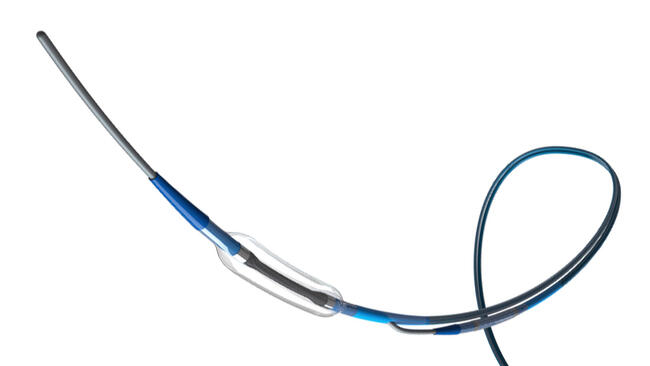
Beta systems do allow you to do pullbacks, like the Galileo System from Guidant (Santa Clara, Ca.), or the Beta-Cath System from Novoste (Norcross, Ga.). Novoste has a 60mm beta source train available in Europe (which should be available in the U.S. soon) that will allow you to treat longer lesions (see Figure 1).
What do you think is the true length of follow-up necessary for radiation trials?
From an efficacy standpoint, six to eight months is considered an adequate length of followup.
There are theoretical issues regarding follow-up for long-term safety, and some controversy exists over whether the beneficial treatment effect could in fact erode over time. For instance the SCRIPPS trial (Scripps Coronary Radiation to Inhibit Proliferation Post Stenting) has follow-up up to 3“5 years and it shows a maintenance of the beneficial effects of radiation. The long-term effects that we might worry about, like in Hodgkin™s disease, where radiation is associated with late coronary disease at 25 years out, we can™t know, obviously, until there™s longer term follow-up. However, the radiation that was delivered in Hodgkin™s disease is much higher compared to what™s being done in the coronaries. They had given over 40 gray to the coronary vessels, but intracoronary doses are much lower, anywhere from 14-23 gray.
Clinical followup will be obtained in these trials at 1, 2, 3 and 5 years. Now it appears the effects are being maintained.
The RENO registry included diabetic patients (n=256), patients with long lesions (mean lesion length 25.9 mm, n=555) and patients with saphenous vein graft disease (n=67). You talked a little about the long lesion patients. What are the special considerations for the other two categories, diabetic and saphenous vein graft patients?
Diabetics have higher rates of in-stent restenosis compared to non-diabetics, and when they have in-stent restenosis, they commonly have diffuse in-stent restenosis rather than focal. Failure rates (50-80%) are higher in diabetics with conventional therapy. These are the patients who need radiation more than not. In fact, if you look at the treatment effect of diabetics in the original SCRIPPS study, or in GAMMA I (A Multicenter Randomized Trial of Localized Radiation Therapy to Inhibit Restenosis after Stenting) and others, the treatment effect in diabetics is, if anything, higher than in non-diabetics, because the placebo rates of failure are substantially higher.
It™s the same for long lesions. When you have long lesions and diffuse disease, in contrast, failure rates exceed 50% if you don™t use radiation. In contrast, when you use radiation, the failure rates are usually between 15-20%, and what I tell patients is, the choice is almost like a flip. If you don™t use radiation, your likelihood of failure approaches up to 80%. If you do use radiation, your likelihood of success is approaches 80%.
The same thing actually holds for saphenous vein grafts (SVG). We know from SVG WRIST (Intracoronary Gamma Radiation for In-Stent Restenosis in Saphenous Vein Grafts), which was a gamma trial, that the failure rates in vein grafts, just in regular conventional therapy without radiation is between 50-60%. If you use radiation, failure rates are only about 15%. The relative risk reduction is about 15 over 60, which is really high.
In clinical practice, which patients do you radiate?
We radiate anyone with diffuse in-stent restenosis, diabetics with in-stent restenosis, whether it is focal or diffuse, and first time SVG in-stent restenosis, whether it™s focal or diffuse. A lot of doctors will give focal in-stent restenosis a chance with conventional therapy, because when it™s very short disease, if you dilate it or you cut it out, the likelihood of success is about 70%. Obviously, we radiate anyone that fails conventional treatment for focal in-stent restenosis.
Have patients ever been treated multiple times at the same site with brachytherapy?
There are no approved systems to retreat the same site twice. We perform radiation in multiple vessels if necessary. There are certainly patients who are frequent flyers in the cath lab, who get a stent in the LAD, and then 3 months later get a stent in their right.
Only a couple of centers in the world have IDEs or protocols for retreating the same identical site with a double dose of radiation. There are several centers in Europe, and I believe Paul Teirstein and Dean Kereiakes in the U.S. have IDEs for double treatment, same site. It™s uncommon, only because when we do pullback treatments or overlapping treatments, we™re very careful about limiting the overlap of double-dose radiation. By treating the same site twice, you™re giving the vessel a high dose of radiation, with potential toxicity. We know from the Candado experience in Venezuela, that when you™ve got over 90 gray of near-field dose, your patient appears to be at risk of vessel damage from radiation. When we give 18 gray, or 20 gray at 2mm, the near-field dose is higher. Roughly speaking, I think with the Novoste Beta-Cath System, it™s about 2.3x higher. With the catheter against the wall, it™s about 2.3 x 18 gray that™s about 40 gray. If you double-treat, now the exposure goes up to 90 gray. That is probably not a significant concern with pullback, where overlap is limited to 1-2mm.
NULL
Subscriber
Cath Lab Digest Newsletter