Device Use in the Diagnosis and Treatment of Peripheral Vascular and Coronary Artery Disease at Anaheim Regional Medical Center
September 2010
Anaheim Regional Medical Center is a small community hospital in the city of Anaheim, California, just a few miles away from Disneyland. We find it ironic that the happiest place on earth can be located next to a war zone. Yes, that’s right — our hospital, Anaheim Regional Medical Center, is just one of many battlefields in the county committed to fight and win the war on cardiovascular disease. Our soldiers consist of physicians, nurses, and technologists. Our weapons are represented by the vast array of medical devices available in the cardiac market today.
When a patient is diagnosed with coronary artery disease, chances are high that he/she may also have concomitant peripheral vascular disease, anywhere from head to foot. Patients are completely reliant upon the knowledge and expertise of the physician and medical staff to ensure that adequate diagnostic examinations and management of the disease process are performed. While there are a multitude of diagnostic tests for both coronary and peripheral arterial disease detection, the ultimate gold standard is coronary and peripheral angiography. The ability to visualize and analyze anatomy are two key components for the proper management of arterial disease. It is a fact that over the past couple of decades, the average weight of the population has increased, while the number of diabetics in our population has also increased. There is no denying it; patients are arriving bigger and sicker than ever before. The incidence of co-morbid conditions has also increased. It is vital that the x-ray system have the capability of penetrating very large patients. Weaker and older x-ray systems make it almost impossible to make an accurate diagnosis and analysis of vascular disease.
At Anaheim, we use state-of-the-art flat-plate technology. Our cath lab performs a fairly large number of angiograms. We utilize standard 6 French (Fr) diagnostic catheters for both the femoral and radial approach. Our cardiac room is set up for peripheral angiography as well. We have a separate digital system, the Eigen DSA (digital subtraction angiography) (Grass Valley, CA), to perform peripheral work in conjunction with cardiac procedures. Most of our interventional radiology procedures are done in our special procedures room.
Diagnostic Information: IVUS and FFR
Angiography alone may sometimes not be enough to diagnose arterial disease. There are certain angles and lesion morphology that prevent a clear angiographic picture. Borderline lesions do exist and additional diagnostic equipment is needed to make a proper vessel lesion diagnosis. Intravascular ultrasound (IVUS) and fractional flow reserve (FFR) are the two of the most important tools utilized today to provide additional essential diagnostic information in vessel lesions that are otherwise equivocal or angiographically unclear. IVUS has been underutilized in many cath labs in the United States. First-generation IVUS machines were too bulky and took several minutes to get ready and set up. Today, IVUS systems can be set up permanently in the lab and are always on a ready-function mode.
Vessel lesion morphology can vary from soft and fibrotic to hard and calcified plaque. Standard vessel angiography can help identify these lesions, but in order to be 100% accurate, IVUS is a must. In order to treat a compromised vessel properly, you must first identify its size, length and lesion morphology. The main goal of vessel angioplasty is to treat the lesion, and prevent restenosis and adverse cardiac events. All of these goals, when put together and achieved, basically lead to a good patient outcome.
When a diseased vessel is identified, analyzed and diagnosed, the physician has to give the patient several choices. The patient can have percutaneous transluminal coronary angioplasty (PTCA) with a balloon only or with a stent. Coronary artery bypass surgery can also be another option, or the physician may opt to leave things alone and place the patient on medications. All of these choices depend on the severity of the coronary disease and the overall condition of the patient.
Of all the coronary interventions performed at Anaheim Regional Medical Center, we utilize IVUS in about 10–20% of cases. This number will increase, as we are completing the installation of a permanent IVUS system in each lab. Although our IVUS usage is not very high, our in-stent restenosis rates are very low compared to nationwide figures. According to our computerized patient monitoring system, our percentage of patients returning to the cath lab due to in-stent restenosis is 0.04% for the year 2009. This statistic is based on the total number of patients returning within one calendar year.
Intimal Preparation Prior to Stenting
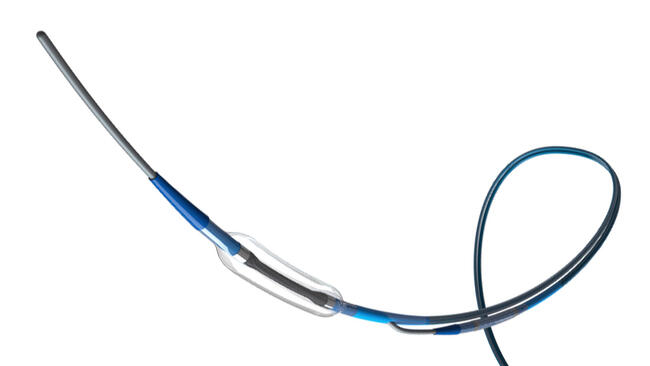
Before a stent is placed, proper preparation of the intima by balloon angioplasty or scoring with either the AngioSculpt (AngioScore, Freemont, CA) or the Cutting Balloon (Boston Scientific, Natick, MA) will definitely improve overall stent apposition and minimize in-stent restenosis. The stent must be accurately sized and deployed with adequate pressure. Sometimes, post-stent ballooning is necessary. We tend to favor use of the AngioSculpt balloon, because it is very flexible and can get to distal and small lesions with ease. We utilize the intimal scoring technique in branch vessels and have been very satisfied with the angiographic results. Renal artery stenosis cases showing fibromuscular dysplasia-type morphology also benefit from intimal scoring. After multiple inflations with a scoring balloon, we place a stent with great confidence that a good patient outcome will result.
There are times when we encounter rock-hard lesions in both the coronary and peripheral circulation. In these cases, a more powerful tool is necessary. Rotational atherectomy is the procedure of choice for these types of lesions. There is no way that a very calcified vessel can be treated with a stent or balloon without debulking the lesion. Rotational atherectomy involves a specially designed burr, which is rotated at very high speeds to cut through calcified plaque. Multiple passes are performed in order to achieve a maximum removal of plaque. We use the Rotoblator (Boston Scientific, Natick, MA) for our coronary lesions and the Diamondback 360° (Cardiovascular Systems, Inc., St. Paul, MN) for our peripheral lesions. These tools allow us to properly treat any calcified lesion.
We have had tremendous success in popliteal and below-the-knee arterial treatment, and have found the larger peripheral AngioSculpt balloon very beneficial in these cases. Post-scoring arterial angiogram results, as well as the low incidence of patients returning with the same lesion problems, have been impressive. We find IVUS shows much better apposition of stent struts to the vessel wall after an AngioSculpt balloon is used as compared to a regular peripheral balloon. We do not have any ongoing internal trials at this time, but of our IVUS exams performed post peripheral stent deployment, more aggressive post stent ballooning was needed for all non pre-scored lesions in order to attain adequate stent apposition.
In a recent case, a patient presented with foot ischemia. Angiography revealed a moderately diseased distal anterior tibial artery at the level of the ankle. A coronary balloon was the sole device used to reach the lesion. After multiple inflations, the lesion did not seem to improve. It was ultimately decided to place a coronary AngioSculpt balloon, and after two inflations, the angiogram revealed dramatic improvement.
Final Thoughts
The results of both peripheral and coronary intervention can vary according to many factors. The best patient outcomes result from good diagnosis and even better management. Although we discussed mechanical techniques for preparing and treating diseased vessels, it is important to note that pharmacologic agents used before, during and after an intervention also play a critical role in determining good patient outcomes. And, at the end of the day, the patient must be part of the equation in order to achieve a good long-term outcome. The patient must be compliant with medications and lifestyle changes, promoting their own good health through diet and exercise.
Benjamin Manacop can be contacted at benjamin.manacop@ahmchealth.com.
Disclosure: Benjamin Manacop has no conflicts of interest regarding the content herein.
NULL
Subscriber
Cath Lab Digest Newsletter