Cath Lab Spotlight
Carilion Roanoke Memorial Hospital
September 2003
What type of procedures are performed at your facility?
We perform diagnostic and interventional procedures in our lab. On average, we do 150 cases a week. Our lab does not do peripheral intervention.
Our annual volume is approximately 4800 diagnostic and 2300 interventional cases, with over 11,000 procedures performed annually.
Does your cath lab perform primary angioplasty with/without surgical backup?
Primary angioplasty is performed with and without surgical backup. Cardiac Surgery is physically adjacent to our lab and the cardiac surgery call team can be available within thirty minutes for the emergencies. Backup is not normally scheduled except for high-risk procedures during the day.
What procedures do you perform on an outpatient basis?
Our diagnostic cases are primarily outpatient.
What percentage of your patients are female?
According to our statistics, our female population is 45% (85% are obese).
Who manages your cath lab?
Charlene (Charlie) Cole is the Director; she also manages Cardiac Surgery, the EP Lab, and the outpatient cardiac floor. Dr. Shiner and Dr. Chapman are our Co-Medical Directors. The Clinical Team Leader, Pamela Smith, is responsible for the daily operations of the lab.
Do you have cross-training?
Our staff is cross-trained. RNs can perform in all three positions as well as the RT, RRTs and CS-CVTs. We have a few Cardiovascular Invasive Assistants who scrub everyday. RNs, RTs, RRTs and CS-CVTs can perform in the role of scrub tech, monitor, or circulator.
Does your lab have a clinical ladder?
We have a clinical ladder with three levels: Cardiovascular Tech I, II, and III. Additional experience and education requirements must be met to advance. The Registered Cardiovascular Invasive Specialist credential (RCIS) is required for CVT III.
What are some of the new equipment, devices and products introduced at your lab lately?
Our lab has all of the newest technology, including:
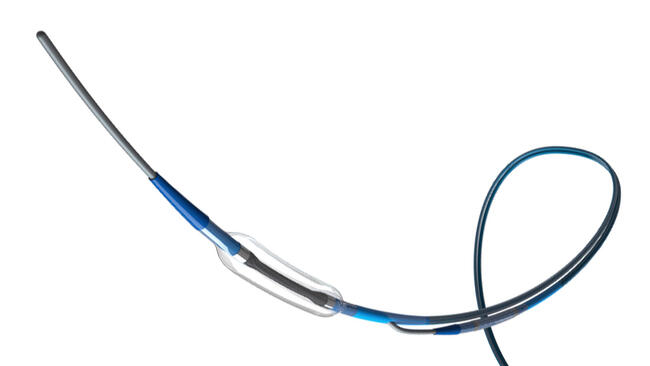
AngioJet® (Possis Medical, Inc., Minneapolis, MN);
PressureWire (RADI Medical Systems, Inc., Reading, MA);
Brachytherapy (both beta and gamma)
PercuSurge (Medtronic, Santa Rosa, CA)
Galaxy IVUS Imaging System (Boston Scientific, Maple Grove, MN)
Cutting Balloon (Boston Scientific)
BiodivYsio® Stent (Abbott Vascular Devices, Redwood City, CA)
Jomed Stent (Abbott Vascular Devices)
FilterWire Ex (Boston Scientific)
FrontRunner CTO Catheter (LuMend, Redwood City, CA)
The Cypher Stent (Cordis Corporation, Miami Lakes, FL) was FDA-approved on April 24, 2003, and we began using the stent on April 28, 2003. We were one of the first labs in Virginia to begin using the Cypher Stent. Because of the news media, patients have become more aware and are becoming more involved in their own healthcare. Once a patient learns that he or she needs a stent, they usually request the Cypher. But because of the limited number of sizes, the cardiologists have to explain to the patients whether or not they are a candidate for a drug-eluting stent (DES).
Is your cath lab filmless?
Our lab went totally filmless in 1998. We have the Siemens digital archiving system.
How does your lab handle hemostasis?
We have a six-bed holding area staffed by two RNs and Cardiovascular Assistants, who are trained to hold pressure. Many of our doctors use closure devices when indicated. We use Perclose® A-T (Abbott Vascular Devices), Angio-Seal (St. Jude Medical, Minnetonka, MN) and Chito-Seal (Abbott Vascular Devices). We have a dedicated nursing unit for outpatients and same-day admissions. The staff on that unit pulls sheaths and takes care of after-hours sheath removals in other areas of the hospital.
Does your lab have a hematoma management policy?
Yes. We have a hematoma management policy in place to help control any complications. We have a very low incidence of hematomas.
How is inventory managed at your cath lab?
We have a Buyer for the cath lab. She manages our entire inventory, as well as the purchasing of supplies. We use PalmPilots to scan inventory, which is then downloaded into the computer to track used products.
Has your cath lab recently expanded in size and patient volume, or will it be in the near future?
We started with one room in 1971. In 1978, a second lab was added, and in 1994, we expanded to four cath labs. In 2001, one lab was renovated to become a swing lab for additional capacity. We plan to add two new labs in the near future.
Is your lab involved in clinical research?
The clinical trials that we have been involved in are Senior AMI, REPLACE-2, SYNERGY and COMPANION.
Have you had any cath lab-related complications in the past year requiring emergent cardiac surgery?
Yes, however, the number of patients to surgery emergently is less than 1% of our interventional volume.
What measures has your cath lab implemented in order to cut or contain costs?
Our Buyer and our sales representatives work together to set up bundling arrangements to cut down on our costs. We also do bulk buys for additional savings. The doctors monitor per case cost.
What types of quality control/quality assurance measures are practiced in your cath lab?
We have staff that come in early and do quality control on our equipment. We also have committees to monitor patient satisfaction, deaths, emergent surgeries and containing and preventing hematomas.
How does your cath lab compete for patients? Has your institution formed an alliance with others in the area?
Carilion Roanoke Memorial is part of Carilion Health System and is the flagship hospital for the system. We receive referrals from all over southwest Virginia and southern West Virginia. There is only one other hospital in our area that performs interventions. We compete by providing the latest technology and excellent patient care. Some of our smaller hospitals only do diagnostic catheterizations. Patients are then transported to Carilion Roanoke Memorial Hospital for interventions.
How are new employees oriented and trained at your facility? What licensure is required for all professionals who work in your lab?
Pamela Sayre, preceptor, monitors new staff orientation. The orientation schedule is typically six weeks for monitor, six weeks for circulator, and nine weeks to scrub. We require one of the following credentials: RN, RCIS, RT, and/or RT(R), for our positions of CVT I, II or III (the RCIS credential is required for CVT III). We do offer CVIA positions (Cardiovascular Invasive Assistants) to those with a medical background. CVIAs can advance to CVT level by passing the Basic Science and RCIS exams. All employees receive on-the-job training.
What type of continuing education opportunities are provided
to staff members?
The preceptor, as well as the clinical specialists from some of our vendors, handle continuing education. Scheduled monthly inservices and opportunities to attend national seminars are available.
How do you handle vendor visits to your lab?
The secretary in the lab schedules vendors. The vendors must check in through our purchasing department and are given a badge before coming to the lab. They are allowed in the lab for teaching as well as working with our buyer on inventory of supplies. The scheduled time in the lab is rotated to give vendors an equal share of lab time.
How is staff competency evaluated?
We have annual competency evaluations that encompass all the skills necessary to work in the cath lab.
Does your lab utilize any alternative therapies (such as guided imagery, etc.)?
Yes, we have guided imagery. Linda Starr and Kathy Wager provide music and relaxation therapy for the patients. We find patients who take advantage of this service to be less anxious.
How does your lab handle call time for staff members?
Each staff member has seven call days, five late days and one 8-12 shift on Saturday in an eight-week block. The call team consists of one nurse and two techs. The work schedule is 7am-6pm, Monday through Friday. After 6pm, the late team and the call team complete the overflow cases of the day. We have several staff members that work four 10-hour shifts to help with cases until 6pm. We currently also have one flex RN employee.
What trends do you see emerging in the practice of invasive cardiology?
A few of our cardiologists stated that they expect to see more treatment of multivessel disease and an increase in complex cases. With the increase in complex cases, cardiologists will require increased skills. Because of the increase in complex cases, there should also be a decrease in surgical consults. We expect to see an increase in IVUS usage. Our reoccurrence rate will hopefully decrease with the use of DES.
Has your lab has undergone a JCAHO inspection in the past three years?
Yes, in May of 2003, and we had no recommendations.
Where is your cath lab located in relation to the Cardiac OR department, ER, and radiology departments?
Our lab is located directly adjacent to the cardiac OR. We are four floors above the ER and radiology departments. The majority of our cardiologists would prefer to be close to the ER.
Please tell the readers what you consider unique or innovative about your cath lab and its staff.
The cardiac cath lab is well supported by hospital administration when considering new technologies and supplies.
We provide a happy, cheerful atmosphere for patients. Staff is remarkably well trained. We provide an excellent experience for patients from entry to exit of the hospital. Our lab is also unique because of its size and layout. We have all of the latest technology and spend a lot of time on education. Our staff works together as a team and we strive for quality patient care.
Is there a problem or challenge your lab has faced?
A year ago, we had a large turnover in staff. We are now fully staffed and most of the new staff have completed orientation. At the turnover time, we used travelers and offered sign-on and retention bonuses. One of our traveler nurses joined our staff.
What’s special about your city or general regional area in comparison
to the rest of the U.S.?
Roanoke, Virginia is the center of one of Virginia’s largest metropolitan regions, and a hub of transportation, finance and industry for the southwestern part of the state. The beauty of the Roanoke Valley, located between the Blue Ridge and the Virginia Alleghany Highlands, makes the city a pleasant as well as economically diverse place to live and work. A five-time All-America City, Roanoke offers stunning natural beauty and an unparalleled quality of life.
The following questions are courtesy of the Society of Invasive Cardiovascular Professionals (SICP):
Do you require your clinical staff members to take the registry exam for Registered Cardiovascular Invasive Specialist (RCIS)? Do staff receive an incentive bonus or raise upon passing the exam?
Our staff is required to pass the RCIS exam in order to advance to the CVT III level. We encourage the RCIS by making many study tools available, funding seminars and reimbursement of application fees upon passing the exam.
Are your clinical and/or managerial team members involved with any professional organizations that support the invasive cardiology service line, such as the SICP, ACVP, or regional organizations?
The Director is a member of the American College of Cardiovascular Administrators. Two of our CVTs belong to the ASRT. Other staff are not currently members of any professional organization, but membership is encouraged.
Christina D. Smith can be reached at Brneydgals@adelphia.net
NULL
Subscriber
Cath Lab Digest Newsletter