Augmented Reality for Live Tracking of 3D Stent-Graft Positions During EVAR Surgery
Endovascular aneurysm repair (EVAR) has become increasingly image-led, yet operators still rely on two-dimensional fluoroscopy to deploy a three-dimensional (3D) device within a complex, moving anatomy. Augmented reality (AR) promises a different kind of situational awareness – not replacing the fundamentals of EVAR technique, but potentially making them safer by improving navigation, deployment accuracy and procedural efficiency, while also opening a pathway to reducing fluoroscopy time and contrast use.
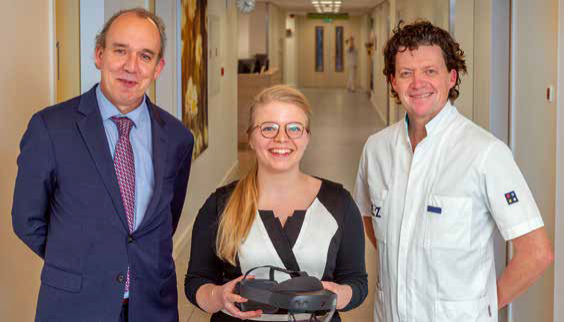
LINC Today spoke with Annabel Groenenberg (Tilburg University/Elisabeth-Tweesteden Hospital, Tilburg, the Netherlands) about her team’s LAMARR concept, which aims to provide live intraoperative 3D tracking of stent-graft position from a single fluoroscopy image, and how it could ultimately be coupled with a marker-less AR navigation platform to visualize the device relative to the patient’s aorta in full 3D. She discussed where the technology might add the most value in EVAR workflows today, what level of accuracy is clinically meaningful, and what evidence and integration steps are still needed before AR tracking can move from the research setting to routine practice.
At its core, what problem does live AR tracking predominantly aim to solve in EVAR – navigation, accuracy of deployment, or reducing fluoroscopy/ contrast burden?
All three, and none of them at the same time. The main goal is to improve safety during EVAR surgery. By providing a clinician with better insight, we hope that the aforementioned factors (e.g. better navigation, decrease of radiation dose and increased accuracy of deployment) will lead to a more efficient and safer surgery for both patient and staff.
Your LAMARR concept is described as live intraoperative 3D tracking of the stent-graft – what exactly is being tracked, and what does the operator see?
The LAMARR system detects radiopaque stent-graft markers based on a single fluoroscopy image. By comparing the orientation and positions of these markers found on the image to a simulated 3D position and orientation of a stent-graft, a match can be found. This allows for a direct calculation of the 3D position of the stent-graft that corresponds with the fluoroscopy image.
This 3D model can be visualized in various ways. One could overlay the 3D model onto a fluoroscopy image and use colors to show the front/back if a general insight into the 3D position is required. For better and more accurate 3D visualization, LAMARR could be employed on a see-through headset, where the stent-graft is rendered in full scale in 3D. Optionally, the fluoroscopy image and virtual 3D models of the patient can be rendered as well within the headset.
Can you tell us about the markerless aspect of the system?
The LAMARR system does need radiopaque stent-graft markers in order to work, yet it does not need any additional instruments or markers. The next step for this system is to not only render the 3D position of the stent-graft on the fluoroscopy on a screen or within a headset, but to couple it with our markerless augmented-reality based navigation system called ARCUS.
The ARCUS system provides a clinician with a fully overlayed 3D hologram of the internal anatomy of a patient. It needs no reference markers, such as infrared-reflective balls or QR codes. Instead, ARCUS recognizes a patient’s body automatically by shape and overlays a 3D hologram of the patient-specific anatomy onto the live body. We aim to couple this system with our LAMARR system so we can not only live-track the 3D shape and orientation of the stent-graft, but also track it relative to the aorta of a patient in full 3D. This would allow for a full, three-dimensional augmented-reality guided EVAR procedure.
What level of accuracy is clinically meaningful for EVAR deployment guidance – and how do you validate accuracy?
For our initial research, we conducted both phantom experiments in a hybrid OR as well as retrospective patient tests. We test both the performance of the detection capabilities (sensitivity and specificity) of the LAMARR algorithm as well as the accuracy of the matching capabilities. For the matching algorithm, we can assess both the general and the precise position and orientation of the device. Our goal is to reach millimeter-precision and minimal rotational offset.
EVAR isn’t a static environment: vessels deform, devices foreshorten, patients move. What are the main sources of registration drift, and how do you correct for them in real time?
The LAMARR algorithm does not track the full aorta; instead, it tracks the stent-graft itself. The initial proof-of-concept still works only with rigid models, but we plan to implement device deformation in the very near future. A stent-graft has a limited degree of deformation, which can be estimated fairly well with various algorithms.
How does AR tracking fit alongside existing tools like 3D image fusion and road mapping? Does it replace anything, or is it an additional situational awareness layer?
AR is a visualization method. The great thing about it is that it allows for integration of preoperative data directly onto the real-time, live situation. This new type of fusion can be implemented either on a screen or via a headset. Integration with available fusion software could be an option in the future in order to achieve full navigation.
Where do you think this helps most, for instance initial main-body positioning, and renal-level precision (fenestrated/branched)?
Our current goal is for the LAMARR system to help most with initial main-body positioning and renal precision and contralateral leg attachment, with later extension to fenestrated/branched device guidance. We especially envision the system to optimize maximum seal in the aortic neck by properly estimating the landing zone of a stent-graft.
What early signals have you seen so far in terms of reducing radiation time?
Until now, our experiments have been aimed at proving feasibility and accuracy, conducted within phantom and retrospective patient experiments. We’re excited to conduct clinical, quantitative research on radiation reduction as soon as the safety is proven. Early-stage input from vascular surgeons has been positive, especially regarding reduction of fluoroscopy time.
What are the current limitations that still stop AR tracking from being routine?
Currently, the system was developed within a research setting. Like any other innovation, full validation and clinical verification and evidence is needed before implementation is possible. Additionally, integration with various systems and the general acceptance of the end-users are important, especially since the change in visualization method on a headset is radically different from the current situation.
What’s next in terms of evidence generation?
We are now gathering new data that would allow for an even more accurate analysis of the performance of the LAMARR system. Next up are a prospective patient study as well as further development regarding expansion to stent-graft models and implementation of deformation correction.
For the LINC audience, what are the most important takeaways?
To reach a good clinical outcome, skill and science go hand-in-hand. It’s inspiring to have met so many vascular surgeons who are open to radical innovations and new technologies. This mindset allows for great collaboration and improved implementation of technologies that can make surgeries safer and more efficient. I thank everyone involved and LINC for contributing to this kind of environment.