Jeffrey G. Carr, MD, FACC, FSCAI; Ralf Langhoff, MD; Brian DeRubertis, MD, FACS; Kristin L. Hood, PhD; Prakash Krishnan, MD, FACC; Vikram Puttaswamy, MD; Thomas Zeller, MD, PhD; Eric A. Secemsky, MD, MSc, RPVI, FACC, FAHA, FSCAI
In this literature review, the authors aim to comprehensively summarize the evidence quality and clinical outcomes following peripheral atherectomy in patients with and without CLTI.
In this literature review, the authors aim to comprehensively summarize the evidence quality and clinical outcomes following peripheral atherectomy in patients with and without CLTI.
The authors comment on the article by Carr et al, "Outcomes in Patients With and Without Chronic Limb-Threatening Ischemia: A Systematic Literature Review on Atherectomy for Peripheral Interventions".
The authors comment on the article by Carr et al, "Outcomes in Patients With and Without Chronic Limb-Threatening Ischemia: A Systematic Literature Review on Atherectomy for Peripheral Interventions".
In this video from ISET 2026, Fabrizio Fanelli, MD, from Careggi University Hospital in Florence, Italy, explores the evolving role of specialty balloons in the treatment of tibial vessel disease.
In this video from ISET 2026, Fabrizio Fanelli, MD, from Careggi University Hospital in Florence, Italy, explores the evolving role of specialty balloons in the treatment of tibial vessel disease.
Anxhela Hasanlli, MD; John H. Rundback, MD, FAHA, FSVM, FSIR; Kevin Herman, MD; Edel Mendoza, MD
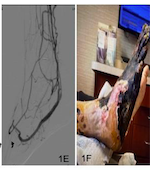
The authors present a retrospective case series of 3 patients with ALI who underwent DVA due to persistent, unresolvable limb-threatening tibiopedal occlusive disease after failed endovascular or surgical procedures.
The authors present a retrospective case series of 3 patients with ALI who underwent DVA due to persistent, unresolvable limb-threatening tibiopedal occlusive disease after failed endovascular or surgical procedures.
HELSINKI, March 12, 2026 (GLOBE NEWSWIRE) -- Aplagon, a clinical stage biotech pioneering a first-in-class treatment for thrombo-inflammatory diseases, known as APAC, a heparin proteoglycan mimetic with antiplatelet and anticoagulant...
HELSINKI, March 12, 2026 (GLOBE NEWSWIRE) -- Aplagon, a clinical stage biotech pioneering a first-in-class treatment for thrombo-inflammatory diseases, known as APAC, a heparin proteoglycan mimetic with antiplatelet and anticoagulant...
At AMP 2025, Interventional radiologist Jos van den Berg, MD, PhD, from the Clinica Luganese Moncucco in Lugano, Switzerland, delivered a presentation titled “The Economic Burden of CLTI in Europe.”
At AMP 2025, Interventional radiologist Jos van den Berg, MD, PhD, from the Clinica Luganese Moncucco in Lugano, Switzerland, delivered a presentation titled “The Economic Burden of CLTI in Europe.”
Richard Neville, MD, outlines how CLTI programs are redefining “quality.” The era of anecdotal morbidity and mortality reviews has given way to continuous, data-driven evaluation aligned with value-based care.
Richard Neville, MD, outlines how CLTI programs are redefining “quality.” The era of anecdotal morbidity and mortality reviews has given way to continuous, data-driven evaluation aligned with value-based care.