Latest Data from Landmark STORM-PE Randomized Controlled Trial Demonstrate that CAVT with Anticoagulation Significantly Improves Functional Outcomes for Patients with Pulmonary Embolism
--The STORM-PE RCT data presented at the VIVA 2025 Conference showed PE patients treated with CAVT in combination with anticoagulation demonstrated significantly greater improvements in thrombus burden reduction, heart rate, oxygen requirement, and functional outcomes compared to those who received only anticoagulation
--Results of STORM-PE demonstrating superior efficacy of CAVT with anticoagulation versus anticoagulation alone were also published in Circulation today
--The STORM-PE RCT data presented at the VIVA 2025 Conference showed PE patients treated with CAVT in combination with anticoagulation demonstrated significantly greater improvements in thrombus burden reduction, heart rate, oxygen requirement, and functional outcomes compared to those who received only anticoagulation
--Results of STORM-PE demonstrating superior efficacy of CAVT with anticoagulation versus anticoagulation alone were also published in Circulation today
ALAMEDA, Calif.— Penumbra, Inc. announced additional results of the ground-breaking STORM-PE randomized controlled trial (RCT), which found that the use of computer assisted vacuum thrombectomy (CAVT™) with anticoagulation achieved significantly greater improvements in thrombus burden reduction, heart rate, oxygen requirement, and functional outcomes compared to anticoagulation alone in patients with acute intermediate-high risk pulmonary embolism (PE). The data were presented at this week’s Vascular Interventional Advances (VIVA) 2025 Conference. The primary results were also published today in American Heart Association’s journal Circulation.
“The latest STORM-PE findings demonstrate substantial improvements in both clinical and functional outcomes, with a significantly higher proportion of patients treated with CAVT plus anticoagulation returning to normalization within 48 hours compared to anticoagulation alone-a remarkable result,” Rachel Rosovsky, MD, MPH, co-global principal investigator of STORM-PE RCT, hematologist at Massachusetts General Hospital and Associate Professor of Medicine at Harvard Medical School.
“STORM-PE highlights the critical importance of early intervention in patients with intermediate-high risk PE and provides the strongest evidence to date that advanced therapy with CAVT offers superior efficacy compared to the current standard treatment of anticoagulation alone. These breakthrough results not only advance the field but also have the potential to meaningfully improve patient care and recovery.”
In the trial, patients treated with CAVT plus anticoagulation experienced:
- Significantly lowered thrombus burden at 48 hours, with a 2.7 times larger reduction in refined modified Miller score (42.1% vs. 15.6% relative reduction; P < 0.001)
- Early physiological recovery with significantly lower heart rate (80.0 bpm vs 86.4 bpm; P = 0.022) and less tachycardia (heart rate > 100, 2.2% vs 20%; P = 0.008), reduced supplemental oxygen requirements (0.5 L/min vs 1.4 L/min; P = 0.027), and a lower NEWS2 risk of clinical deterioration (1.8 vs. 2.7; P = 0.034) at 48 hours
- 2.2 times greater likelihood of progressing towards recovery of functional status, based on post-venous thromboembolism functional status (PVFS) from pre-PE event to discharge (P = 0.032)
- Significantly longer distance walked during the 90-day six-minute walk test (472m vs 376m; P = 0.019). Additionally, CAVT patients near normalized by 90-days, walking 94% of their predicted walk distance vs 75% in the anticoagulation only arm (P = 0.022)
- Safety rates through 90 days were comparable, with no device-related mortality, no additional PE-related mortality > 7 days, and no difference in symptomatic PE-recurrence, confirming the safety profile of CAVT.
“These impressive functional outcomes combined with superior reduction in right heart strain add to the growing body of evidence demonstrating the significant impact CAVT can have on acute PE patients,” said Robert Lookstein, MD, MSc; co-global principal investigator of the STORM-PE RCT and professor of radiology and surgery at Icahn School of Medicine at Mount Sinai. “This is a foundational trial that will significantly advance PE care, allowing these advanced therapies to be offered to more patients, improving patient outcomes, and potentially leading to the inclusion in future treatment guidelines.”
As published today in Circulation, STORM-PE primary outcomes show that patients treated with CAVT in addition to anticoagulation achieved superior reduction in right heart strain with a comparable safety profile versus anticoagulation alone in patients with acute intermediate-high risk PE. These findings were also presented at the Transcatheter Cardiovascular Therapeutics® (TCT®), the annual scientific symposium of the Cardiovascular Research Foundation® (CRF®), last week.
“STORM-PE confirms that mechanical thrombectomy with CAVT has a significant impact on clinical and functional outcomes,” said James F. Benenati, MD, FSIR, chief medical officer at Penumbra. “The STORM-PE results demonstrate that CAVT can rapidly and safely improve patient outcomes and should be considered as a therapeutic option for patients with acute intermediate-high risk PE.”
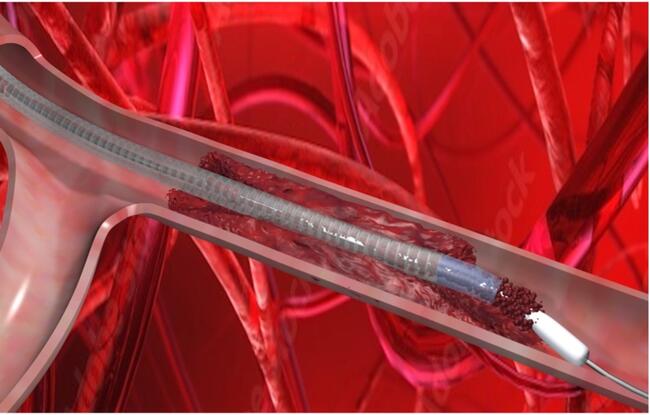
In the U.S., an estimated 900,000 cases of venous thromboembolism, which includes PE, occur annuallyi. PE can be life-threatening, representing the third leading cause of cardiovascular death after heart attack and stroke. i,ii. Penumbra’s Lightning Flash portfolio is the most advanced mechanical thrombectomy system on the market to address venous and pulmonary thrombus. It features Penumbra’s Lightning CAVT technology with the latest dual clot detection algorithms, using both pressure and flow-based processes to detect blood clot and blood flow. The portfolio is designed to help remove blood clots with speed, safety, and simplicity, allowing physicians to better navigate the body’s complex anatomy and deliver high power aspiration for clot removal.
About STORM-PE
STORM-PE is a pivotal, prospective, multi-center randomized controlled trial that enrolled 100 patients across 22 international sites to evaluate computer assisted vacuum thrombectomy (CAVT) using Penumbra’s Lightning Flash™ plus anticoagulation, versus anticoagulation alone, for the treatment of acute intermediate-high risk pulmonary embolism (PE). Conducted in partnership with The PERT Consortium®, the trial’s primary efficacy endpoint – reduction in RV/LV ratio at 48 hours – was assessed by a blinded independent core laboratory. All safety events were independently adjudicated by an external clinical events committee.
About Penumbra
Penumbra, Inc., the world’s leading thrombectomy company, is focused on developing the most innovative technologies for challenging medical conditions such as ischemic stroke, venous thromboembolism such as pulmonary embolism, and acute limb ischemia. Our broad portfolio, which includes computer assisted vacuum thrombectomy (CAVT™), centers on removing blood clots from head-to-toe with speed, safety, and simplicity. By pioneering these innovations, we support healthcare providers, hospitals and clinics in more than 100 countries, working to improve patient outcomes and quality of life. For more information, visit www.penumbrainc.com and connect on Instagram, LinkedIn and X.
i “Learn about Pulmonary Embolism,” American Lung Association. Accessed on Oct. 7, 2025. https://www.lung.org/lung-health-diseases/lung-disease-lookup/pulmonary-embolism/learn-about-pulmonary-embolism
ii “Pulmonary Embolism: A Clinical Approach,” American College of Cardiology. Accessed on Oct. 9, 2025. https://www.acc.org/Latest-in-Cardiology/Articles/2025/02/01/42/Cover-Story-Pulmonary-Embolism#:~:text=Pulmonary%20embolism%20(PE)%20continues%20to,venous%20thromboembolism%20in%20the%20country.