How a Complex TAVR Case Sparked a Structural Heart Training Program in Goa, India
© 2026 HMP Global. All Rights Reserved.
Any views and opinions expressed are those of the author(s) and/or participants and do not necessarily reflect the views, policy, or position of Cath Lab Digest or HMP Global, their employees, and affiliates.
Siddharth Wayangankar, MD, MPH, FACC, FSCAI, RPVI
Cath Lab Director, Baptist Heart Hospital, Baptist Health Jacksonville, Florida
Dr Sid Wayangankar can be contacted at docsiddhuw@gmail.com.
Can you tell us about your background and institution?
I completed my interventional training at Cleveland Clinic, where I was on staff from 2014 to 2016. From 2016 to 2020, I was an assistant professor at the University of Florida in Gainesville, where I spearheaded and performed several advanced structural heart, coronary, and peripheral procedures. In 2020, I moved to Jacksonville, Florida, to join Baptist Heart Hospital.
There are seven hospitals in our area that perform structural heart procedures. In the last 6 years we have rapidly expanded our structural heart and interventional program, and currently, Baptist Heart Hospital has become one of the leading structural heart programs in the state of Florida. We perform a high volume of procedures and have developed a strong reputation.
Tell us about the patient whose treatment ultimately led to the development of the training program.
Baptist Heart Hospital does receive referrals for difficult cases, including cases where other centers have been unable to proceed, but this was an unusual and high risk situation. This particular patient was a woman in her 50s who had been turned down at multiple hospitals. She had lymphoma as a child and had undergone radiation therapy. As a result, she had significant vascular disease involving not only the aorta and carotid arteries, but also severe aortic valve disease. Overall, her anatomy was not suitable for surgery, and she was clearly prohibitive risk as deemed by surgeons at three different institutions prior to us.
When she came to me, there was no doubt she was high risk. But she was only in her 50s, and we had to consider whether there was a path forward. Before we could even consider a high-risk transcatheter aortic valve replacement (TAVR), we first had to address her carotid disease.
Because of her history of radiation, she also had severe subclavian artery stenosis. At an outside hospital, when they tried to treat that disease, they perforated the artery and she almost died. As a result, she had a great deal of anxiety and post-traumatic stress related to procedures. Her previous procedures had been very difficult for her.
After a lot of reassurance, we laid out a plan. I told her that if the initial procedures went well, we could prepare her for the valve procedure, but before we addressed the valve, we needed to make sure the carotids were treated. I performed carotid stenting, which was difficult because the vessels were so heavily calcified. Once the carotids were treated, we brought her back for the TAVR evaluation.
She had an extremely small annular size, which meant she would require the smallest possible valve, and even that valve was slightly large for her anatomy. Two TAVR companies had already turned her down because she was outside their instructions for use. The only valve we could potentially use was the smallest Edwards Lifesciences valve, but even then, we had to adjust the deployment volume and configure it in a way that would allow us to perform the procedure safely.
The procedure went well. We were able to implant the valve. Each part of the case was challenging. Ultimately, the procedure went very well. At her 30-day follow-up, she was asymptomatic and walking.
How did that patient’s recovery lead to the idea of creating a TAVR training program in Goa?
One of our patient’s close friends was so impressed by her recovery that she came forward with a grant. This philanthropist’s father had been a surgeon at a major hospital in the United States, but his roots were in the state of Goa in India. She asked whether I could go to Goa and teach the doctors there what we do.
The big issue with TAVR internationally is cost. The valve itself is expensive. When I travel internationally to teach, the biggest impediment is almost always the valve. Because of that, TAVR volume internationally is not high, and the learning curve for many operators is extremely steep and long.
What did you need to do to build this program from the ground up?
TAVR is a team sport, so it is not just about training the physicians but training the entire team — hence the planning had to be more robust and comprehensive, and the selection of the team to visit Goa had to be representative of a heart team here in the U.S. The first thing I had to do was obtain my credentials in India. I completed Medical Council of India certification so I could participate in the cases. Then we began training the team there through virtual valve conferences. We connected Baptist Heart Hospital with Goa Medical College, which is one of Asia’s oldest medical colleges, and started holding weekly valve conferences with their proceduralists to go over CT scans and train in the art of appropriate patient selection.
The funding was secured in November 2024. By January 2025, my certification had been submitted, and by February or March 2025, we had started the online valve conferences to support selecting patients. The donation was enough to purchase seven valves, so we decided that we would use the funding to perform the first seven appropriate cases.
A key point is that TAVR is not an individual sport. It is a team sport. I made sure that my echo technologist, cath lab technologist, nurse, and a structural imaging cardiologist accompanied me. We all participated in the virtual conferences with Goa Medical College. We reviewed the basics of how to look at computed tomography (CT) imaging, and how to think through patient selection and procedural planning. The ultimate decision about which patients to treat was up to the physicians at Goa Medical College, but we were there to guide them.
We booked our tickets and everyone obtained visas. The local political leadership also became involved and the health minister was excited to attend the opening ceremony.
When did you travel to Goa, and what was the plan for when you arrived?
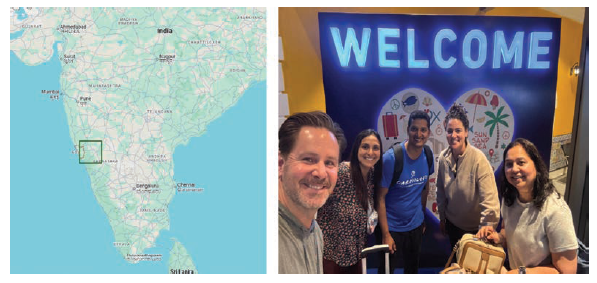
We landed in Goa on April 19, 2025 (Figure 1). Our Baptist structural heart team traveled from Jacksonville to Miami, then to Doha in Qatar, and then from Doha to Goa. After landing, some of the team rested, and some of us went to the temple to seek blessings from almighty before beginning the endeavor.
The biggest stressor was that we were teaching a group of physicians who had never done TAVR. In fact, they had not even done routine aortic balloon aortic valvuloplasty. The concern was how we were going to translate this procedure to that environment.
For me, doing the procedure myself is straightforward. But the donor’s goal was not for us to simply go there and do the procedures. The goal was to equip the local physicians to do this independently. I often travel to several countries to train physicians, so teaching internationally is second nature, but starting a program de novo was a stressor.
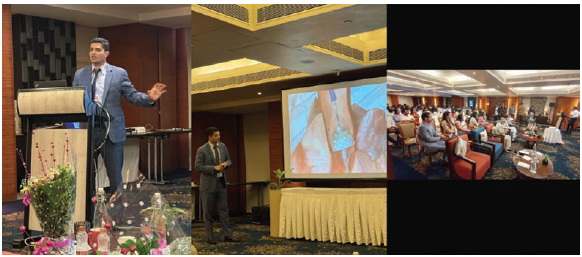
The next morning, Sunday, we held didactic sessions at a hotel (Figure 2). The cardiovascular department, surgeons, and cardiologists were all there, and the health minister inaugurated the event. He was very appreciative of Baptist and of an American hospital coming to train physicians in Goa.
We reviewed aortic valve disease, basic TAVR onboarding, and simulator-based training. We identified who the operators would be. There were many cardiologists who wanted to be part of the procedures, so each physician was likely to get only one or two cases. That was not ideal, but they all trained well.
Tell us about your first cases.
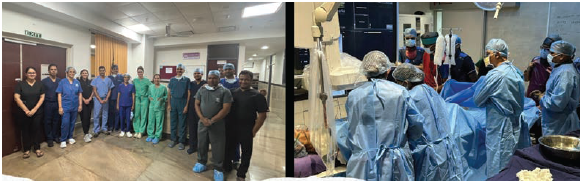
On Monday, we performed the first two cases. In the morning, my echo technologist taught their echo team what to look for. My cath lab nurse worked with their cath lab staff on how to prepare the lab the way we do in the United States. I spent time with the physicians developing a pregame strategy: How are we going to do the procedure? What is the plan? (Figure 3)
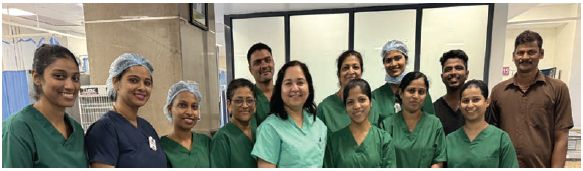
To their credit, they executed it perfectly. The first two cases went well (Figure 4). Of course, they had to be walked through each step, so it was a stressful day, but it was successful.
That evening, we received a call that there was a patient who needed TMVR — a transcatheter mitral valve-in-valve procedure. I said, “You have just begun to do TAVRs. How are we going to do TMVR?” But the patient was very sick, young, and had children, so we agreed to evaluate the case.
We quickly completed the CT analysis, and it looked as if we could perform the TMVR. Believe it or not, the next day we started with the TMVR. My structural imager, Dr Ghetiya, was handling the echo, I was guiding them through the procedure, and they executed that case as well. It was heartening to see how much knowledge and training could be transferred so efficiently, and how much they were able to gain from the experience. We did three more TAVR procedures that day.
How did patients in Goa compare with TAVR patients you typically see in the United States?
The patients are quite different. India does not have widespread access to TAVR technology, and this is a government medical college. Many of the patients were very, very sick because their aortic stenosis could not be treated for years, so they had essentially been followed like heart failure patients. Their mean gradients were often 60, 70, or 80 mmHg, which we barely see here. Some already had low ejection fractions. On a severity and risk scale of 1 to 10, they were all above 8.
That made me understand how important access to care is, and especially timely access to contemporary high-tech care. We are blessed in the United States to have reimbursement and access to many innovative procedures. In other countries, these procedures are often out-of-pocket. As I said, the biggest problem with TAVR is the expense of the valve itself.
Can you talk about the infrastructure and cath lab resources at Goa Medical College?
This was a government hospital. I was impressed with the facilities. The cath lab equipment is probably better than mine, to be honest. With government support, they have the latest technology. In fact, some of the artificial intelligence simulation software for TAVR was something I had never seen before, even though I have been involved in more than 3000 TAVR cases.
The cath lab and echocardiography equipment were top-notch. I did not feel anything was subpar. The deficiency was not equipment, but knowledge, training, scale, and financial constraints related to advanced structural procedures.
The team was also substantial, with about 30 professionals involved. Goa Medical College is a large medical school in India, with residents, fellows, and super fellows. It is a large institution with a separate super-specialty building, and the facility overall is outstanding.
What was the role of the surgical team in Goa?
The surgeons were part of the discussion, but their involvement was minimal. At that hospital, this was primarily driven by the interventional cardiologists. The surgeons there have a tremendous amount of other work. They were included in the discussions and were technically part of the procedure, but they did not want to be heavily involved in this particular program.
Did Edwards Lifesciences travel with you to help prepare the valves and support the program?
Edwards has a team in India, but we also had Edwards personnel from the United States, including senior leadership, travel with us to see how the program would unfold. That was impressive. Todd Petering, VP, Sales & Programs, Transcatheter Heart Valves, flew in with us. The Asia-Pacific Edwards leader also came. There were a lot of people there, and there was a large audience, but everything was executed very well.
I will say it took a lot of effort to get everyone on board. It was a very different experience to start a TAVR program in another country while also working full time in the United States.
How did your team respond to the experience?
For many of them, it was an eye-opener. Most of our team members are American, although some have Indian backgrounds. The first reaction was on seeing the need for advanced healthcare. There are so many patients. You are talking about many times the patient volume we see in a hospital here, because India has such a large population.
The second reaction was an appreciation for how people work with limited resources. In the United States, we use wires and balloons freely. In India, they are much more careful with wires, balloons, and other supplies. For this particular training program, we had everything new for the patients, but in general, the resource environment is very different. Recently, when I was in India on another trip and proctoring an interventional cardiologist in a TAVR procedure, he was doing a case in between, and the wire he was using was a banged-up wire that had already been used four or five times. Here, if we do not like a wire, we throw it away and ask for a new one. They do not do that. You appreciate the skill set Indian physicians have and how they can make certain procedures look much simpler than we sometimes make them look here.
Our team also experienced a different culture of training, patient care, and clinical practice. They gained an appreciation for how medicine is practiced in India. Most importantly, they were honored and delighted to be part of a charitable effort that will remain a lifelong memory. They repeatedly thanked me for giving them the opportunity. None of them had imagined they would travel across the world to help set up a TAVR program that still exists now. Once we were there, my structural imager was doing echocardiograms between TAVR cases and teaching the fellows the basics of echo. My echo technologist spent time with their echo technologists teaching Doppler measurements, and tips and tricks. I spent time with the interventionalists discussing other procedures they were doing. These team members are already waiting to return to India, and now everyone else in my U.S. team wants their turn to do similar work!
Goa is known as a tourist destination. Did that play into the experience for the team?
Yes, Goa is a beautiful, very tourist-oriented place, and my team was blown away by it. That was the icing on the cake. Of all the places where we could have started a program, it was Goa.
I also have a special connection to Goa. I grew up in India, and as a child, our family used to go to Goa every year. I do not know whether it was fate or something else, but somehow I became associated with Goa again.
This patient, her friend, and the friend’s connection to Goa came out of nowhere. Sometimes you feel you should trust in fate. Sometimes fate brings you back.
I travel to India often and teach structural procedures in different cities three or four times a year, but this was probably one of my best trips. I felt like I was truly giving back to my mother country.
It sounds as if your team received as much as they gave.
Absolutely. They made lifelong friends. Some of the people there still text us for opinions on echocardiograms, and I still receive texts about certain cases. I think my team came away with a greater appreciation for the work they do here than they had before.
Do you see a future in which international mobile heart teams play a larger role?
The exchange of ideas is very useful in this global era, and we need to be part of that. International collaboration is always useful. We are now working to establish an exchange visitor program with that hospital and other hospitals in India, and other countries. I think that will be my focus for the next three to five years.
In the short term, the biggest deficiency is knowledge and exposure. In a procedural field like interventional cardiology, if you do not have a high volume of procedures, it is difficult to develop and maintain expertise.
One of my mentors at Cleveland Clinic during my fellowship training days used to say that watching is as good as doing the procedure. When you watch, you are not under the stress of performing the procedure, so you can observe each step carefully and understand why it is being done. Then, when your chance comes to do it, you do it more accurately. I strongly agree with him and believe in this process of learning.
We have to look at this as the short-term first step. We went there and taught them, which was great. But then they have to become self-sufficient and do at least two or three TAVRs per month to maintain their skills. We are encouraging them to create a foundation and seek support from the government and other sources.
The next step is to bring their team here to observe. That is what I am working on now. They can come and see how a heart team in United States works. We perform structural procedures every day. We are one of the leading structural programs in the state of Florida, and we have five days of structural cases each week. They can observe how we perform multiple TAVRs in a day in one lab and take that experience back with them.
That does not only affect their knowledge of TAVR, but changes how they think about other procedures as well. As India develops its own TAVR valves — some of which already look promising — they will be better equipped and able to hit the ground running.
International collaboration is also valuable for us here in the U.S. When I was an interventional cardiology fellow at Cleveland Clinic, I was sent to Bangalore, India, to learn balloon mitral valvuloplasty. At the time, I wondered why I was learning it, because we rarely see those patients here. I did a couple of cases at the University of Florida when I came back, but not many. Recently at Baptist, we had a 26-year-old patient from Saudi Arabia who was 26 weeks pregnant and had severe mitral stenosis. Without intervention, there was a 50% mortality risk for the mother and baby. She had been to several hospitals, and then the pediatrician and obstetrician called me and asked whether I could do the procedure. Because of the knowledge I gained through international collaboration, I was able to perform that case successfully in less than 30 minutes.
My concept of transseptal puncture matured because of my experience in India. They trained me do it with fluoroscopy alone, without even transesophageal echo (TEE). They taught me how to feel the septum and the pulsation of the septum. When I came back here, with TEE available, it became much easier. I know where I am fluoroscopically, I have the TEE, and everything comes together.
The learning is always both ways. You are exposed to disease states and conditions that you may not see here. And when you see how procedures are done with one-tenth of the resources, you come back changed. You make changes to your own efficiency. It depends on whether you see the glass as half empty or half full. The process has to start somewhere: you go there and teach others, they come here and observe, and as the relationship grows, the collaboration goes to the next level.