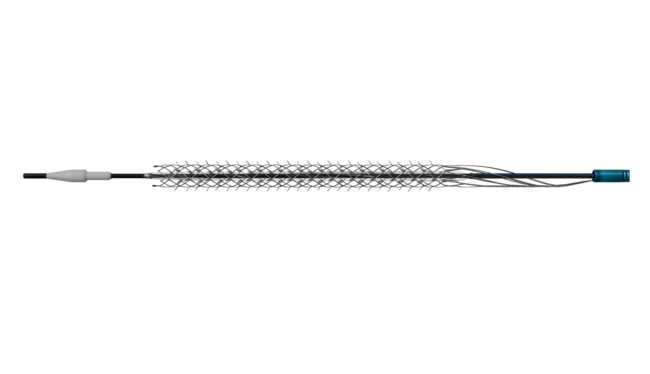
Mechanical Computer-Assisted Aspiration Thrombectomy Using the Indigo System: Latest Results From the STRIDE Multicenter Trial
An Interview With Thomas Maldonado, MD
An Interview With Thomas Maldonado, MD
Key Summary
- STRIDE is a prospective, international, multicenter, real-world trial (3 EU, 13 US centers) of 119 patients with acute limb ischemia (ALI) treated first-line with the Indigo™ Aspiration System (Penumbra); 45% of participants were women.
- Trial reported efficacy and safety with up to 1-year patency and limb salvage and improved quality of life; native-vessel and in-stent/in-graft thrombosis showed comparable effectiveness, though adjunctive lytics were used more often in stent/graft occlusions.
- STRIDE supports endovascular first-line aspiration for ALI across anatomies in everyday practice; limits include nonrandomized interview-reported data and lack of published effect sizes; further comparative trials would clarify relative benefit and lytic strategies.
© 2026 HMP Global. All Rights Reserved.
Any views and opinions expressed are those of the author(s) and/or participants and do not necessarily reflect the views, policy, or position of Vascular Disease Management or HMP Global, their employees, and affiliates.
VASCULAR DISEASE MANAGEMENT. 2026;23(2):E21-E22

NYU Langone Health, New York, New York
At the 2025 VEITHsymposium, Thomas Maldonado, MD, Schwartz-Buckley Professor of Surgery in the Division of Vascular and Endovascular Surgery at NYU Langone Health, and National PI of STRIDE, presented updated findings from the STRIDE Multicenter Trial, a prospective, real-world evaluation of mechanical computer-assisted aspiration thrombectomy using the Indigo™ Aspiration System (Penumbra) in patients with acute limb ischemia (ALI).
In this interview, Dr Maldonado discusses the design and significance of the STRIDE trial, highlights key findings presented at VEITH, and explains how these data may inform endovascular treatment strategies for both native vessel and in-stent or in-graft thrombosis in everyday vascular practice.
Give us an overview of the STRIDE Multicenter Trial. Why is this research important for vascular specialists?
The STRIDE study is an international study with three European centers and 13 U S. centers enrolling 119 patients who had ALI and were treated with the Indigo aspiration catheter (Penumbra) as a first-line therapy. It’s important because it provides real-world experience on the efficacy and safety of this exciting technology that allows patients to be treated for ALI expeditiously with no need for open surgery or extended hospital-length stay, ICU stay, and has shown up to a year of good results with excellent patency and limb salvage. We have good quality-of-life (QoL) data as well, showing that there has been a great improvement in QoL in these patients.
It’s also important, in my opinion, because it has a large representation of female patients, which is something you don't see in a lot of studies for ALI. They're underrepresented, but this study had 45% women, showing that they also stand to benefit from this technology.
The STRIDE trial involves multiple centers and a broad patient population. What distinguishes the trial's design or methodology? How do these elements strengthen the validity of the data?
The STRIDE trial is a prospective study with strict inclusion/exclusion criteria, with excellent oversight and robust follow-up. But what’s most important in its methodology in my opinion is that is designed to capture real-world study experience, representing a variety of different centers and users. I think this makes it very powerful data.
Can you share some of the most significant or surprising findings from the trial, and what implications might they have for current treatment protocols?
The most recent subgroup analysis or cohort analysis that we presented at the VEITH meeting this year really spoke to a cohort of patients who had prior stents or prior grafts in place. These are unique patients who sometimes have had a number of different procedures done for peripheral arterial occlusive disease and usually present with thrombosed stents or grafts. We found that the Penumbra platform is as effective in these very complex patients and as in patients who have thrombosis is native vessels.
These patients with occluded stents or bypass grafts appear to often require adjunctive lytic therapy; a slightly higher incidence than in the native vessel thrombosis. So we think it's important to know that while you can still use this technology for the in-graft and in-stent thrombosis with excellent results, you can anticipate having to use adjunctive lytics more often than in native occlusions.
What is the main takeaway that you wanted attendees to get from your presentation?
I think attendees should understand that whether it's patients with ALI who have native vessel thrombosis or those who present with more complex anatomy and a prior history of grafts or stents, these patients benefit equally from the Penumbra first-line therapy with the Indigo system. Nevertheless one should recognize that when treating stents or grafts that thrombose, use of adjunctive lytics is often required. n