Advances in Dermatomyositis: The Evolving Landscape and Potential Role of Novel Therapies to Improve Disease Outcomes
Dermatomyositis (DM) is a systemic autoimmune myopathy with prominent cutaneous features and significant heterogeneity across organ involvement, autoantibody profiles, and disease course. At the 2026 Masterclasses in Dermatology Annual Meeting, experts reviewed landmark advances in classification criteria, evolving understanding of disease pathophysiology, validated outcome measures, and an expanding therapeutic landscape shaped by targeted biologic and small molecule agents.
A major advance in the field has been the development of the 2017 European Alliance of Associations for Rheumatology/American College of Rheumatology (EULAR/ACR) Classification Criteria for Idiopathic Inflammatory Myopathies, which introduced a probability-based scoring system spanning 3 strata: low (S1), medium (S2), and high (S3) probability of myositis. When applied to patients with suspected DM, this classification system identifies approximately 73.7% of patients as having a high probability of disease, representing a meaningful improvement over earlier diagnostic frameworks. The criteria were developed using a rigorous Delphi consensus process, through which the broader myositis community collaborated to define and weight clinical, laboratory, and histopathologic variables. A new EULAR/ACR Myositis Criteria Project is currently underway that aims to refine these criteria further, with dermatology playing a central role in incorporating skin specific features that are often underrepresented in rheumatology driven classification tools.
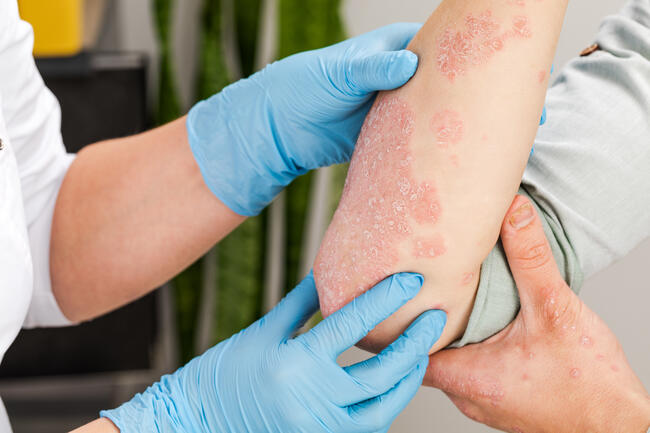
Understanding the pathophysiology of DM has advanced considerably and now informs both biomarker development and therapeutic targeting. Skin biopsy in DM characteristically reveals interface dermatitis, with vacuolar change at the dermal epidermal junction and a mononuclear infiltrate. A hallmark finding is the inappropriate activation of the type I interferon (IFN) system, driven by innate immune dysregulation. Plasmacytoid dendritic cells and macrophages are prominent in affected skin and muscle, serving as major producers of type I IFNs. Notably, IFN signatures differ across DM subtypes and autoantibody groups, with specific upregulation of IFN beta observed in a subset of patients. A linear correlation between IFN beta levels and disease activity has been demonstrated, providing both a mechanistic rationale and therapeutic justification for targeting this pathway. These findings position type I IFN signaling as a central driver of DM and a compelling target for intervention.
Comprehensive patient evaluation in DM requires integration of clinical history, autoantibody profiling, and multisystem assessment. Myositis specific antibodies and myositis associated antibodies are critical to subclassifying disease and anticipating complications, including interstitial lung disease, malignancy risk, and articular involvement. A thorough medication history is essential, as several agents can exacerbate or unmask DM, including immunostimulatory herbal supplements, which are often overlooked in standard intake. Patients should be specifically asked about the use of herbal preparations, such as echinacea, astragalus, and medicinal mushroom blends, all of which have documented immunostimulatory activity and may precipitate flares. Clinicians should also be alert to the temporal relationship between COVID-19 vaccination and the onset or worsening of DM, a pattern that has been reported in the literature and warrants careful documentation during history taking.
Validated outcome measures are essential for both clinical practice and trial design in DM. The Cutaneous Dermatomyositis Disease Area and Severity Index is the most widely used and validated instrument for capturing skin disease activity and damage in DM, with strong interrater reliability and sensitivity to change. The Skindex is a dermatology specific health related quality of life instrument that has been applied in DM populations to quantify the psychosocial and symptomatic burden of skin disease. The SF 36 questionnaire provides a broader assessment of general health related quality of life and has demonstrated significant impairment across physical and social functioning domains in patients with DM.
Qualitative research has illuminated the patient experience in important ways. DM is a profoundly pruritic condition, and studies have documented that itch is frequently underappreciated by clinicians relative to the burden it imposes on patients. In patients with classic DM involving both skin and muscle, the priorities of physicians and patients often diverge. While clinicians focus heavily on muscle strength and creatine kinase levels, patients consistently rate cutaneous symptoms, fatigue, and social participation as their primary concerns. More than 50% of patients with DM report that social functioning and participation in daily activities are negatively impacted by their skin disease, underscoring the importance of patient-centered endpoints in both clinical care and trial design.
Treatment decision-making in DM must account for the specific disease manifestations present. Patients with interstitial lung disease, inflammatory arthralgia, or concurrent malignancy require tailored therapeutic approaches that go beyond standard skin or muscle directed regimens. Hydroxychloroquine is commonly used for cutaneous DM but requires 8 to 12 weeks before meaningful clinical effect is observed, limiting its utility as a rapid acting agent. Intravenous immunoglobulin works comparatively quickly and is effective, although its use is constrained by availability, cost, infusion burden, and insurance approval challenges. Patient level barriers, including access to infusion centers, time away from work, and systemic side effects, represent meaningful unmet needs that affect adherence and long-term outcomes.
The unmet needs in DM remain substantial. Clinical trial design has been a persistent challenge in the field, largely due to the rarity and heterogeneity of DM and the absence of universally accepted, validated composite endpoints that capture both cutaneous and extracutaneous disease. Endpoint selection has hampered the interpretation of prior trials and delayed regulatory approval of new agents. Lenabasum, a cannabinoid receptor type 2 agonist with anti-inflammatory and antifibrotic properties, has been investigated in DM and represents one of several investigational agents targeting non-IFN inflammatory pathways. While its phase II results generated interest, further development has highlighted the endpoint challenges that continue to face the field.
The type I IFN pathway remains the central mechanistic focus of therapeutic development in DM. Dysregulated type I IFN signaling drives a self-amplifying cycle involving autoantibody production; complement mediated vascular injury, a key contributor to the perifascicular pattern of muscle damage; and aberrant keratinocyte and endothelial activation in skin. Pruritus in DM is increasingly understood to be mechanistically distinct from itch in other inflammatory dermatoses, with IL-31 implicated as a key mediator via its action on sensory neurons, providing a rationale for targeted antipruritic strategies. The convergence of these mechanisms on the JAK-STAT signaling axis has made this pathway a primary therapeutic target.
Anifrolumab, a fully human monoclonal antibody targeting the type I IFN receptor subunit 1, blocks signaling by all type I IFNs and has demonstrated efficacy in systemic lupus erythematosus, with emerging data supporting its investigation in DM. By broadly suppressing type I IFN activity, anifrolumab addresses the upstream driver of DM pathogenesis and has generated interest as a potential treatment across multiple myositis specific antibody subgroups.
Brepocitinib is an oral dual TYK2 and JAK1 inhibitor that selectively modulates both type I IFN receptor signaling and several cytokine pathways implicated in DM, including IL-12, IL-23, and IL-31. In a phase 2 proof of concept trial in DM, brepocitinib demonstrated clinically meaningful improvements in both cutaneous and muscle disease activity, with favorable tolerability. Its dual mechanism, simultaneously attenuating IFN driven inflammation and itch associated IL-31 signaling, positions brepocitinib as a particularly compelling candidate for patients with prominent skin involvement and significant pruritus. As these and other targeted agents continue through clinical development, the field is moving toward a precision medicine approach in which autoantibody profile, organ involvement, and biomarker defined IFN status will guide individualized treatment selection.
Reference
Werth V, Elman S. Advances in dermatomyositis: the evolving landscape and potential role of novel therapies to improve disease outcomes. Presented at: Masterclasses in Dermatology; February 19–22, 2026; Sarasota, FL.