Prevalence of Atrial Fibrillation Increases Major Adverse Cardiovascular Events, Particularly Heart Failure Hospitalization in Patients With Peripheral Arterial Disease
Interview With Viet Le, DMSc, MPAS, PA-C, FACC, FAHA, HF-Cert
Interview With Viet Le, DMSc, MPAS, PA-C, FACC, FAHA, HF-Cert
© 2025 HMP Global. All Rights Reserved.
Any views and opinions expressed are those of the author(s) and/or participants and do not necessarily reflect the views, policy, or position of EP Lab Digest or HMP Global, their employees, and affiliates.
Interview by Isabel Vega
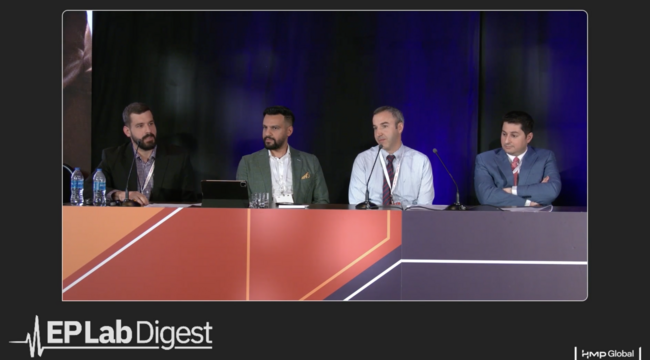
Watch as Viet Le, DMSc, MPAS, PA-C, FACC, FAHA, HF-Cert, discusses his abstract from AHA 2025.
Clinical Summary
- Peripheral arterial disease (PAD) + atrial fibrillation (AFib): Intermountain Health (Utah) analysis (2006–2021) identified ~7,600 PAD patients, revealing AFib prevalence ≈25%, underscoring under-recognition of arrhythmia in this cohort.
- Clinical impact: AFib was a key driver of heart failure (HF) hospitalization and major adverse cardiovascular events (MACE); shared comorbidities (diabetes, CKD, ischemic disease) amplify risk.
- Practice implications: Authors advocate routine AFib screening in PAD (including AI-enabled wearable ECG/PPG tools), earlier rhythm control/ablation, and multidisciplinary PAD–EP collaboration to reduce HF and MACE burden.
Reviewed by Isabel Vega, Associate Digital Editor, Cardiovascular
Transcripts
Peripheral arterial disease (PAD) and atrial fibrillation (AFib) are both major contributors to cardiovascular morbidity, yet their intersection has been less explored. What led you to investigate how AFib increases the risk of major adverse cardiovascular events in patients with PAD?
Viet Le, DMSc, MPAS, PA-C, FACC, FAHA, HF-Cert: It was interesting because we embarked on this project of understanding peripheral arterial disease at Intermountain first. That was really the genesis of all this work—to better understand how we were treating, or identifying, and screening, and then chronically managing PAD.
In doing so, we queried the entire Intermountain Health in Utah at that time. Of course, we've merged now and increased our footprint, but what we found using ICD-10 codes and chart review, is about 7600 patients from 2006 to 2021 were diagnosed with PAD. And I think that's less than I thought would have PAD.
As we investigated this data, that's when we started to see these interesting patterns that start to evolve. Amongst 7600 patients, of course they had multiple comorbid conditions, but AFib is one of those that’s so common for the general population. We were trying to understand whether it was just as common, or more common in PAD. And so, that really led us to do more analyses in this population that we'd already identified, but that had PAD and happened to be seen at a system like ours, Intermountain Health.
Given the strong association between AFib and heart failure (HF) hospitalization in patients with PAD, what underlying electrophysiologic or hemodynamic mechanisms might explain this cardiovascular risk?
Viet Le, DMSc, MPAS, PA-C, FACC, FAHA, HF-Cert: Yes, this is of great interest, both in the electrophysiology (EP) world, but in the vascular world as well. I don't think it's too far of a stretch to say that one of the more common etiologies or causes of AFib is ischemic disease. I think there's a lot of associations and crossover between the 2 diseases.
But I think here especially, I have Dr Doug Packer who has come to Intermountain, folks will recognize the CABANA trial, but there are several mechanisms here that I think he would probably say the same. Which is, we have this loss of atrial contribution—that atrial kick—when there's AFib, there's HF, right? This is part of the problem. You lose that atrial kick, then it congests, so that left ventricular systolic filling is less, but also its contraction is less. Then you have that irregular ventricular response, that poor timing, where atrium is not lined up, and then the ventricle is contracting at odd times as it receives electrical impulses through the atrioventricular node.
So, I think, those 2 are probably more common. I think it is less common, but increasingly we’re recognizing this, especially as we start to see research within GLP-1s and other anti-inflammatory therapies, there's probably an increase in neurohormonal activation, and then this systemic inflammation that somehow is irritating these cardiomyocytes in the atrium.
But I think it comes down to these shared comorbid conditions between HF and AFib, you know, chicken or the egg, you're not sure which one, but you have diabetes, chronic kidney disease, etc. So, I think all of those combined somehow make both of these diseases, certainly worse for HF hospitalization. If you have HF and AFib. Then I think you're duly blessed or cursed, if you have both of those together.
How might early rhythm monitoring or AFib screening protocols in patients with PAD reshape current management strategies to prevent major adverse cardiovascular events?
Viet Le, DMSc, MPAS, PA-C, FACC, FAHA, HF-Cert: First of all, I think I was a little surprised that there were so many patients with PAD that had AFib. What that tells us, is that we probably should screen more often when we identify someone with PAD that 1 in 4 patients will probably have AFib.
So, when we think of early screening and early recognition, we live in this era of smart devices. So many of the devices now have FDA clearance on being able to identify AFib early on a 30-second, single-lead ECG and now we're starting to see the advent of artificial intelligence (AI) in all of this.
So, perhaps what that might do is on a photoplethysmography (PPG), your watch may have AI that says, “perhaps you do an actual electrocardiogram (ECG),” rather than just get this pulse analysis through PPG.
But in doing so, I think we can capture people earlier, rather than having this substrate of AFib going on for months, years, before it's recognized. And then the success rate for ablation is even poorer the longer that AFib is around. Well, now we can identify it perhaps sooner, and implement early recognition, and then earlier management, whether that's antiarrhythmic or ablation. I think gone are the days that we necessarily must think of rate control, per se, but maybe earlier rhythm control. But the cool thing about all this is we're having this confluence of cardiovascular kidney metabolic (CKM) health, and this understanding that perhaps if you manage lipids, blood pressure, glucose, and kidney function much better, those are antiarrhythmic therapies, just as much as flecainide, or amiodarone, sotalol, etc.
And so, we must pull back and say, “well, whose job is it?” And the answer is it's all of ours. So multidisciplinary management and a lot more collaboration as we think of this era of CKM and how that affects AFib.
Considering that HF hospitalization was a key driver of adverse outcomes, what role do you envision for electrophysiologists in collaborative PAD care teams to mitigate this risk through rhythm control or device-based interventions?
Viet Le, DMSc, MPAS, PA-C, FACC, FAHA, HF-Cert: I can't overstate that we need to be better at collaborating. For the vascular side, vascular medicine, or preventive cardiology—that's where I'm at with PAD—our EP partners will probably start seeing more referrals from me, with regards to AFib management, and perhaps earlier ablation.
So, the question is, how comfortable will you feel in the EP side for a patient that comes in with peripheral arterial disease, which is so much more devastating, I think, as an atherosclerotic disease, even over a coronary disease, or a stroke. But I think for EPs from the AFib side might be a trigger for you to be evaluating an underlying ASCVD process, an atherosclerotic process. So, from that side, AFib patients who are managed with EPs, more screening for ASCVD, but from our side, from the atherosclerotic side, we need to be screening more for AFib and referring sooner for rhythm control strategies, and even dare I say, curative, if we can work together.
But deploying device-based monitoring might be sooner, and will allow us to understand AFib burdens, so implantable loop recorders (ILRs), look for more referrals, or maybe collaborate, and educate us a little sooner on, when we need to deploy ILR and utilize Holter monitoring, etc, in those cases.
But since HF hospitalizations were such a big part of this, we need to think about cardiac resynchronization therapies and whether those can be used more often, or pacing, AV nodal ablation, etc. So, I think here, with HF being such a key driver in all this, EP really stands to be more involved outside of AFib, to understand the guideline-directed medical therapies in HF better and deeper.
Is there anything else you'd like to share with our readers?
Viet Le, DMSc, MPAS, PA-C, FACC, FAHA, HF-Cert: What was surprising to me about this journey of trying to understand PAD is, yes, it's a single-center experience, but mortality is so high in these individuals. I think overall, I reported 1-year and 3-year MACE, and certainly AFib drives that risk in HF hospitalization, which was the event we were looking at, and I think that we're not screening often enough for PAD, and so it could be a 2-way street where folks that manage AFib, my EP partners, might be able to refer sooner, to preventive cardiology or vascular medicine, to screen for PAD. But vice versa, I think for PAD specialists, we should be a little more aware that AFib is quite prevalent in our populations, and hopefully we can manage those better. So, everyone needs to be a little better at screening for it, to be more aware, and identify it much sooner. But I look forward to the future research that's coming. Look for something from the CABANA teams in HFpEF, which notoriously has a lot of AFib prevalence there, too. So, I think for those that are out there thinking about PAD and AFib, just recognize that there's a high prevalence of both sets of patients in each of those populations.
The transcripts were edited for clarity and length.
Related Content